
I am jealous that you have it, but since I can't take one to Mexico with me, perhaps it's best that you have it and not me. You need to learn to post photos on here so you can really stick it to me anytime you want to by just posting new photos of it. Let me know what you find out about the logo, which (by the way) I rather like.














































You are using an out of date browser. It may not display this or other websites correctly.
You should upgrade or use an alternative browser.
You should upgrade or use an alternative browser.
Double Action Snubby
- Thread starter Ganderite
- Start date
Well, that's two of us that like the "Raptor" logo.
A lot of the traditionalists are offended that S&W would do such a thing and say they would never own such a gun. They also denegrate the new S&W action as we did when the 'new' short action replaced the old, smooth 'long action'. Things change and we adapt or not.
I tend to be a traditionalist myself as I abhor plastic framed pistols and their ergonomics. Having said that, my wife owned a pair of Ruger SR9s she used to take a Black Badge course, and while she disliked them, I enjoyed them. They fit my small hand, were light, soft shooting with 147 gr ammo and very concealable.
Remember when the Series '80 Colts came out? All of a sudden Series '70s went for a premium, even tho' a couple I've owned were loose rattlers with abominable triggers.
A lot of the traditionalists are offended that S&W would do such a thing and say they would never own such a gun. They also denegrate the new S&W action as we did when the 'new' short action replaced the old, smooth 'long action'. Things change and we adapt or not.
I tend to be a traditionalist myself as I abhor plastic framed pistols and their ergonomics. Having said that, my wife owned a pair of Ruger SR9s she used to take a Black Badge course, and while she disliked them, I enjoyed them. They fit my small hand, were light, soft shooting with 147 gr ammo and very concealable.
Remember when the Series '80 Colts came out? All of a sudden Series '70s went for a premium, even tho' a couple I've owned were loose rattlers with abominable triggers.
mudgunner49
CGN Ultra frequent flyer
The H.K.S. speedloaders were advertised as "5 second loaders" at one time. Perhaps they still are. In the Mexican Practical Shooting, we tried to stress that 4.5 seconds should be considered the slowest reload you wanted to shoot for, and 3.5 would be "peachy". That way, using El Presidente as an example, if you could do the spin, draw and first 6 shots in 3 seconds -- reload in 3.5 and then finish your last 6 shots in 2.5 seconds you'd end up with a total time of 9 seconds. An acceptable time for a revolver. 8 seconds is better, but hard to do "3 time in a row on demand". The Safariland Comp III loaders and the Jet loaders seemed faster than the H.K.S. (to me, anyway), but H.K.S. was what one would probably actually carry and so it was best to maintain one's familiarity with those. (Mostly, with snubbies, people use speed strips.)
The S.L. Variant loaders were the most popular, and we had this guy in the Club who seemed to be able to always get us all we wanted. I think he got them direct out of Europe, I don't remember. But although they were pricey, they were very popular loaders. I believe in the "pin" video above I am using S.L. Variant N-frame loaders on the reload.
Here is a photo of the Lee C-358-200-RF bullet, loaded into a .38 Special case. It was our loading for the Coonan's that had come down into Mexico remarked as .38 Special Coonans -- although they were just regular off-the-shelf Coonans. The very long Lee 200 grain Round-Flat bullet was loaded to the same Max-overall length as a normal .357 round and sped out at 1,150 fps operating the Coonan's perfectly and appearing for all the World to be .38 Special ammo. Next in line is the Accurate Molds 200 Grain SWC Michael and I thrashed out. With our mix it weighted 202 grains and we loaded it up to 1,200 (and slightly plus) fps for Pin Shooting and it worked well. Lastly is a normal, regular Lee 358 SWC tumble lube bullet for comparison.

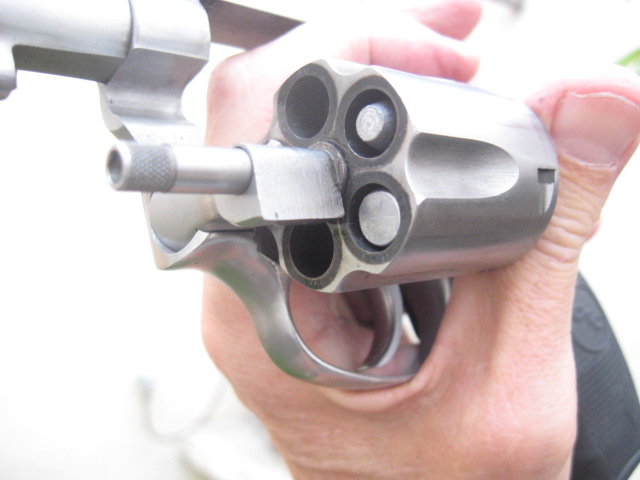
Here is a photo of my wife's Model 60 with the Lee 200 grain bullet (which is long enough to slightly prevent closure of the cylinder) we used in the Coonans and the "Big Honkin' Bullet" as we called it, the 202 grain SWC for Pin Shooting. We actually did play around with the 202 grain bullet in the snubbies and got it up to 750 fps. But it was painful to shoot and the little guns seemed to cry out in a Scottish accent "Captain, she canna take much more 'ah this!" So we abandoned that line of research.
Any chance that you have a mold number for that Accurate Molds bullet?? there are several on there that are fairly close in profile... I think that I need to run some of those through the SP101...
thanks
blake
Heard back from S&W re: my "Raptor" 686-6.
It was made as a Pro Series in 02/2016. Not factory engraved. Any engraving thereafter was done by an importer.
Which begs the questions: by whom and why?
I got mine from Epps and P&D listed one as well. There may be others .....
It was made as a Pro Series in 02/2016. Not factory engraved. Any engraving thereafter was done by an importer.
Which begs the questions: by whom and why?
I got mine from Epps and P&D listed one as well. There may be others .....
I think they must have done the etching. Normally, S&W has markings on both sides of the barrel flats even on PC guns, and this one -- if your's is the same as the photo earlier posted -- just says "Rappy" on one side of the barrel flat. It would be weird if it didn't come from the plant like that.
MDG phoned me today, out of the blue. I told him you and I had connected here on the forum, and he chuckled.
MDG phoned me today, out of the blue. I told him you and I had connected here on the forum, and he chuckled.
Well S&W is denying they did the etching.
The "Raptor" image on the right side of the frame appears where the S&W logo normally appears so the guns had to ordered that way or S&W did the etching. You tell me ....
I just bought a copy of Kimber's "Lands & Grooves" magazine. Lots to drool over, including their selection of snubby revolvers. There is an article on three methods of revolver reloading; the two we are all familiar with and a third method that was new to me. It is said to be best used when using loose rds. I won't go into detail about it as I don't know why anyone would load a revolver with loose rds. On the few occasions when I do, I keep the gun in my strong hand and use my left.
I think that a copy of this magazine article would prove useful for anyone giving instruction on loading a revolver as it has great full colour pictures of the steps for all three methods. The author (Patrick Sweeney) says he was taught by Jerry Miculek to keep the gun in the strong hand and reload with the left even tho' Miculek currently does not use that method.
I may be in contact with MDG as it may fall to me to be the next IPSC Director for our club.
The "Raptor" image on the right side of the frame appears where the S&W logo normally appears so the guns had to ordered that way or S&W did the etching. You tell me ....
I just bought a copy of Kimber's "Lands & Grooves" magazine. Lots to drool over, including their selection of snubby revolvers. There is an article on three methods of revolver reloading; the two we are all familiar with and a third method that was new to me. It is said to be best used when using loose rds. I won't go into detail about it as I don't know why anyone would load a revolver with loose rds. On the few occasions when I do, I keep the gun in my strong hand and use my left.
I think that a copy of this magazine article would prove useful for anyone giving instruction on loading a revolver as it has great full colour pictures of the steps for all three methods. The author (Patrick Sweeney) says he was taught by Jerry Miculek to keep the gun in the strong hand and reload with the left even tho' Miculek currently does not use that method.
I may be in contact with MDG as it may fall to me to be the next IPSC Director for our club.
mudgunner49
CGN Ultra frequent flyer
36-200B is the Accurate number.
Thanks!!!

Interesting posts guys, 686 in 44 mag?, I don't think so?
I have never shoot 9mm in a revolver, thinking about it, 9mm is cheap these days.
Ganderite, I have seen those Rappy's ( pictures,LOL ) not really sold on the look, but I would like to try one.
As a old wheel gun guy with his own privet range, shooting bulls eye, I never had to worry about muzzle when reloading.
I shoot a steel challenge last summer and had to take note of that.
Did alright for a newbe at that , middle of the road, time wise, and I don't move fast anymore. 100% hits, some of the pro's where shooting hi end comp guns, so I was happy. One of the pros did a stage in 1.9 sec.
I used my 4 in s-w M19-2, don't have enough speed loaders for the colts.
I use to have a Dan Wesson that was way faster than the smith's or colts in lock time on the double action, about the same as my 9mm semi's, but they can be prone to light strikes
when shooting real fast, as they have a short stroke in DA
That gun range , all I can saw is holly crap, and that membership price is great.
Keep it up.
I have never shoot 9mm in a revolver, thinking about it, 9mm is cheap these days.
Ganderite, I have seen those Rappy's ( pictures,LOL ) not really sold on the look, but I would like to try one.
As a old wheel gun guy with his own privet range, shooting bulls eye, I never had to worry about muzzle when reloading.
I shoot a steel challenge last summer and had to take note of that.
Did alright for a newbe at that , middle of the road, time wise, and I don't move fast anymore. 100% hits, some of the pro's where shooting hi end comp guns, so I was happy. One of the pros did a stage in 1.9 sec.
I used my 4 in s-w M19-2, don't have enough speed loaders for the colts.
I use to have a Dan Wesson that was way faster than the smith's or colts in lock time on the double action, about the same as my 9mm semi's, but they can be prone to light strikes
when shooting real fast, as they have a short stroke in DA
That gun range , all I can saw is holly crap, and that membership price is great.
Keep it up.
Thanks, Ganderite!
"Rappy" certainly looks happy, doesn't he/she/it?
I think the gun has a really purposeful look about it, demanding to shot. And so shall it be done.
This is my first S&W with no firing pin on the hammer and MIM parts, like the trigger and hammer.
We have three other revolver shooters in our IPSC section, all of them shooting S&W "PRO" series revolvers in .357/.38 Spl. or 9mm. One loner who bought a 6" 686 .44 Spl. model.
The 8 rd guys rot my socks as I'm an inveterate six gunner from sway back. Oddly, they have more trouble reloading with moon clips than I do with Comp II speed loaders

Interesting posts guys, 686 in 44 mag?, I don't think so?
I have never shoot 9mm in a revolver, thinking about it, 9mm is cheap these days.
Ganderite, I have seen those Rappy's ( pictures,LOL ) not really sold on the look, but I would like to try one.
As a old wheel gun guy with his own privet range, shooting bulls eye, I never had to worry about muzzle when reloading.
I shoot a steel challenge last summer and had to take note of that.
Did alright for a newbe at that , middle of the road, time wise, and I don't move fast anymore. 100% hits, some of the pro's where shooting hi end comp guns, so I was happy. One of the pros did a stage in 1.9 sec.
I used my 4 in s-w M19-2, don't have enough speed loaders for the colts.
I use to have a Dan Wesson that was way faster than the smith's or colts in lock time on the double action, about the same as my 9mm semi's, but they can be prone to light strikes
when shooting real fast, as they have a short stroke in DA
That gun range , all I can saw is holly crap, and that membership price is great.
Keep it up.
They have the 696 in 44 Special and the 69 in 44 mag. Both are L frames, same as the 686. - dan
Well, I'm in Central Mexico for a month once again (and...loving it). I have not been able to get over to the Queretaro Club like I hoped because there's just too much going on around Salamanca and San Miguel that draws my attention. I was able to get out to the San Miguel Club on Wednesday as a friend went to pickup four handguns being sold off by a member moving to Colombia who could not take them with her. It was a decent buy: a Glock 25 in .380 that has not been modified to .380 Cal. and a S&W Model 10 that were both purchased from the Mexican Army Store in Mexico City and bore the SEDENA markings. Also a Walther PPK/S in .380 and a nice S&W Model 60. All registered by her with the Army, so it will be easy enough to transfer the registrations.

But why bother with paperwork? Without worrying about getting the transfers done first, we ran out to the San Miguel range to test them all out. Remember that if firearms are not "prohibited firearms" under Mexican Law, being caught violating a paperwork-rule is a misdemeaner, not a high-crime. I had not set foot on the San Miguel range since June of 2016 and was eager to see how much progress had been made.
The Club is registered as the Club Cinegetico IPSC San Miguel. A neat name for a Gun Club.

I forgot to snap a photo of it this time around, but I had an old one from when we were first building the place showing Cooper's 4 rules painted on the side of the entrance building wall (in Spanish).

The Walther PPK/S was very popular with the 3 of us who went. I think we put 100+ rounds of Aguila 95 grain FMJ factory ammo through it without a bobble. I was amazed how well it worked.

The little gun really was surprisingly reliable. I don't think the .380 factory cartridge is powerful enough for self-defense (and in Mexico, that's what we are talking about). "Sport" is a secondary reason for handgun ownership for otherwise unarmed civilians in the current environment here in Mexico. But I was surprised how well the little gun worked and it would certainly be better than nothing against a well-armed opponent foolish enough to get close to you because you appeared to be unarmed.

So I don't have photos of us shooting the other 3 pieces although they all shot just fine. The Model 10 is a pre-lock model, but with the tear-drop thumb-piece and the roundbutt and the firing pin in the frame. It worked great and I told my host that if he decides to sell it, I might like it myself. I just have photos of us shooting the PPK/S though, using the standard San Miguel/Queretaro Club P.P.C. targets.

We did a couple of draw-and-fire-5-shots in 10 seconds drills using the Model 60 and the PPK/S. At 5 yards, keeping the 5 shots in the Orange Center was fairly easy for all 3 of us. If there were flyers, they went into the "9" ring. However, when faced with an A.K. or A.R. armed opponent at close range and all you have is a snubby or a pocket-auto you really have to hit the noggin so we really wanted to see 5 for 5 in the orange. I just have no photos of it, but yes it certainly can be done.
The current bay that is finished has a full-length cement bench behind the firing points to sit in the cool shade behind the line. The sun just beats down out there without end, so the cool shade is appreciated.

Walking over to the next bay, I find that the construction is still moving ahead slowly (a brick at a time). This bay will be a mirror image of the first one but with a Target and Equipment Storage closet installed in the back wall separating the full-length bench.

The bathrooms are also "under construction" and although they do not appear that they will be as elegant as the Queretaro Club bathrooms, they will certainly do. Membership in the San Miguel Club is about 5,000.00 pesos a year or 335.00 Canadian dollars PLUS you pay for your transport permit yearly renewal, which is another 100.00 bucks more or less if you have 8 to 10 guns. It's maybe 70.00 bucks if you have 5 or less. (Queretaro Club rates are around 800.00 dollars a year but your transport permit renewal is included in that fee). Queretaro is a more oppulent club but the San Miguel Club is "quaint" and I really like it as well. Also, the San Miguel Club is very "Provincial", or to translate it better, "rural".

Construction has slowed down because the Club has gone back to shunning North American members who do not speak enough Spanish to go and stand in front of the Army Base Chief of Staff and "converse" without the help of a 3rd party translator -- a great source of extra income as they always paid higher fees than the rest of us. Apparently, this was something mentioned by the Army as being something they'd like to see happen and so the Club responded. Of course, in Mexico, this is your P.A.L., to stand there in front of an Army Officer on your first-time registry and explain why you want to join a shooting club and have guns. In Spanish. I mean, it's really easy, you just chat. But if you can't do it, you can't do it and that's too bad for you. Few North Americans moving to Mexico actually learn to speak Spanish, to their own disadvantage. So, like the Seinfeld Soup Nazi, it's "No Gunclub for you!" The few American and Canadian members who came in during that first draft where non-Spanish speaking members were being accepted have not had any problems, the Club accepted them (as did the Army) and they seem to be motoring along A-Okay. That's good news (at least, for them).
When I asked if it could be a problem that we were taking 4 guns we did not have transport permits for to the range because we were just in the process of buying them, the reply was "The local Police know the difference between Club members and actual criminals. They aren't going to waste their time over a paper-crime. They'll extort 20.00 bucks out of us and tell us to get our papers in order and let it go at that." Which is pretty much what I expected. For me this is a breath of fresh air, but the law-and-order-by-the-book types will probably frown upon it. But who cares?
Heading home, the first job isn't gun cleaning. In a place where the sun just won't quit, an emergency dip in the infinity pool over-looking San Miguel is just a must!

Wednesday evening, we cleaned up the guns. Then we spent a couple hours watching Russian Tank movies ("Tankers" and "T-34") on the wide-screen T.V. . I took this photo of my host's unloaded nightstand Beretta 92fs with Wilson stocks and some other Wilson Combat mods sitting beside the PPK/S which he says he is not going to part with. An end to another perfect day in Mexico.

But why bother with paperwork? Without worrying about getting the transfers done first, we ran out to the San Miguel range to test them all out. Remember that if firearms are not "prohibited firearms" under Mexican Law, being caught violating a paperwork-rule is a misdemeaner, not a high-crime. I had not set foot on the San Miguel range since June of 2016 and was eager to see how much progress had been made.
The Club is registered as the Club Cinegetico IPSC San Miguel. A neat name for a Gun Club.
I forgot to snap a photo of it this time around, but I had an old one from when we were first building the place showing Cooper's 4 rules painted on the side of the entrance building wall (in Spanish).
The Walther PPK/S was very popular with the 3 of us who went. I think we put 100+ rounds of Aguila 95 grain FMJ factory ammo through it without a bobble. I was amazed how well it worked.
The little gun really was surprisingly reliable. I don't think the .380 factory cartridge is powerful enough for self-defense (and in Mexico, that's what we are talking about). "Sport" is a secondary reason for handgun ownership for otherwise unarmed civilians in the current environment here in Mexico. But I was surprised how well the little gun worked and it would certainly be better than nothing against a well-armed opponent foolish enough to get close to you because you appeared to be unarmed.
So I don't have photos of us shooting the other 3 pieces although they all shot just fine. The Model 10 is a pre-lock model, but with the tear-drop thumb-piece and the roundbutt and the firing pin in the frame. It worked great and I told my host that if he decides to sell it, I might like it myself. I just have photos of us shooting the PPK/S though, using the standard San Miguel/Queretaro Club P.P.C. targets.
We did a couple of draw-and-fire-5-shots in 10 seconds drills using the Model 60 and the PPK/S. At 5 yards, keeping the 5 shots in the Orange Center was fairly easy for all 3 of us. If there were flyers, they went into the "9" ring. However, when faced with an A.K. or A.R. armed opponent at close range and all you have is a snubby or a pocket-auto you really have to hit the noggin so we really wanted to see 5 for 5 in the orange. I just have no photos of it, but yes it certainly can be done.
The current bay that is finished has a full-length cement bench behind the firing points to sit in the cool shade behind the line. The sun just beats down out there without end, so the cool shade is appreciated.
Walking over to the next bay, I find that the construction is still moving ahead slowly (a brick at a time). This bay will be a mirror image of the first one but with a Target and Equipment Storage closet installed in the back wall separating the full-length bench.
The bathrooms are also "under construction" and although they do not appear that they will be as elegant as the Queretaro Club bathrooms, they will certainly do. Membership in the San Miguel Club is about 5,000.00 pesos a year or 335.00 Canadian dollars PLUS you pay for your transport permit yearly renewal, which is another 100.00 bucks more or less if you have 8 to 10 guns. It's maybe 70.00 bucks if you have 5 or less. (Queretaro Club rates are around 800.00 dollars a year but your transport permit renewal is included in that fee). Queretaro is a more oppulent club but the San Miguel Club is "quaint" and I really like it as well. Also, the San Miguel Club is very "Provincial", or to translate it better, "rural".
Construction has slowed down because the Club has gone back to shunning North American members who do not speak enough Spanish to go and stand in front of the Army Base Chief of Staff and "converse" without the help of a 3rd party translator -- a great source of extra income as they always paid higher fees than the rest of us. Apparently, this was something mentioned by the Army as being something they'd like to see happen and so the Club responded. Of course, in Mexico, this is your P.A.L., to stand there in front of an Army Officer on your first-time registry and explain why you want to join a shooting club and have guns. In Spanish. I mean, it's really easy, you just chat. But if you can't do it, you can't do it and that's too bad for you. Few North Americans moving to Mexico actually learn to speak Spanish, to their own disadvantage. So, like the Seinfeld Soup Nazi, it's "No Gunclub for you!" The few American and Canadian members who came in during that first draft where non-Spanish speaking members were being accepted have not had any problems, the Club accepted them (as did the Army) and they seem to be motoring along A-Okay. That's good news (at least, for them).
When I asked if it could be a problem that we were taking 4 guns we did not have transport permits for to the range because we were just in the process of buying them, the reply was "The local Police know the difference between Club members and actual criminals. They aren't going to waste their time over a paper-crime. They'll extort 20.00 bucks out of us and tell us to get our papers in order and let it go at that." Which is pretty much what I expected. For me this is a breath of fresh air, but the law-and-order-by-the-book types will probably frown upon it. But who cares?
Heading home, the first job isn't gun cleaning. In a place where the sun just won't quit, an emergency dip in the infinity pool over-looking San Miguel is just a must!
Wednesday evening, we cleaned up the guns. Then we spent a couple hours watching Russian Tank movies ("Tankers" and "T-34") on the wide-screen T.V. . I took this photo of my host's unloaded nightstand Beretta 92fs with Wilson stocks and some other Wilson Combat mods sitting beside the PPK/S which he says he is not going to part with. An end to another perfect day in Mexico.
Last edited:
Still alive
CGN Ultra frequent flyer
- Location
- Rainy mosquito infested part of BC
Does the 92FS come in another caliber other than 9mm or .40 in Mexico? Is that a .22 conversion?
I thought 9mm was verboten?
I thought 9mm was verboten?
Last edited:
Does the 92FS come in another caliber other than 9mm or .40 in Mexico? Is that a .22 conversion?
I thought 9mm was verboten?
Correct. The gun is in .380 Cal. The 9mm is verbotten and is a trip to jail -- for a mandatory sentence. But a .380 is not verbotten, so it's possible to get the guns registered and get transport permits.
WHAT IS A .380 CAL?: In 2002 or so, Allan Williams Gallindo held up a S&W Model 469 he had in his office and asked me "If I converted this to .380, would it work?" I told him that "no, it would not" because it fired from a locked breech. "You would need to convert it to either a straight blowback or a delayed blowback like a Glock 25 to make it work."
"What if" he questioned me, "we got a barrel with a .380 chamber and just loaded the snot out of the .380 case. Would that work?" I just stared at him with my mouth open. Al was on to something. In those days, there were not quite so many restrictions and I immediately ordered from a couple of different barrel companies some barrels for the Glock 19, the S&W 469/669, the S&W 3904/5904, the 1911, and a few others in 9mm but with SHORT CHAMBERS cut around a .60 depth or less. (.380 OAL is about .675 - .680 on the case mouth). Our gunsmith at the Marine Custom Shop ordered some chambering reamers for the .380 chamber but with a 9 mm nose lead-in from Pacific Die and Tool and the experiment started.
Photo: from the left, a .380 Aguila 95 grain factory round, a .380 Cal loaded with a Lee 120 TC, a Lee 124 grain RN tumble lube, a Lee 125 - 128 grain RN, and the EXCELLENT Saeco #383 142 grain SWC.
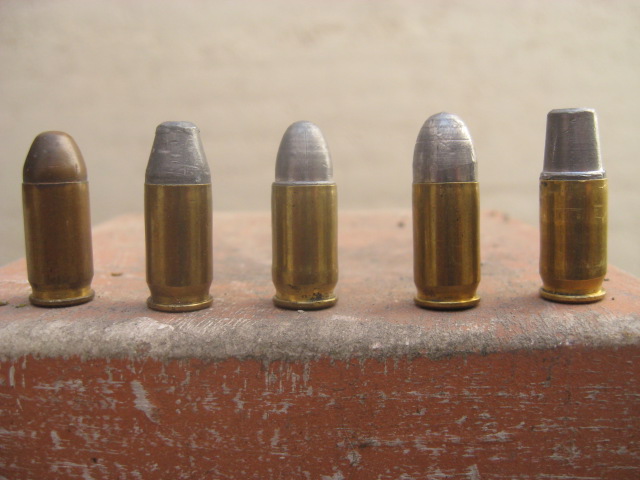
Experiments in a wide variety of handguns proceeded with great success. I talked to Murray Gardner in a swimming pool in his hotel in Puerto Vallharta in 2004 about changing the World IPSC rules to allow the .380 but he told me it was out of the question. The rules stated that minimum bore diameter was .355 but case length had to be 9x19. "Well," I though, "screw it. We'll just write our own rules." It was also a chance to rectify problems I had with the existing rules -- which Murray himself had put together in 1980 while I was in the room. We found out what works and what doesn't pretty quickly.
WELL THEN, WHAT WORKS?: We found out PDQ that all the guns made for the 1985 U.S. Small Arms Trials did not have any problems at all with the .380 Cal Cartridge. Remember, we're working with 1 mm less case so the OAL in shorter. Still, the Glock 19 and 17, the S&W 3rd Generation guns (3904/5904 et al), the Beretta 92 series and the Ruger P series all just seem to work and keep on working. Older guns, like the Browning Hi-Power and CZ-75 are more sensitive to short rounds and need careful doctoring to work -- and even then 1 in 100 rounds jam or do something we don't like. The two most ubiquitous pistols in Mexico in civilian hands are the Glock 25 in .380 or .380 Cal (with a Glock 19 slide and barrel in a .380 chamber with a 9mm lead-in) and the Browning Hi-Power. That's because numerous State and Federal agencies moved away from the Hi-Power and went to the Glock/Beretta/Sig pistols in the late '90's and early 2,000's and those guns -- although prohibited -- found their way by the thousands into civilian hands. Converted to .380 Cal, they can be registered. But they rarely work perfectly. Still, if you tinker with them enough, and play with and choose your mags carefully, you can get them to work.
Video: "Castlebravo", who helped me so much writing the Mexican IPSC rulebook that his name is on it along with mine, shoots his .380 Cal Browning Hi-Power in a 9-pin event at the Queretaro Club. His gun has been meticulously worked over by the Custom Shop and it just works!
WELL, HOW POWERFUL IS THIS SUCKER?: A regular factory 9mm 124 grain loading leaving the barrel around 1,120 fps has a power factor of just under 140. Let's call it 140. The most popular .380 Cal loadings these days are 135 to 142 grain bullets loaded long to an OAL of about 1.050 to 1.060. The 142 grain Saeco #383 -- my favorite -- zips out of a 4 inch Glock 19/25 or S&W 3904 at 1,030 fps using 3.6 grains of Bullseye for a Power Factor of about 146. Out of a longer barrel, like the Beretta, you get about 1,060 for a 150 Power Factor. In Mexico, there are no "magazine limits" so a Glock 19/25 or a Beretta 92 with a 20 shot magazine in the 145+ Power Factor range gets you into the game! Personally, I prefer six shots of 225 Power Factor .38 Special Heavy Duty loads shot out of remarked .357 Magnum revolvers but I like my autos too, and a Beretta 92 is in my future I should think.
Using the 1911 platform with fully-supported chambers (we use the Clark/Para ramps), you can squeeze 4.2 grains of Bullseye into the little .380 Case and using a "powder compression die" make enough room to correctly seat the Saeco #383 bullet to 1.060 OAL. The 1911's eat that stuff up! And the power is impressive. We use CCI primers on this load as they seem to be quite hard, and 5-inch 1911's give a velocity of 1,150 fps! That's a Power Factor of 163 with the 142 grain SWC! Moving up to a 6-inch Longslide, the velocity is around 1,200 and just nudges into the 170 Power Factory area! This loading is called the .380 Super Cal, and the primers are painted red with a permanent marker so they don't accidently get used in an unsupported chamber. Castlebravo did the (accidently) experiments on this and the case bulging was impressive!!!
Photo: The Castlebravo "Oooops!" casing. We started painting .380 Super Cal primers RED immediately after this near-extinction-event.

Video: Pin practice for the 9-pin event using my 5-inch 1911 and the .380 Super Cal loading.
WELL, SHOULD I BUILD ONE?; Unless you live in Mexico, I cannot see why you would. If you do live in Mexico, I cannot understand why you wouldn't. Unless you don't reload of course. But if you don't reload yet still live in Mexico, why don't you just take up golf? Ammo is super expensive in Mexico and availability is limited. If you don't reload, you'll never be able to learn to shoot very well and your power levels will be disturbingly low. But to each his own.
HOW ARE THE GUNS MARKED?: Normally, in the San Miguel/Queretaro area, .380 firearms are marked .380 ACP or 9x18 Kurz. .380 Cal firearms are marked .380 Cal or .380 Cal ACP. Either works.
Photo: A Glock 19/25/34 with a 20 round magazine lays between two IPSC/Mexico hats. A 20-round mag of 145 Power Factor SWC ammo isn't bad. 124 grain FMJ ammo in 9mm would be slightly less powerful and probably less effective. Either way, the .380 Cal is legal and lets us play! This gun has a Lonewolf Glock 34 slide and gap-filler installed on the Glock 25/19 frame. Any Glock 17 mag with a +2 follower generally holds an even 20 rounds of .380 Cal because of the slight differences between the .380 and 9 mm cases. Works great, too!
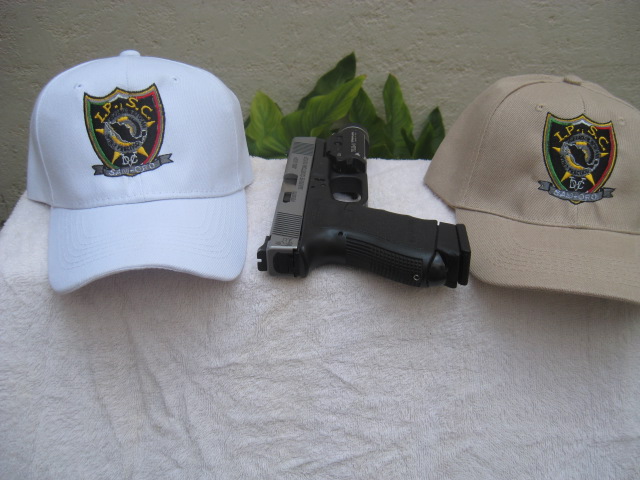
Another of the early experimental Glock 19/25/34 guns with Glock 17 mags and 125 grain Lee RN bullets. That's how I know it's an early photo. All .380 Cal loadings after about 2012 were of the 135 grain RNFP or the 142 grain SWC or the Saeco 150 grain pointy RN. This early example is marked .380 Auto.

OKAY, SO WHO DEVELOPED THIS AGAIN?: Allan Williams Gallindo had the first idea and sparked the project. I did the development work. Several U.S. barrel companies provided the barrels and they will not be mentioned because there are Putos in Law Enforcement Uniforms who think that harrassing civilian shooters makes them look like they are doing something while the Cartels run uninhibited and those Putos don't have "the need to know" and they never will have it. Pacific Die and Tool made the reamers just to the specs we provided and somewhere I have the number written down for the reamer but you can just use a normal .380 Chamber reamer and a 9mm nose pilot and get the same result. The Marine Custom Shop did all the gunsmithing, chambering, checkering, and tweaking. NOBODY ELSE had any significant contribution to the design or development of the .380 Cal cartridge. I guess I should give Castlebravo an honorable mention for almost blowing himself up by firing a .380 Super Cal round out of his .380 Cal Glock 19/25 (not fully-supported). And that's it.
.380 Cal = .380 Cal and Allan. Simple as that.
Still alive
CGN Ultra frequent flyer
- Location
- Rainy mosquito infested part of BC
Wow!! Great explanation Calmex! Talk about necessity being the mother of all inventions!
Does the .380 ammo fit ok in a 9mm mag? Or are the mags modded too? I thought .380 was a bit skinnier than 9mm. How many .380 rounds will fit in a standard 15 rd 9mm mag?
Does the .380 ammo fit ok in a 9mm mag? Or are the mags modded too? I thought .380 was a bit skinnier than 9mm. How many .380 rounds will fit in a standard 15 rd 9mm mag?
Wow!! Great explanation Calmex! Talk about necessity being the mother of all inventions!
Does the .380 ammo fit ok in a 9mm mag? Or are the mags modded too? I thought .380 was a bit skinnier than 9mm. How many .380 rounds will fit in a standard 15 rd 9mm mag?
Any of the mags for guns from the 1985 Small Arms Trials work perfectly. A 15 round mag is normally a 15 round mag...but sometimes you can squeeze in 16. Makes it hard to chamber, though, unless you do it from slide-lock. Yes, the .380 is slightly skinnier than the 9 mm. In my own S&W 3904 I could get 10 rounds in the 9-round factory mags and load NOT from slide-lock. Worked perfectly!
I loved my 3904. I had a 9mm barrel and a .380 Cal barrel but I just used the .380 Cal barrel after I found that it worked just as well, was slightly more powerful than the 9, and gave me one more shot!

1911 mags work fine, but the BEST ones are the Wilson or Chip McCormick 10-rounders. Those were flawless. I mean, flawless. My 1911 did not jam. Sorry, 1911 shamers. The Browning Hi-Power mags had to have the feed-lips turned in ever-so-slightly to obtain 100% feeding. I suppose any of the older (pre-1985) guns might suffer so, as they were not as much of a "straight in feed" as the 1985 and later gun designs.
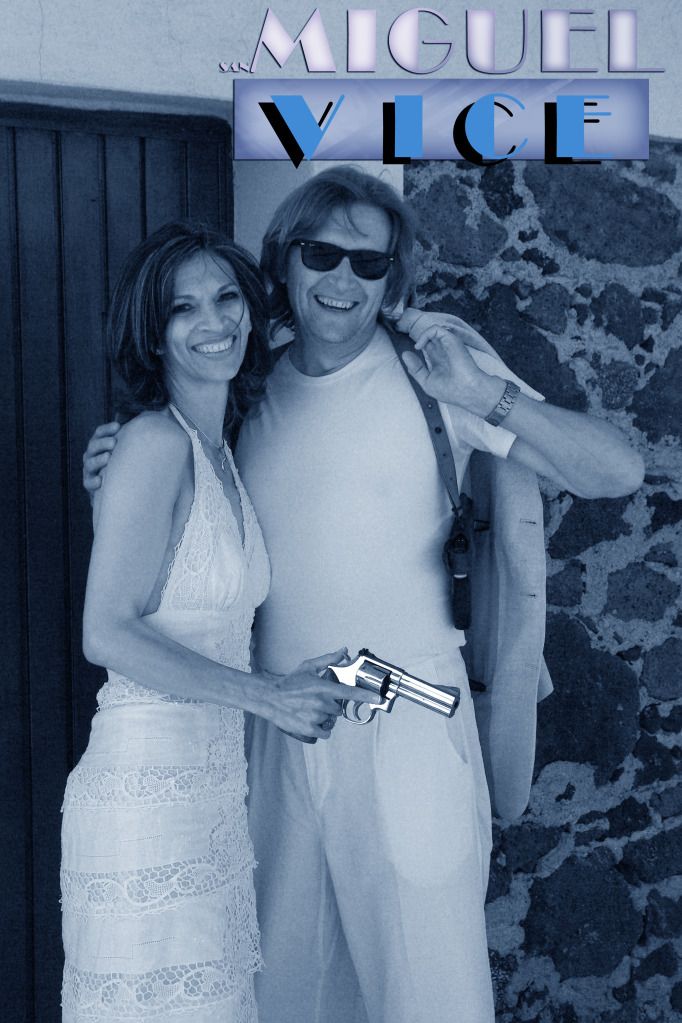
The 3904 was my Miami Vice gun. I wore it most of the time I didn't need to be "deep concealed".
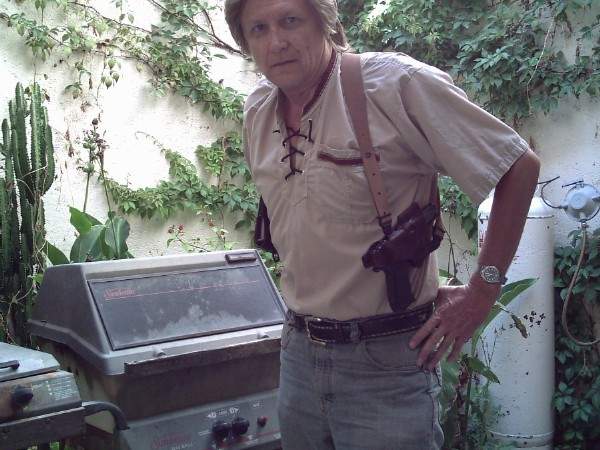
Or, like at my Miami Vice wedding....on my brother-in-law's ranch here in Salamanca...
Or out in the back-country on exploration trips in my VW Safari (Thing)....
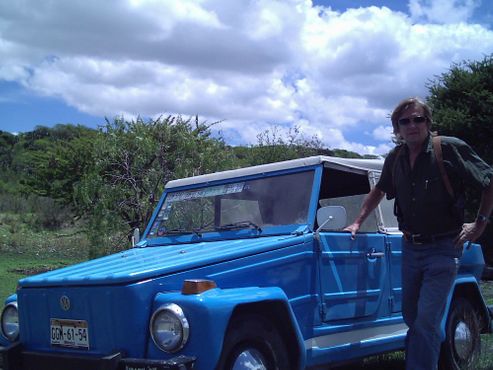
I loved that gun. But, I sold it when I moved back to Canada to serve my 6.5 year sentence of exile from Mexico. However, that 3904 was one of the early experimental guns -- like, I mean, one of the earliest earliest. And it worked. 100% from the get-go. So we knew we were really on to something. But when I go back, I think a P226 or Beretta 92fs is probably the way to go for playing Miami Vice out in the campo. Lots of shots and they work 100%, and out in the back-country around here you're in No Man's Land. In town, the snubby in the pocket is the way to go unless things are really going to hell.
My 3904 and Jackie Chan's (we call him that because he friggin' looks like Jackie Chan) 669. Two of the earliest experimental .380 Cal guns. These are marked .380 ACP with the Marine Custom Shop markings. Later, a logo that looks incredibly like the S&W logo but is actually a M, C, and S intertwined was used. I'll have to see if I can dig up a drawing or photo of the later MCS markings somewhere. Although only a 2nd Generation Smith, Jackie's 669 worked flawlessly from the get-go. His 12 round magazines hold 13 rounds, making his a 14 shooter.

Still alive
CGN Ultra frequent flyer
- Location
- Rainy mosquito infested part of BC
Thanks again Cal. You’ve lived and still live a very interesting life. And you have a very classy looking wife.
Too bad you sold the 3904. The 2 tone slide is beautiful and classic for the time.
And thanks again for the education. You must get acclimated to the weather after a while. Wearing a shoulder holster even with a light jacket in Mexico would get old fast for me.
Stay safe!
Too bad you sold the 3904. The 2 tone slide is beautiful and classic for the time.
And thanks again for the education. You must get acclimated to the weather after a while. Wearing a shoulder holster even with a light jacket in Mexico would get old fast for me.
Stay safe!
Too bad you sold the 3904. The 2 tone slide is beautiful and classic for the time.
And thanks again for the education. You must get acclimated to the weather after a while. Wearing a shoulder holster even with a light jacket in Mexico would get old fast for me.
I sold the 3904 -- although I loved the gun -- because a friend desperately wanted it and I had the nagging suspicion that what I really wanted was a double-stack. I like the S&W 3rd Generation series, but I once broke the trigger-bar on the 3904. This completely buggers the gun. You cannot fire it. I had to order a replacement and then wait for it to arrive and completely disassemble the piece to fix it. The SEALS have had good success with the P226. The U.S. Army has had good success with the 92fs. I think that -- talking .380 Cal here -- those might be the way to go.
Hollowpoints are illegal in Mexico, but the Hornady 135 grain FlexLock Critical Duty bullets would probably pass muster. Those are not sold as individual bullets, but next winter I intend to have some pulled bullets to try reloading into .380 cases for use in the .380 Cal autos. I believe they will be reliable and as accurate as any 9mm loading and duplicating the velocities will be no problem at all. I actually have that load for sale where I am working in Canadian Tire, Oliver so I can just sell it to myself -- then pull the bullets. I will do a "test" fire of the actual 9mm rounds in Canada to confirm velocities and accuracy before coming down here. That's a plan for next year.
As to the weather; Central Mexico has two seasons. For about 8 months of the year, one wanders about in "short-sleeve weather". That means what it appears to mean. It does not get cold at night and the days are sunny and warm or even hot. From mid-November through mid-February you are in "long-sleeve weather". No problem wearing a light suit-jacket during most of this time, although some really warm days can still creep in screwing up your wardrobe plans. San Miguel is at about 6500 feet and Salamanca is at 5600. Guanajuato (where we will live when we come back) is at 6500 as well. At these altitudes you don't get the scorching hot weather of the beach.
Allan (and I) adopted shirt-styles that were meant to be worn untucked. Allan had a lot of Guayabera-style shirts (a la former U.S. Consul Phil Maher) and I wore those or Hawaiian style shirts -- untucked. Although I saw Allan just the other night, we did not talk about "concealed carry" at all. I mean, why would we? That topic was "talked out" between us years ago. However, I know for a fact that for quite a while Allan walked around his great restaurant all day long in a Guayabera-style shirt top with his Model 66 Super Snub in a Galco Speed Paddle and nobody ever noted. In short-sleeve weather, the snubby-the-pocket-holster is the best answer I've personally come up with. Now that the new snubbies are so light, you could actually have one in each pants-front pocket. I still (personally) prefer a 160 grain SWC at 850 - 900 fps over a .380 Cal 142 grain bullet at around 980 - 1000 fps (out of a real short mini-9) but that's just me. It's not so much the power difference (virtually none) as the fact that the mini-autos easily jam if fired weak-handed because of battle-damage and the revolvers won't. But again, that's just me.
Allan and I in his restaurant, February 2019. Long-sleeve weather. Allan and I pretty much tore up San Miguel until I got married in 2008. A bigger pair of raging drunks pushing the limit and running truly wild I can hardly imagine. We once rode a motorcycle across the San Miguel town square to get Allan to an office to pay a bill right at closing time. At a friend's Mexican wedding once, we two went around to all the tables and confiscated the expensive bottles of champagne on each table telling all the people in somber voices that the champagne was "tainted" and had to be removed for safety and then took the bottles all back to our table where we tried to drink them all. That night remains a blur except for the hugging the toilet part.
We're pretty toned-back now.

Last edited:
The Bullets for the .380 Cal that work best are heavier bullets with longer noses that help get the OAL up to 1.050 or longer when seated in the .380 ACP casing. In any of the guns from the 1985 tests onwards that we experimented with (Glocks, 3rd Gen Smiths, Ruger P-series and the one Sig P226 we could play with) even shorter bullets worked fine. But the longer OAL you can load and still maintain accuracy, the better.
The top bullet so far, in my opinion, is the great Saeco #383 140 - 142 grain SWC. The downside is that it only comes in heavier steel moulds that offer a 4-cavity at best. But it is amazingly accurate and works great.

Another very popular bullet is the Accurate Molds design 35-135A. The Queretaro boys use this one -- which can be purchased as a 5-cavity aluminum mould -- often in powdercoated form as they use a lot of suppressors out there "just for fun". So they tend to powdercoat. This also is a very accurate, reliable bullet.

The Noe bullet 358-136-FN-PB is another contender. I have not tried it, but have been told it works great.

A new contender that I intend to experiment with this summer is the Arsenal Moulds 259-133 Mihec bullet. This looks like just what we are looking for. The .380 case doesn't leave a lot of room for powder if you fill it up with bullet, so you need a bullet base that is somewhat shorter and a bullet nose that is somewhat longer. This can lead to accuracy problems (the Saeco 150 grain RN has the same short base as the #383 SWC but a longer nose and is inaccurate in all rifling twists we have tried from 1/10 up through 1/24. So I do not recommend that particular bullet. The Saeco Mould number is #910 if you feel the need to investigate it.
The Arsenal bullet looks interesting!

It looks like it's exactly what we are looking for, in the weight-range we like (which, just by coincidence, is the same weight as the Hornady Critical Duty 135 Flex-lock which might help give us a practice load and service load that hit pretty much the same. Experiments to follow!). Only testing will prove if it will work out for us. We want a bullet that feeds 100%, is accurate enough to shoot the P.P.C., and that comes in a big enough mould to make production rapid. Also, we want a flat nose and SWC shape to help transmit energy to maximize battle-damage. This might just be what we're looking for as it comes in a 5-cavity aluminum mould for 80.00 U.S. . I guess we'll see.

Many of the guns out Queretaro/San Juan way have owners who like the suppressor life. These work amazingly well and are all pretty much set up to use the 135 grain Accurate Molds powdercoated bullet. I have read in many places that pistol suppressors don't "silence" the shot all that well, but I have to say that the better titanium machined suppressors that I have seen used completely blow that claim out the window. They are really quiet. Hollywood quiet. Personally, I think this is pretty much like the silliness one reads about how one could remove the "H" lock from a 1921 or 1928 Thompson and still fire the gun. Well, perhaps you could, but how would you #### it? Without the "H" piece connecting the bolt to the actuator the only way to #### the thing would be to shove a cleaning rod down the barrel and push the bolt back. This crap is put out there by one idiot who doesn't actually know what he's talking about but throws it out there anyway because he's an "expert" and then everyone else piles on a repeats his claims because he's an "expert". (I am not an "expert" but have been around a bit).
You need to use a "recoil booster" to get semi-auto action out of your Glock 19/25 using the .380 Cal but they work amazingly well. I realize that Sgt. Renfrew and his band of merrymen in red tights frown on "the quiet life" but there's no problem with it in Mexico. So probably Canadian readers shouldn't go down that road unless it's clearly understood that legal problems could result. Down here, though, just have at it if it suits your fancy.

The top bullet so far, in my opinion, is the great Saeco #383 140 - 142 grain SWC. The downside is that it only comes in heavier steel moulds that offer a 4-cavity at best. But it is amazingly accurate and works great.
Another very popular bullet is the Accurate Molds design 35-135A. The Queretaro boys use this one -- which can be purchased as a 5-cavity aluminum mould -- often in powdercoated form as they use a lot of suppressors out there "just for fun". So they tend to powdercoat. This also is a very accurate, reliable bullet.
The Noe bullet 358-136-FN-PB is another contender. I have not tried it, but have been told it works great.
A new contender that I intend to experiment with this summer is the Arsenal Moulds 259-133 Mihec bullet. This looks like just what we are looking for. The .380 case doesn't leave a lot of room for powder if you fill it up with bullet, so you need a bullet base that is somewhat shorter and a bullet nose that is somewhat longer. This can lead to accuracy problems (the Saeco 150 grain RN has the same short base as the #383 SWC but a longer nose and is inaccurate in all rifling twists we have tried from 1/10 up through 1/24. So I do not recommend that particular bullet. The Saeco Mould number is #910 if you feel the need to investigate it.
The Arsenal bullet looks interesting!
It looks like it's exactly what we are looking for, in the weight-range we like (which, just by coincidence, is the same weight as the Hornady Critical Duty 135 Flex-lock which might help give us a practice load and service load that hit pretty much the same. Experiments to follow!). Only testing will prove if it will work out for us. We want a bullet that feeds 100%, is accurate enough to shoot the P.P.C., and that comes in a big enough mould to make production rapid. Also, we want a flat nose and SWC shape to help transmit energy to maximize battle-damage. This might just be what we're looking for as it comes in a 5-cavity aluminum mould for 80.00 U.S. . I guess we'll see.
Many of the guns out Queretaro/San Juan way have owners who like the suppressor life. These work amazingly well and are all pretty much set up to use the 135 grain Accurate Molds powdercoated bullet. I have read in many places that pistol suppressors don't "silence" the shot all that well, but I have to say that the better titanium machined suppressors that I have seen used completely blow that claim out the window. They are really quiet. Hollywood quiet. Personally, I think this is pretty much like the silliness one reads about how one could remove the "H" lock from a 1921 or 1928 Thompson and still fire the gun. Well, perhaps you could, but how would you #### it? Without the "H" piece connecting the bolt to the actuator the only way to #### the thing would be to shove a cleaning rod down the barrel and push the bolt back. This crap is put out there by one idiot who doesn't actually know what he's talking about but throws it out there anyway because he's an "expert" and then everyone else piles on a repeats his claims because he's an "expert". (I am not an "expert" but have been around a bit).
You need to use a "recoil booster" to get semi-auto action out of your Glock 19/25 using the .380 Cal but they work amazingly well. I realize that Sgt. Renfrew and his band of merrymen in red tights frown on "the quiet life" but there's no problem with it in Mexico. So probably Canadian readers shouldn't go down that road unless it's clearly understood that legal problems could result. Down here, though, just have at it if it suits your fancy.
The contrast between your lifestyle there and our namby-pamby/feel-good society here comes as a revelation. Yours is better.
I don't know if I would be willing to work that hard to get the results you're after unless it was from dire necessity - which I guess it is for you. Willing co-operation from like minded qualified people being essential.
'Hatcher's Notebook' talks about shooting .380 ACP from 9mm guns like the Luger and P-38. They shot just fine but had to operated manually. I bring this up every time some expert states that cartridges such as the .45 ACP, 9mm and others MUST headspace on the case mouth. Hatcher proved that the extractor held the rds sufficiently for the firing pin to hit the primer.
My .45 brass has never been trimmed, some of it so old the head stamps are getting difficult to read. Miking them for length is a joke, but they keep on chugging along, discarded when they split. Wiley Clapp (US gun writwer) occasionally talks about a friend who delights in showing him pics of one hole groups fired with a 1911 from a Ransom rest using range pick up brass.
The late Rod Philipsen, our IPSC 'smith back in the day, once too deeply reamed the chamber on a Bar-Sto 9mm barrel for a customer's gun. A friend bought the barrel for cheap and had it fitted to his Hi-Power which he used in BCRA Pistol matches. Accuracy was unimpaired.
I don't know if I would be willing to work that hard to get the results you're after unless it was from dire necessity - which I guess it is for you. Willing co-operation from like minded qualified people being essential.
'Hatcher's Notebook' talks about shooting .380 ACP from 9mm guns like the Luger and P-38. They shot just fine but had to operated manually. I bring this up every time some expert states that cartridges such as the .45 ACP, 9mm and others MUST headspace on the case mouth. Hatcher proved that the extractor held the rds sufficiently for the firing pin to hit the primer.
My .45 brass has never been trimmed, some of it so old the head stamps are getting difficult to read. Miking them for length is a joke, but they keep on chugging along, discarded when they split. Wiley Clapp (US gun writwer) occasionally talks about a friend who delights in showing him pics of one hole groups fired with a 1911 from a Ransom rest using range pick up brass.
The late Rod Philipsen, our IPSC 'smith back in the day, once too deeply reamed the chamber on a Bar-Sto 9mm barrel for a customer's gun. A friend bought the barrel for cheap and had it fitted to his Hi-Power which he used in BCRA Pistol matches. Accuracy was unimpaired.






















