English Shotgun

tiriaq

Super Moderator
Moderating Team
Rating - 100%
252   0   0
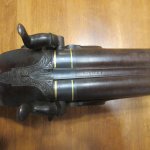
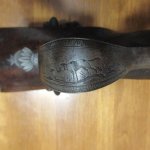
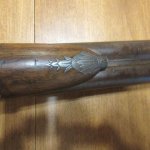
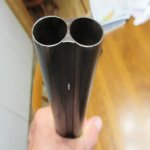
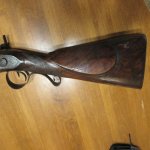
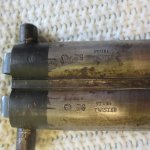
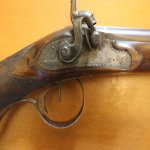
Converted from flint. Barber & Boaler Newark. 16ga, 32 1/2" barrels. Thinking ca 1800. Note the low top rib, and the sight set back from the muzzle. The bores are shiny.
002.jpg
014.jpg
015.jpg
017.jpg
019.jpg
018.jpg
 

Attachments

  • 002.jpg
    002.jpg
    60.9 KB · Views: 329
  • 014.jpg
    014.jpg
    71.7 KB · Views: 324
  • 015.jpg
    015.jpg
    58.3 KB · Views: 324
  • 017.jpg
    017.jpg
    68.6 KB · Views: 325
  • 019.jpg
    019.jpg
    42.1 KB · Views: 325
  • 018.jpg
    018.jpg
    85 KB · Views: 328
Last edited:
Beautiful gun. Isaac Barber started making guns in Market Place, Newark, Nottinghamshire in 1773. He joined with Joseph Boaler in 1800 at Cartergate, Newark, and they were in business until 1816.
 
Beauty SG! Love these oldies: I reload 2.5" BP shells and regularly shoot two nice antique Damascus- one with hammers, one with internal pins.

You have a lovely oldie
 
I believe that the proofs are pre-1813, so that would date the gun to 1800 -1813. Barrels are stamped "STUBS TWIST". along with the 16ga stamp.
Pull to the front trigger is 15".
Given its overall condition including the bores, it was used carefully and properly cleaned.
 
What a beautiful older gun! I don't have one, but I do have the occasional use of one made by an East Anglian gunmaker whose name currently escapes me, except that he was working out of Norwich. These older guns have a definitive feel to them that is unlike anything modern - a quick lightness in handling even the larger gauges with longer barrels, and some had 36" barrels. We have a lot of lfint and percussion clay pigeon shooting in the part of Eastern England that we currently inhabit, and watching people smoking clays with a flintlock - half a second or so after squeezing off the shot - is pure delight.
 
What a sweetheart! The 15" length of pull is curious, it would be too long for most shooters even today. It must be original because that butt plate certainly is. Perhaps a different style of shooting? The breech plugs look different than the barrel material, maybe replaced during the conversion from flint? Or more recently reblued? Smooth shiny bores - been cleaned up? Still in proof? Ya gotta hunt with this old lady, I sure would.
 
The breechplugs are the flint plugs with the drums replacing the touch holes. I believe they are different colour relative to the barrels because they are casehardened. The gun shows no evidence of refinishing or reworking, other than the percussion conversion. Whoever did that did a very neat and tidy job, with minimal harm to the lockplates. The checkering shows modest wear. Ramrod is a hickory replacement. I think originally it would have been rosewood.
Some more modern English guns have long pulls. I think it is because they were used for shooting incoming driven game, rather than rough(or snap) shooting.
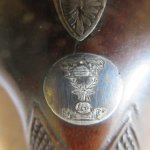
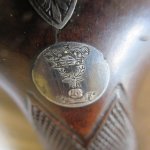
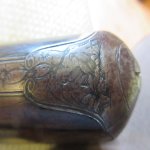
The thumb piece was reattached with a couple of little brads. The crest is a crown over a stag over another different crown. Might be traceable.
Apart from removing the barrels, I have yet to do any disassembly. The locks have that positive click, click and free movement typical of English locks.
 
Seeing the crest under magnification, the heads of the little brads are engraved. I noticed in the photos that there appears to be a tiny gold dot like a little jewel - centered in the upper crown. It isn't just an artifact of the photography. Had a good look with a strong light and a magnifier, it is a feature of the crown.
001.jpg
002.jpg
 

Attachments

  • 001.jpg
    001.jpg
    55.9 KB · Views: 243
  • 002.jpg
    002.jpg
    62.5 KB · Views: 243
Last edited:
Thank you! I had found another crest with a stag gazing left, but that orientation is significantly different.
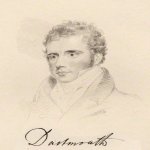
William Legge, 4th Earl of Dartmouth, 1784 - 1853. His age would coincide nicely with a gun made 1800- 1812. Certainly a possibility.
4thEarlOfDartmouth.jpg
 

Attachments

  • 4thEarlOfDartmouth.jpg
    4thEarlOfDartmouth.jpg
    64.6 KB · Views: 104
Very very cool. If it was mine, I would definitely take some game with it!!!

Quite the find, and the possible lineage is intriguing!

Cheers
Jay
 
STUBS - seems to me that this refers to steel made from recovered horseshoe nails that seemed to have better carbon inclusion or some such reason. The old story was that the nails were recovered from the roadways by diligent boys who were paid so much a pound for them by blacksmiths. Not sure if this is the whole story but certainly interesting!
 
I've heard that they thought the constant hammering of the horses' hooves on the hard, hard, highway compacted and improved the iron. Because of the way horseshoe nails are used - hammered into place, bent over and nipped off - they needed to be soft and ductile. Used nails - stubs - were collected, welded into bars, and then welded into barrels. I read somewhere that a pair of barrels weighing a few pounds would need some 15 lbs of stubs. The barrels show plain twist, not the fancy two and three stripe damascus popular later on.
Based on the "feel" when I wiped out the barrels, I think that they are taper bored. British gunmakers were taper boring shotgun barrels long before choke boring was developed.
I'm assuming that the crown over IS is the barrel forgers mark.
 
stub twist was made by forge welding horseshoe nails into a lump then strip (skelp) of iron then to a barrel. Theory was that the pounding of hooves on the pavement somehow changed the chemical nature of the iron and I assume claimed that it reduced the carbon content. In a book I am currently reading about Spanish firearms, used horseshoes were apparently also used, at least in Spain.

The obvious question comes up; "how do you forge weld nails together". In one of the books on the subject, the nails were held together into a tight bundle by an iron hoop, then heated and fused. The main reason for twist and damascus barrels made from many smaller pieces, was the difficulty of producing iron with a homogenous carbon content and forge welding reduced the carbon content as well as mixing high and low carbon pieces to reduce the risk of brittle barrels. In my limited experience of grinding scraps of forge welded barrels, they appear to have a very low carbon content. The Bessemer process came out in 1854 and revolutionized iron / steel making although British iron was still high in phosphorous (I think, perhaps sulfur) and somewhat brittle. There was enough demand for forge welded barrels that they were sold until the 1920s.

cheers mooncoon
 
I think that we forget how much skill and plain hard work went into making these things. I've read that filers would sweep up and the filings would be placed on a plate, put in a forge, and welded into bars from which trigger guards, buttplates and other fittings would be forged. Saturday night beer money was earned this way.
It took quite a while for Bessemer process steel making to be perfected. Apparently the steel plate used in the Titanic contributed to the disaster. It was brittle, and the gash opened up more than if the ship had been made with iron plate.
 
Back
Top Bottom