I'm going to try this a bit differently...
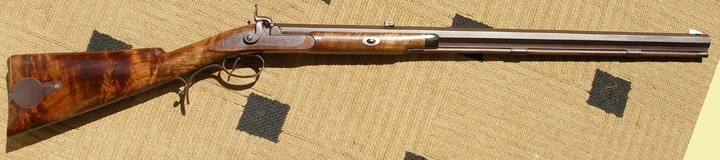
I have an English Sporting Rifle that has been in my family for many years. It was built by Mr William Beckwith, of Skinner Street, in London, around 1863. My grandfather brought it with him when he emigrated in 1890.
The rifle is a 14 bore, or .58 cal, more or less. The mould that goes with the rifle casts a hollow base conical bullet, .57 cal. The bullet fits very loosely in the bore, suggesting that it required a linen patch. Paper patch would not be thick enough. I plan, in the next few days, to make a bore cast of ferro safe, and get accurate measurements. As well, I will determine the twist rate so I can determine if the bullet dimensions are appropriate.
The brass mould is a pain in the butt to use. It is a side pour, and doesnt release the bullet well at all, even when well smoked, and has no sprue cutter, leaving a nasty sprue, very difficult to remove cleanly. I will likely get Leo Bumphrey to make me a better one, once I get all the information I need.
As I mentioned earlier, the rifle was built around 1863, which, I believe, was early in the development period of the tremendously accurate slug rifles used in the Creedmore matches, and such. The rifles made by Gibbs, and the like, fired bullets that were more or less 3 calibers in length. This one is 2. I have not yet measured the twist rate, as I havent found the proper cleaning rod to do it, but I can only assume that the twist will be slower than the Gibbs.
I plan to shoot the rifle. I had it reconditioned by a competent gun smit, who declared it perfectly safe to fire. If anyone is interested, I will record my progress.

I have an English Sporting Rifle that has been in my family for many years. It was built by Mr William Beckwith, of Skinner Street, in London, around 1863. My grandfather brought it with him when he emigrated in 1890.
The rifle is a 14 bore, or .58 cal, more or less. The mould that goes with the rifle casts a hollow base conical bullet, .57 cal. The bullet fits very loosely in the bore, suggesting that it required a linen patch. Paper patch would not be thick enough. I plan, in the next few days, to make a bore cast of ferro safe, and get accurate measurements. As well, I will determine the twist rate so I can determine if the bullet dimensions are appropriate.
The brass mould is a pain in the butt to use. It is a side pour, and doesnt release the bullet well at all, even when well smoked, and has no sprue cutter, leaving a nasty sprue, very difficult to remove cleanly. I will likely get Leo Bumphrey to make me a better one, once I get all the information I need.
As I mentioned earlier, the rifle was built around 1863, which, I believe, was early in the development period of the tremendously accurate slug rifles used in the Creedmore matches, and such. The rifles made by Gibbs, and the like, fired bullets that were more or less 3 calibers in length. This one is 2. I have not yet measured the twist rate, as I havent found the proper cleaning rod to do it, but I can only assume that the twist will be slower than the Gibbs.
I plan to shoot the rifle. I had it reconditioned by a competent gun smit, who declared it perfectly safe to fire. If anyone is interested, I will record my progress.