Experienced Quickload users - Meed your input

digitalblue

CGN Regular
Rating - 100%
55   0   0
I've been shooting quite a bit of rifle(mainly 308, 30-06, 30-30, etc) and I'm finding that the powder is the most expensive component. I find it a tad bit wasteful for the type of shooting I do as full powered loads aren't really needed so even a 25% reduction in velocity is acceptable.

Having read around, I'm toying with the idea of using small/moderate charges of pistol powder to create some decently powerful reduced loads. Unfortunately, a lot of the anecdotal load data on forums is typically for pipsqeak "gallery" loads using very light bullets or very small charges of pistol powder.

Recently got quickload and after tweaking some numbers, I'm very surprised how much performance you can (allegedly) get with a modest amount of pistol powder.

Quickload is telling me in a 308, 20gr of HS-6 will push a 147gr FMJ 2000FPS with a peak pressure of only 39KPSI.

I know they cannot guarantee the safety of their data due to variations in the components and liability, but how reasonable accurate is quickload for a starting load?
The load I'm proposing is 30% below max pressure for a 308, can I assume this is reasonably safe?
 
Appreciate your concern but I'm very careful when it comes to reloading. Primed ready to load cases are stored upside down(primer up) on a separate loading block and a bullet gets stuffed on immediately after it's charged.
 
If you play with Quickload a little more it will also tell you the most efficient powders that give you the best loading density that nearly fills the case.

There is a reason why bulky powders like Trail Boss and the discontinued SR4759 were used with reduced loads. And that is to prevent the chance of a double charge and damage to the firearm.

If you want to save money and still shoot then get out your .22 rifle and practice at 50 yards. Or use reduced loads from the Hodgdon's website using H4895 of Trail Boss powders.

Also remember Quickload is a computer program and you can put garbage in and still get garbage out and HS-6 is not a powder noted for reduced loads.

And remember you need a chronograph to get accurate data from Quickload. And you change the powder burn rate in Quickload until it matches your chronograph velocities. Quickload is a nice program and can tell you many things "BUT" Quickload can not compensate for all the different reloading components unless you tune Quickload for each caliber you are loading for.

Bottom line I would not let Quickload pick a powder for reduced loads and I would stick with printed published known data and powders.
 
Last edited:
On top of this, most powders have a minimum recommended load. If the powder is lying loosely in the case, it can be abnormally distributed resulting in flash burns, slow burns, no ignition, slow ignition, squibs, unburnt powder, etc, etc. Handgun cartridges normally use pistol powders for a reason, the cartridge capacity is small and barrel length is short. Bigped51, you are absolutely correct in suggesting using reduced loads of H4895 or Trail Boss as per Hodgdon. Both of these powders are time tested and reliable. I have done both but prefer H4895 as it can also be loaded up to maximum for performance.
 
Hodgdon lists 8gr of titegroup, no min no max. For the 308 with a 164gr bullet.

I use 3.5-9gr in my 303 british pushing cast lead from 90-240gr at 750-1650fps. I also use w231 in place of titegroup. Works well a bit of a fps spreed though, may want to try a darcon filler, i shoot squirrels with it at about 10m so for me i dont mind the velocity spread

its best to pick a powder that is well known to work with reduced loads below 50% case volume, and doesnt start acting erratic. there are lots of powders out there that in the 308 would work fine loading anywhere from 10-25grs of powder and still very acceptable velocity.

But i really like and mostly use h4895, A5744 and imr3031 in most rifles chambered in rifle calibers for cast and reduced loads

but next time i buy some more powders il be picking up a few faster ones such at 2400 and H110 for some of my rifles that are chambered in pistol cartridges , [44mag and 300gr jacked dont like titegroup or A5744]
 
Last edited:
I'm 67 and have been reloading for over 47 years and last week I had my first double charge of 3.3 grains of Titegroup in my brand new .357 Ruger Vaquero. I'm not sure if I charged the same case twice or if it was my RCBS Chargemaster that went over and I didn't catch it. Bottom line it was my mistake for not paying full attention to what I was doing.

I was lucky that the .357 cylinder is much thicker than larger calibers and did not come unglued and have a kaboom. I had to drive home from the range and pound the case out of the cylinder with a brass rod and hammer. The base diameter of this case was over .004 larger in diameter than a new unfired case. And the base of the case was flattened and the writing was hard to read.

Bottom line, check and double check your reduced loads for double charges and don't let your mind wander off the job at hand. I was lucky that day at the range that I had a thick heavy duty cylinder. If it would have happened with my S&W .44 magnum with its thinner cylinder walls I think the cylinder would have let go and turned into a kaboom.

So again they make bulk powders for safer reduced loads with far less chance of double charges. So be safe and keep focused on what you are doing, because anyone can make a mistake.
 
I've been reloading for close to 10 years and I've implemented what I think is a fairly bulletproof process to ensure double charges or squibs don't happen. I'm very well aware of the dangers involved but confident enough in my own competence and attention to detail to not double charge a case, so the issue of a powder bulk is not a significant concern to me. I've heard plenty of stories of seasoned reloaders grabbing the wrong powder or even stuffing a bullet on an obviously overcharged case (powder right up the neck). At the end of the day we are at the mercy of our own attention and competence, regardless of the precautions we take.

I have a knack for doing unconventional things, but "unconventional" doesn't need to be "unsafe". This is the very reason I shelled out the cash for Quickload, I wanted some insight as to what I'm doing before go ahead and start loading.

As for powder selection, IMO powder is powder, the important characteristics that differentiate them are burn rate and density. I have chosen HS-6 because

The only issue I'm running into is knowing how reasonably accurate quickload is at predicting pressures. I am trying to establish a minimum charge and to do that, I need to figure how much headroom needs to be left in a worst case scenario. Since, I'm not pushing the load anywhere near the pressure limits I think I'll start off by leaving 50% headroom and work the load up to what I think is optimal.
 
Why don't you check as many reloading manuals you can get your hands on that lists HS-6 for reduced rifle loads, and if you do find any load data let us know. :rolleyes:

And you are putting too much faith in Quickload software program and forgetting garbage in, garbage out with any software program.

Quickload is not a miracle software program and its output is nothing more than a computer generated guesstimate. And Quickload must be tweaked and tuned for "approximate" output data.

This why you need a chronograph to tune Quickload to just get in the ball park of actual chamber pressure and velocity. And this is due to all the variations in firearms and reloading components.

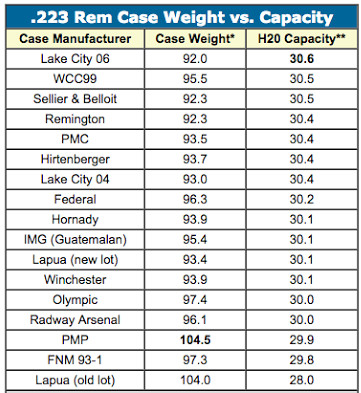
Example, there is 6,000 psi difference in chamber pressure in .223 cases between the most and least case capacity when using Quickload. Now add this to variations in chambers and bore diameter and you we see why you need a chronograph, and case capacity to tweak Quickload to give ball park data.
 
Last edited:
If you play with Quickload a little more it will also tell you the most efficient powders that give you the best loading density that nearly fills the case.

There is a reason why bulky powders like Trail Boss and the discontinued SR4759 were used with reduced loads. And that is to prevent the chance of a double charge and damage to the firearm.

If you want to save money and still shoot then get out your .22 rifle and practice at 50 yards. Or use reduced loads from the Hodgdon's website using H4895 of Trail Boss powders.

Also remember Quickload is a computer program and you can put garbage in and still get garbage out and HS-6 is not a powder noted for reduced loads.

And remember you need a chronograph to get accurate data from Quickload. And you change the powder burn rate in Quickload until it matches your chronograph velocities. Quickload is a nice program and can tell you many things "BUT" Quickload can not compensate for all the different reloading components unless you tune Quickload for each caliber you are loading for.

Bottom line I would not let Quickload pick a powder for reduced loads and I would stick with printed published known data and powders.

I have the quickload program and I completely agree with you.
 
Quickload is very good at some things. Like BigEd said, QL is very good for determining what powders will give good burn rate and case fill for a given cartridge combination. Quickload is not so good as a reloading manual - there are ways to make it useful for load data but as a stand-alone tool, QL unadjusted pressure predictions can easily be out by 15%, and even more on small capacity cartridges.

The fast burning pistol powders are somewhat "spikey" (because that's a normal characteristic of fast burning pistol powders) and it is harder to predict what they do when they get into pressure higher than normally seen in pistols and shotguns. If QL miscalculated the timing of the spike (period of faster pressure rise) by 10%, it could mean the pressure is 50% higher than predicted. There's a reason that pistol powders get used for reduced rifle loads and not full power rifle loads - and the reason is that a small change in the load can result in a large pressure rise and it is very hard to predict accurately.

I'm not saying this is impossible, only that you need more to go on than just QL for this.
 
Last edited:
One of the first things to do when using Quickload is to take a case fired in "your" chamber and get the case capacity. Below at the top of the chart is a Lake City 5.56 case at 30.6 case capacity and at the bottom is a Lapua .223 case at 28.0 case capacity. And there will be 6,000 psi difference in chamber pressure between these two cases using a charge of 25.0 grains of H335.

LjAQ7L9.jpg


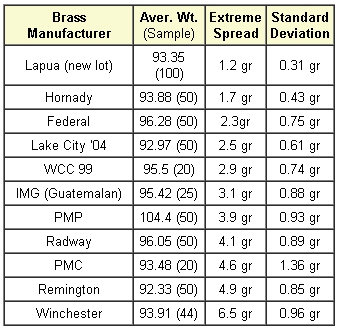
Below you can see the weight variations in brands of cases that can effect case volume and chamber pressure and velocity. And you can see that Lapua is at the top of the list with the least case weight variations, meaning uniformity, quality and lower ES and SD readings.

PExmCCk.jpg


Other things Quickload can not predict is your throat length and diameter, bore diameter, and many of the variations in firearms and reloading components. And as jethunter stated above in is stock unadjusted form it is not as accurate as a reloading manual. And Quickload needs to be calibrated with a chronograph or it can be very far off from reloading manual data.

Bottom line 99.9% of reloaders do not have Quickload "BUT" many reloaders have more than one reloading manual to compare the data. And the reloading manuals list the powders to use and approximate velocities more accurately than Quickload can in its unadjusted and untuned form.

Quickload is fun to play with and get "ball park" estimates but it is "NOT" the miracle computer program that many think it is. And you need a chronograph to adjust Quickload for approximately close chamber pressure and velocity data output from it.

The instructions for Quickload tell you to adjust the burn rate of the powder "and" bullet weight until it matches your chronograph velocity. In other words Quickload must be adjusted for every firearm you have to get your approximate pressure and velocity readings. Ever wonder why the load data varies between reloading manuals? It is the variations in firearms and the reloading components used in testing. And Quickload does not know everything about your firearms until you adjust it using a chronograph. And reloading manuals use pressure measuring equipment and a chronograph in its published data.
 
Last edited:
A few friends and I use Quickload to ascertain a good powder through modelling.

All parameters must be inputted accurately, this is best done by user using accurate weights and measures and the tools and methodology to get them.

In addition, the user must take the principles of internal ballistics to the QL table, QL only helps you do the math.

Some key variables must be reconciled apart from weights and measures.

Bullet weight variance (up to 4%) ,Burn rate (up to 5%), and weight factor (up to 10%).

Also, start pressure defaults in the program are not always accurate and must be calculated. If this is done correctly there is very little tweaking to be done.

We load to barrel time (OBT) and choose a powder that gives us good case fill and a finished burn (deterrent chemicals consumed) at peak pressure which are keys to a good OCW.

Predicted velocities (LabRadar) are within 10fps of actual when the time is spent to get it.

This translates to OBT and OCW and sub 1 moa (5 shot groups) in most any mechanically sound rifle.
 
A few friends and I use Quickload to ascertain a good powder through modelling.

All parameters must be inputted accurately, this is best done by user using accurate weights and measures and the tools and methodology to get them.

In addition, the user must take the principles of internal ballistics to the QL table, QL only helps you do the math.

Some key variables must be reconciled apart from weights and measures.

Bullet weight variance (up to 4%) ,Burn rate (up to 5%), and weight factor (up to 10%).

Also, start pressure defaults in the program are not always accurate and must be calculated. If this is done correctly there is very little tweaking to be done.

We load to barrel time (OBT) and choose a powder that gives us good case fill and a finished burn (deterrent chemicals consumed) at peak pressure which are keys to a good OCW.

Predicted velocities (LabRadar) are within 10fps of actual when the time is spent to get it.

This translates to OBT and OCW and sub 1 moa (5 shot groups) in most any mechanically sound rifle.

So you think the OP's idea is a good one then? :)
 
No I don't think its a good idea, the OP appears to be cheap and cheapness rarely gives good results.

Suggest loading any cartridge to optimum , if cost per round is an issue then use a 223.

Now this message is direct and to the point, I like that much better than the first one even if I don't necessarily agree with all of it.
 
No I don't think its a good idea, the OP appears to be cheap and cheapness rarely gives good results.

Suggest loading any cartridge to optimum , if cost per round is an issue then use a 223.

If I loaded my .303 Enfield rifle to optimum when forming 200 cases I would have a sore shoulder.

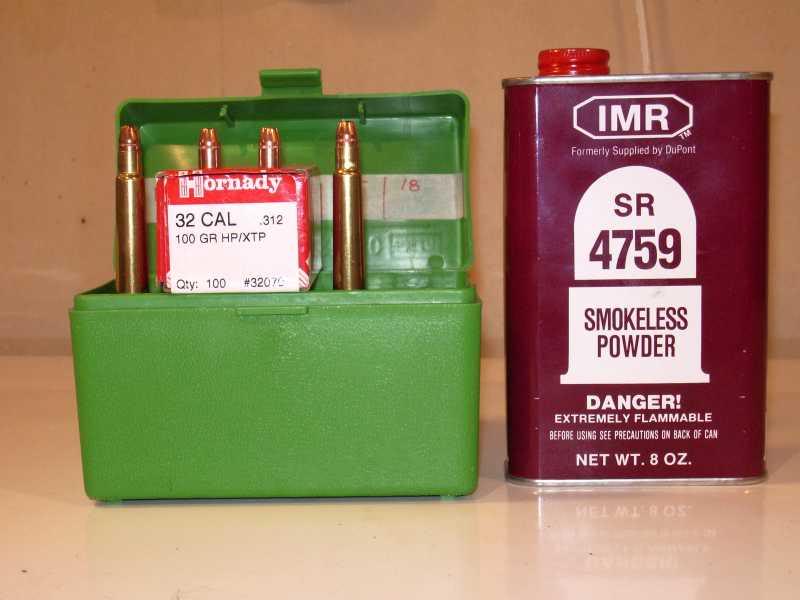
Below I'm using the discontinued SR 4759 powder for reduced loads and make the brass butt plate "softer". And now use Trail Boss as the replacement for it.

HHDfGl9.jpg


I also use reduced loads of Titegroup, 231 and Trail Boss in my .357 and .44 magnum. When I was much younger I would call my shooting buddy and say "Lets go shooting until our hands bleed". I now call him up and ask how his arthritis is doing and if he up to shooting some reduced loads.

Bottom line, there are optimum reduced loads like Cowboy loads and .44 magnum loads that do not scorch and burn the target at 7 yards.

Signed
bigedp51 and his good friend Aleve

aleve-dosage-instructions-800x800.jpg
 
Back
Top Bottom