With the season short on matches and competitions, I still go to the range every week, and have kept from growing bored by making experiments of my own.
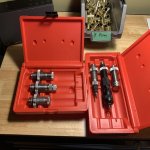
I have set 2 batches of brass aside, each used with their respective die kit.
Each load developed with it’s die kit, as different neck tension equaled different node placement.
Kit #1
Redding body die, Lee collet die, Lee bullet seating die
Kit #2
Forster FLS honed 0.285’’ die with expander ball removed, Sinclair expanding die with 21st century expanding mandrel, Forster micrometer seating die
Here is my take on it so far...
Shoulder bump : Both redding body die and Forster FLS are set to 1.5/2.0 thous shoulder bump, and both have the same consistency in doing it.
Runout : the Lee collet die is a zero thou runout setup, while the Forster die keeps me between 0.5-1.0 thou runout, which is still good but not as perfect as the Lee.
Neck turning : When using the Lee collet die, brass flows a little different than with the Forster FLS die.
While using the Lee, during my neck turning (done every firing due to too tight of a neck on this one), I seem to only shave off 4 vertical grooves, which are obviously caused by the collet.
With my Forster FLS I seem to be shaving the base only, and know there will be a donut there if it wasn’t for regular neck turning.
Bullet tension : On the Lee collet die, it’s factory set for a 2/2.5 thous neck tension. Which causes slight irregular bullet seating depths (0.001/0.002’’ inconsistencies on Ogive). Not to mention the Lee collet is not pleasant to use, I always feel like it’s making my Co-Ax torque in a twisting motion not meant to be, due to the brute force needed to operate this die.
On the Forster FLS honed die setup, my fire case 0.291’’ goes down to 0.285’’ once resized. Back up to 0.2865’’ once expander mandrel passed through, and 0.2875’’ once bullet seated. I love the fact that I can have different mandrels to tune neck tension to my exact liking. At 1 thou neck tension, bullet seating depth is always perfect dead on. In both cases Imperial dry neck lube is applied before sizing necks.
Accuracy/Velocity : load development is slightly different in both scenarios, I blame it on the neck tension.
If both setups we’re running the same tension I’d have a better idea what’s going on.
The Forster die/expander setup win big in this area.
All testing done at 300M with a labradar beside me.
Forster setup have better SD/ES, both low single digit (vs 5 SD/ 10 ES with collet)
Forster setup can go higher in powder loads and in speed without showing pressure signs (would a lower neck tension do that?)
Forster setup has better accuracy, 1/3 moa 5 shot groups being the norm, while having a few 0.20 moa 5 shot groups (while Collet die setup is pretty constant at 1/2 moa never really going under or over).
That’s it for now, if anyone has got anything to share on the subject please do.
While my experiment is not quite over with, it’s coming to an end.
Once I decide on the final outcome I’ll follow through with my other calibers to see what gives!
I have set 2 batches of brass aside, each used with their respective die kit.
Each load developed with it’s die kit, as different neck tension equaled different node placement.
Kit #1
Redding body die, Lee collet die, Lee bullet seating die
Kit #2
Forster FLS honed 0.285’’ die with expander ball removed, Sinclair expanding die with 21st century expanding mandrel, Forster micrometer seating die
Here is my take on it so far...
Shoulder bump : Both redding body die and Forster FLS are set to 1.5/2.0 thous shoulder bump, and both have the same consistency in doing it.
Runout : the Lee collet die is a zero thou runout setup, while the Forster die keeps me between 0.5-1.0 thou runout, which is still good but not as perfect as the Lee.
Neck turning : When using the Lee collet die, brass flows a little different than with the Forster FLS die.
While using the Lee, during my neck turning (done every firing due to too tight of a neck on this one), I seem to only shave off 4 vertical grooves, which are obviously caused by the collet.
With my Forster FLS I seem to be shaving the base only, and know there will be a donut there if it wasn’t for regular neck turning.
Bullet tension : On the Lee collet die, it’s factory set for a 2/2.5 thous neck tension. Which causes slight irregular bullet seating depths (0.001/0.002’’ inconsistencies on Ogive). Not to mention the Lee collet is not pleasant to use, I always feel like it’s making my Co-Ax torque in a twisting motion not meant to be, due to the brute force needed to operate this die.
On the Forster FLS honed die setup, my fire case 0.291’’ goes down to 0.285’’ once resized. Back up to 0.2865’’ once expander mandrel passed through, and 0.2875’’ once bullet seated. I love the fact that I can have different mandrels to tune neck tension to my exact liking. At 1 thou neck tension, bullet seating depth is always perfect dead on. In both cases Imperial dry neck lube is applied before sizing necks.
Accuracy/Velocity : load development is slightly different in both scenarios, I blame it on the neck tension.
If both setups we’re running the same tension I’d have a better idea what’s going on.
The Forster die/expander setup win big in this area.
All testing done at 300M with a labradar beside me.
Forster setup have better SD/ES, both low single digit (vs 5 SD/ 10 ES with collet)
Forster setup can go higher in powder loads and in speed without showing pressure signs (would a lower neck tension do that?)
Forster setup has better accuracy, 1/3 moa 5 shot groups being the norm, while having a few 0.20 moa 5 shot groups (while Collet die setup is pretty constant at 1/2 moa never really going under or over).
That’s it for now, if anyone has got anything to share on the subject please do.
While my experiment is not quite over with, it’s coming to an end.
Once I decide on the final outcome I’ll follow through with my other calibers to see what gives!