












































You are using an out of date browser. It may not display this or other websites correctly.
You should upgrade or use an alternative browser.
You should upgrade or use an alternative browser.
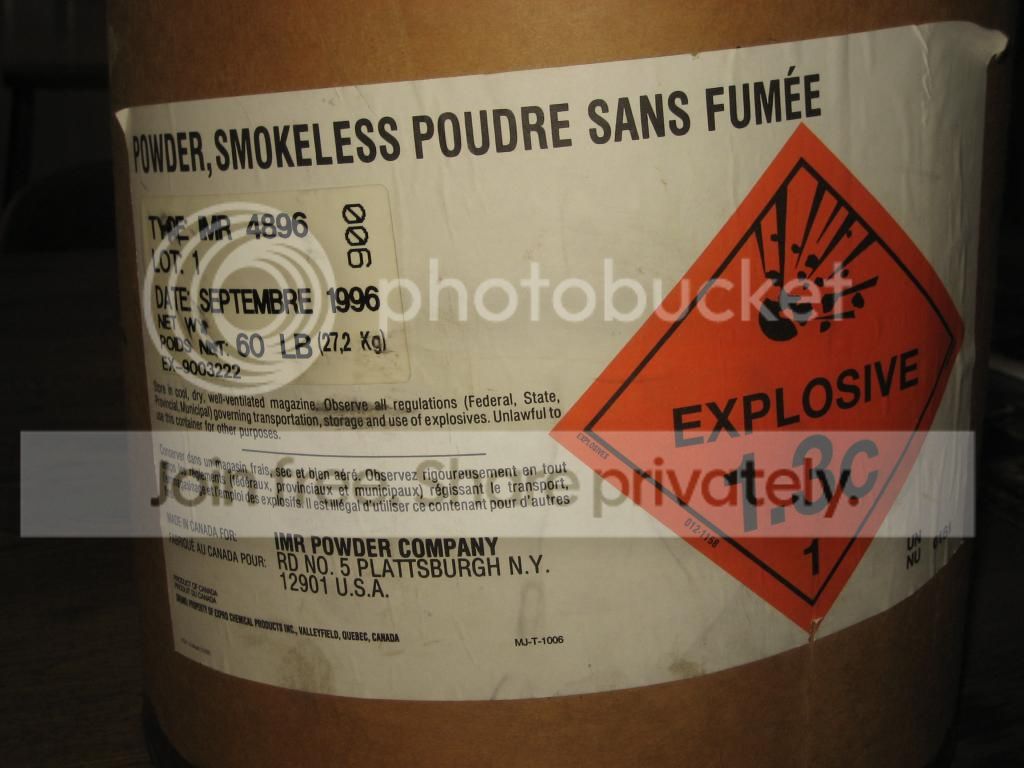
Explain this Powder
- Thread starter Ganderite
- Start date


Aprilia Man
CGN Ultra frequent flyer
- Location
- Canadian "WET" Coast (Raincouver)
1) You found it in your stash hidden way behind your storage container?
2) Some old timer gave it to you?
2) Some old timer gave it to you?


- Location
- West Quebec
Quebecers making powder for New Yorkers..


Umm...
You had IMR design a custom powder tuned exactly to your rifle back in 96 that was modified IMR4895. So renamed to IMR4896 just for you to avoid confusion. One lot was made.
Now you're all out... and seeing if you can get some more.
Good guess?
You had IMR design a custom powder tuned exactly to your rifle back in 96 that was modified IMR4895. So renamed to IMR4896 just for you to avoid confusion. One lot was made.
Now you're all out... and seeing if you can get some more.
Good guess?

- Location
- Saskatchewan
Because it's "lot #1" I'll guess that it is the first test run of rifle powder after the new batch process automation equipment went into service? ( a colleague at work told me he did the process engineering design work for that plant somewhere near that date)

You guys pretty well nailed it. It was a test batch of powder that I called 4896 because it was a variation of 4895.
The test was either a Short Cut experiment or a test where some moly was added to to the process when the graphite was added.
IMR powders were made by Expro, in Valleyfield, Quebec. Development was run by a brilliant Ph.D. chemist, who knew nothing about guns, loading or shooting.
When I tried to explain why I thought some powders should be made as Short Cut, the conversation bogged down when I mentioned the powder thrower. He had no idea what I was talking about. I asked to see the test lab where they made test ammo. They used a scales, a bowel of powder and a teaspoon. They didn't even have a powder trickler. They didn't have a loading block to hold the cases, either.
On my next visit I brought them a care package of loading equipment.
A test batch of powder was 800 to 2000 pounds. They would run a few tests on it and then I would use it for loading real ammo to see how it worked. Some of it got sold to the target rifle and benchrest crowd to try out.
The 4895SC worked well and was well received by shooters. Expro called it a total failure because so far as they could see, the results were identical to regular 4895. A well known American shooter wrote them a letter, begging them not to destroy the remaining powder. I had sent him a sample to try out, and he liked it. What Expro did not know was that the shooter's day job was a procurement officer for US Army ammunition.
When Hodgen got involved with Expro, the first thing they did was start making short cut powder, about 15 years after I tried to get it going.
Did you ever wonder where the funny numbers to name powders came from? A few companies use a logical progression of numbers to indicate burn rate (RL7 is faster than RL19). In the case if IMR, it is an experiment or project number.
As a R&D guy, you are issued a notebook where you record ideas, project specs and project results. You are assigned a block of numbers, listed on page 1. Your block might be 3000 to 3500. If I want to test moly as a powder coating, it might be test 3218 in my notebook. In the IMR system, if the powder went into production, it would be IMR3218.
The test was either a Short Cut experiment or a test where some moly was added to to the process when the graphite was added.
IMR powders were made by Expro, in Valleyfield, Quebec. Development was run by a brilliant Ph.D. chemist, who knew nothing about guns, loading or shooting.
When I tried to explain why I thought some powders should be made as Short Cut, the conversation bogged down when I mentioned the powder thrower. He had no idea what I was talking about. I asked to see the test lab where they made test ammo. They used a scales, a bowel of powder and a teaspoon. They didn't even have a powder trickler. They didn't have a loading block to hold the cases, either.
On my next visit I brought them a care package of loading equipment.
A test batch of powder was 800 to 2000 pounds. They would run a few tests on it and then I would use it for loading real ammo to see how it worked. Some of it got sold to the target rifle and benchrest crowd to try out.
The 4895SC worked well and was well received by shooters. Expro called it a total failure because so far as they could see, the results were identical to regular 4895. A well known American shooter wrote them a letter, begging them not to destroy the remaining powder. I had sent him a sample to try out, and he liked it. What Expro did not know was that the shooter's day job was a procurement officer for US Army ammunition.
When Hodgen got involved with Expro, the first thing they did was start making short cut powder, about 15 years after I tried to get it going.
Did you ever wonder where the funny numbers to name powders came from? A few companies use a logical progression of numbers to indicate burn rate (RL7 is faster than RL19). In the case if IMR, it is an experiment or project number.
As a R&D guy, you are issued a notebook where you record ideas, project specs and project results. You are assigned a block of numbers, listed on page 1. Your block might be 3000 to 3500. If I want to test moly as a powder coating, it might be test 3218 in my notebook. In the IMR system, if the powder went into production, it would be IMR3218.


If you write a book, I will buy it.
I'd buy a copy.

I'd buy a copy.
Don't copy that floppy!

PitBull1973
CGN Ultra frequent flyer
- Location
- Right Behind You
It's great to have a man like you around when we're shooting CQB
It's great to have a man like you around when we're shooting CQB
?? I hobble along behind my walker trying to keep up to you kids. What's so great about that?























