Far east .577 Snider

The Hackmaster

CGN Regular
Rating - 100%
30   0   0
Hey all. I've recently come into possession of a snider enfield conversion with punjabi (I think?) serial numbers. I have experience loading black powder cartridges and access to the tools required to produce ammo for this, but I have never owned something this old. My question is, how do I clean the gunk you see in the pictures off without harming the rifle? It was my uncles wall hanger for almost 40 years and was probably not cleaned in this time, any input would be great.

IMG_0143.jpg
close up of the serial number on the buttplate
IMG_0142.jpg

IMG_0138.jpg

IMG_0141.jpg

IMG_0137.jpg

IMG_0140.jpg

IMG_0139.jpg

IMG_0136.jpg
 
Looks like one of the nepal cache guns to me.

If it was me i would strip the whole gun apart, scrub all the parts lightly with hot soapy water and then oil.

Leave the stock as is or add a couple coats of tung or linseed oil to it.

these guns are alot of fun to shhot !
 
and when outta brass use 28 ga. shells and wrap a small piece of paper around the hull to get the right fit..lol
 
Cool. I'll try the soapy water when I get home tonight. 24 gage brass shotshells don't sound like somthing you buy at wholesale sports tho. I wonder if any of our supporting dealers carry them?
 
Your rifle appears to be a Nepal-made version of the Snider-Enfield. (A British-made rifle would have distinctive markings on the lockplate, and would have British inspection marks on all metal parts.)

I understand that the chamber dimensions of these Nepali rifles can vary considerably .....

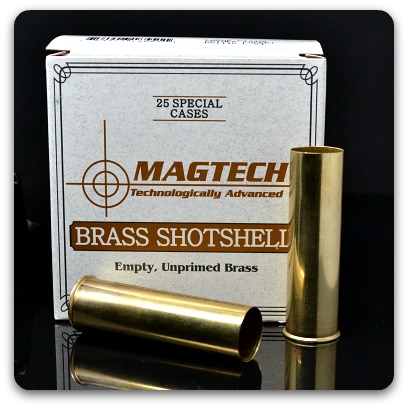
24 gauge all-brass shotgun shells can be relatively easily formed into snider sases, though they do need to be shortened somewhat, and re-sized a bit.

The currently available all-brass 24 gauge shotgun cases (and other sizes) are manufactured in Brazil (headstamped "CBC") and distributed in North America under the MagTech name -

magtechLG.jpg


(Note: these brass shotgun cases use Large Pistol Primers, not shotgun primers.)

They are listed here by Ballistic Products -
http://www.ballisticproducts.com/MagTech-Brass-Shotshells/products/202/

I'm not aware that any of the CGN sponsors carry these cases, but they can be ordered through Bilozir Fine Guns in De Winton, Alberta (just south of Calgary) - who carry most of the product line of Ballistic Products .... you'll have to contact Will Bilozir to inquire about Canadian prices and shipping cost -
http://www.bilozir.net/index.php?option=com_content&view=article&id=51&Itemid=56
 
Cool. I'll try the soapy water when I get home tonight. ...

Mineral spirits/varsol should be OK on the metal parts as it's pretty mild. It will soften and help dissolve old grease and oil. If you prefer water-based, a med. solution of Simple Green would probably do the trick, too.

:) Stuart

(ps- Love the sig. line.)
 
theres some plastic 24ga hulls already primed on gunaddicts right now there better suited for the nepal sniders (there knowen for beating up brass that chambers are not compleatly round on most of them so if you do use brass what you would want to do is mark the case and use it to index the case you would not even need to use sizing dies)

but a 24ga shell(brass or plastic) and a .600 round ball would do the job

by the looks of it you snider has 3 grooves(idk if this is true with the nepal guns) but most 3 groove sniders are around 1 in 78 twist it mite be more suited to round ball and short coincals
 
Last edited:
Please .... it's Snider ;) (.... or, more precisely, Snider-Enfield, since the design was a means of converting Enfield muzzle-loading rifles to breechloading using the Snider system ....)

The .577 Snider-Enfield cartridge was black powder, of course, and considering the age of these firearms (and the fact that the Mark I and Mark II versions have iron barrels rather than steel) in my view it is best to stick to that propellant when loading.

Generally, black powder loads for cartridges which were originally loaded with that propellant are very simple - fill the case with a suitable grade of black powder (F or FF.) What you are trying to do is fill to a point just above where the base of the bullet will seat (so the powder ends up slightly compressed in the finished cartridge - this should be in about the range of 70 grains weight) and then seat the bullet.

Many people don't even use loading dies, especially if they only have one rifle to shoot because the cases will be fire-formed to that particular chamber, and normally won't enlarge beyond that point. Bullets - lubricated with a proper black powder lube, to help keep the fouling soft - can then just be finger-pressed into the neck of the cartridge. If the cartridges are just going to be shot at a range and thus won't be jostled around a lot (such as would happen if they were carried around out in the field for extended periods of time) crimping isn't really necessary, because the rifle is a single-shot.

Any airspace in a black powder cartridge is generally considered to be a "no-no" - because of possible excessive pressure spikes, and resultant danger of ringing the chamber if not actually causing a barrel failure. If you wish to reduce the powder charge in a straight-walled black powder cartridge such as the .577 Snider, place a suitable amount of something like coarse corn meal or cream of wheat (.... dry form, of course! ....) on top of the reduced powder charge, to bring the top level up to the same point in the case as a full powder charge, then seat the bullet.

For what it may be worth, here is the British War Department "List of Changes" entry for the Mark I Snider-Enfield cartridge -

snidr02.jpg


A somewhat more complicated approach - though still pretty simple - uses a "grease cookie": a thin (e.g. 1/16" to 1/8") disk of lubricant sandwiched between two card wads (milk carton material is ideal) between the powder and the bullet. This affords extra lubricant - which squeezes out in the bore as the bullet travels down the bore. The card wads are needed to prevent migration of the lubricant into the powder charge, on the one hand, and to prevent the remnants of the grease cookie from sticking to the base of the bullet .... which can cause erratic ballistic performance.

An excellent black powder lube can be made by mixing equal parts of olive oil and melted beeswax ......
 
Yes but is the aforementioned 24ga brass shell a suitable substitute for SNIDER brass? (got it right that time!)

Yes, they are a practical (and economical) way of getting brass for a Snider. However, they do have to be shortened, and also sized down a wee bit. Anyone with a set of dies for .577 Snider can do that with the sizing die ....
 
Lee Precision make a set of .577 Snider dies, which are probably the most economical .... so anyone who carries Lee Precision products can probably order a set in for you - not likely something most dealers would keep on hand, of course .... ;)

These dies tend to size down the neck of the case too much for most needs .... I believe they were designed to emulate the case-mouth dimensions of original .577 cartridges (which always used an under-bore-size expanding bullet) ..... and also so cartridges loaded with them would fit in the tightest possible surviving chambers .....

Most surviving Sniders don't need the case sized down so much ..... if at all. ..... Full-length sizing with the de-priming/sizing die from this set accordingly ends up causing excessive working of the brass, because the case mouth just gets blown out to near full chamber size each time it is fired .... then gets necked way down again on reloading, and so on.

You could certainly use the sizing die in initial forming of your cases from 24 gauge brass shotgun hulls .... but, as mentioned above, if you are going to be firing the cases in the same rifle each time, you would be best to subsequently use that die for de-priming only.

Another important reason for wanting to avoid sizing down the case mouths so much is that the overwelming consensus of opinion among Snider shooters nowadays is that much better and more consistent accuracy is achieved by using an over-bore-size bullet (ranging from, say, .485" up to as much as .600") rather than the sub-bore-size bullets originally used (and for which these dies seem to be designed.) By the way, some people report getting good results, particularly with the slow-twist (1 turn in 78") three-band Long Rifles, just using a .590" to .600" round ball pressed into the case mouth, instead of an elongated bullet.

Keep in mind that when the original Snider cartridge was developed, they were just emerging from the muzzle-loading era, and didn't seem to have a grasp of the concept of a larger-than-bore-size bullet for best engagement of the rifling, which of course became standard for breechloaders. Instead, they kept trying to use sub-bore-size bullets with expanding bases, as were used in the muzzle-loading Rifle Muskets .... and never did get them to work properly.

The base skirt of a Minie-type bullet must be able to expand at the very instant of ignition of the powder charge ..... but a similar bullet loaded into a cartridge case is constricted from doing so until the base of the bullet clears the case mouth! Even though the Snider-Enfield system was a temporary 'stop-gap" pending adoption of the Martini-Henry rifle, the British War Department went through no less than nine versions of the .577 cartridge between August 1866 and August 1871, trying to achieve consistent results! (It apparently never occurred to them to try a larger-diameter bullet .....:rolleyes: )

 
Hmm interesting! Thanks, it would be nice to do up some loads for a range day...
Where could I get a set of .577 snider dies?

lee makes a set for about $120+ shiping to canada and your going to need a press that can take a 1 1/4 x 12 thread(lee classic cast press with the bushing removed) after you trim the brass run into throught the sizing die and then the expanding die, seat the bullet and fire it you will not have to resize the brass again make sure you deprime and clean the case with hot soapy water.

id use fg blackpowder and a .600 pure lead round ball pushed on the wads and grease cookie to start. depending on the number of grooves in the barrel 3 is 1 in 78 and 5 in 1 in48 the 3 grooves like short and light conicals and roundballs and the 5 groove will like longer coincals it should work ok with round balls but dont count on good groups(id stay away from minie balls and go for atleast a .585 bullet). GrantR seems to be a bit more knowledgeable then me on this subject he could enlighten us a bit more on it.

theres many ways to load the snider even plastic 24ga shotshells hulls work (recommended for the nepal sniders because the chambers are not round)
 
antiqueguy is correct ..... I meant to mention that .577 snider dies are a larger diameter than normal loading dies, and that you need a press which will accommodate that size. I believe that most good-quality single-stage presses now on the market have this feature (with a threaded bushing for when you want to use regular-size dies.) I believe that the Lee Classic Cast press is the most economical one, and quite readily available .... and is the press I now use for this type of loading. (I had an RCBS Rock Chucker for years, but it was the old model without the capability for larger dies, so I gave it to my nephew. The newer Rock Chucker Supreme does have the bushing for two different sizes of dies ....)


Coffee drinkers have access to the ideal method cleaning up black powder cartridge cases - a year or two ago I learned of a very effective alternative to the traditional "soapy water". It involves using a metal coffee can (the kind with a tin lining, not the kind which now have a plastic-like lining) partially filled with water and with a tablespoon or two of ground coffee added. You throw your fired cases into it as soon as possible (.... ideally, you take it right to the range with you ....) and let them soak for at least an hour or two. When they come out, they won't be shiny and clean by any means .... but you just wipe them reasonably dry and/or let them drain and fully air-dry. When subsequently run through the tumbler, they will come out looking like new .... without the seemingly permanent staining that black powder often imparts to cartridge cases.

I don't really understand how this works - I suspect there is some sort of galvanic reaction taking place (the can will start to rust on the inside after just one or two uses, and eventually will have to be replaced) and also that the coffee, which contains alkaloids, must neutralize the acidic black powder fouling - but it certainly does seem to work for me.

A friend of mine discovered this by accident, when he was in a rush to go to the range one day, and didn't want to take the time to find his usual "brass soaking container" and then prepare his usual soapy water solution. Instead, he grabbed a coffee can which had just been emptied (although it had a bit of the coffee which wouldn't empty out past the lip remaining in the bottom) and was sitting on the counter - filled it half full of water and took off. He was amazed at how much cleaner and shinier the brass soaked in this container turned out, after being tumbled, than when soaked in the traditional soapy water. Subsequent hit-or-miss experimentation showed it doesn't work in a can with a plastic lining, nor in any sort of plastic or glass container - it definitely seems to need both the tin-lined can and the coffee. (I have since been told that this "secret" has been known and used for years by black powder shooters in Australia.)
thsmiley_drinkcoffee-1.gif
lovecoffee.gif
 
Back
Top Bottom