













































From time to time there is a post asking what powder would be best for a shorter rifle barrel. Conventional wisdom is that the powder that gets the best velocity in a long barrel will also be the fastest in a short barrel.
Another issue is the muzzle blast in a short barrel. Would the unburned powder from a shot barrel increase the muzzle blast?
I made up about 100 rounds of ammo (2 of each load - 1 for each barrel length) and shot them for velocity.
The Rifles
Shultz Larsen M54 with a Sportco 24" barrel, 0.300 x 0.307". SAAMI Minimum Match Chamber
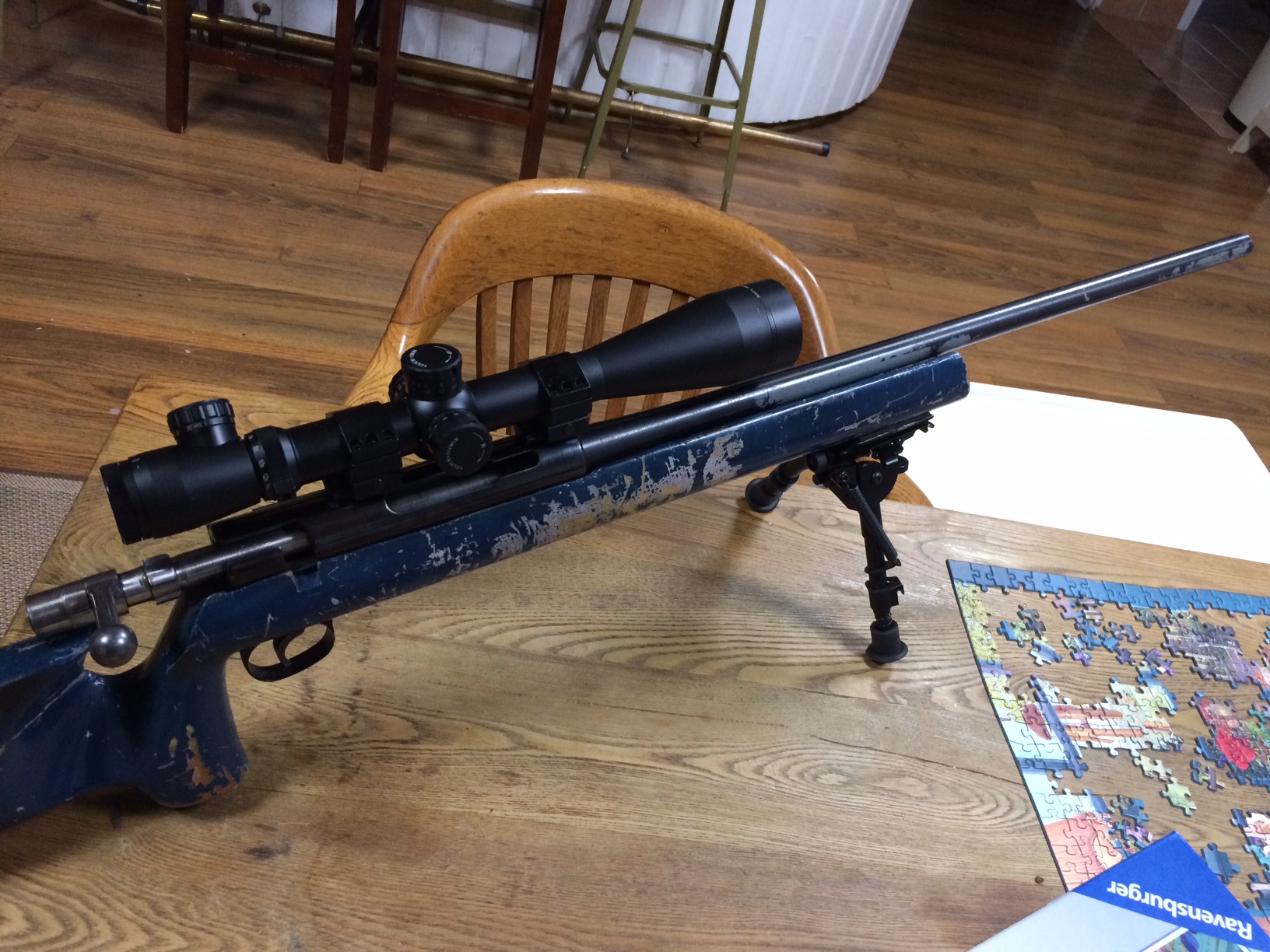
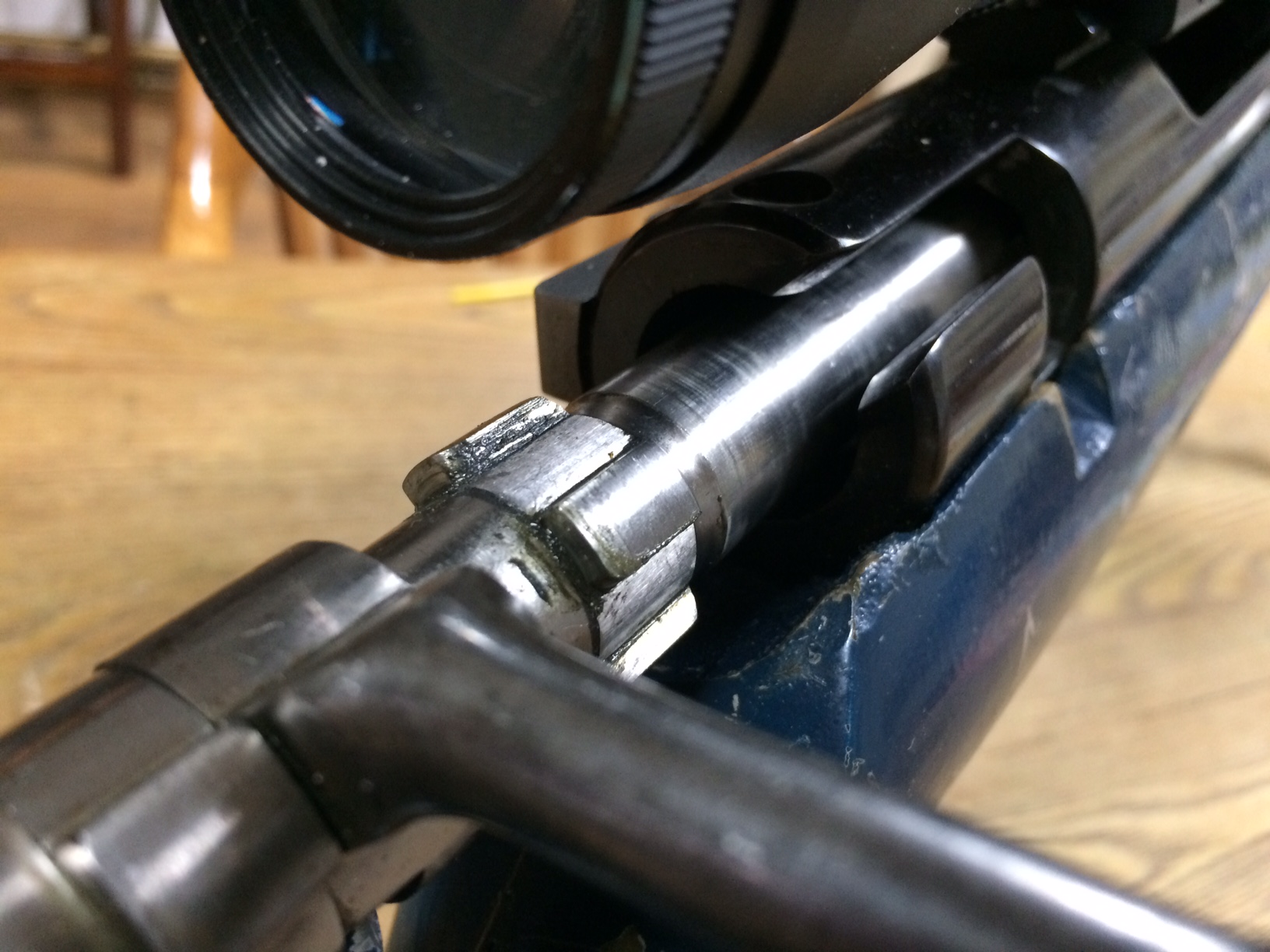
This is a very heavy action with thick receiver walls and 4 lapped locking lugs. It will take brass to destruction (80,000 psi) without issue.
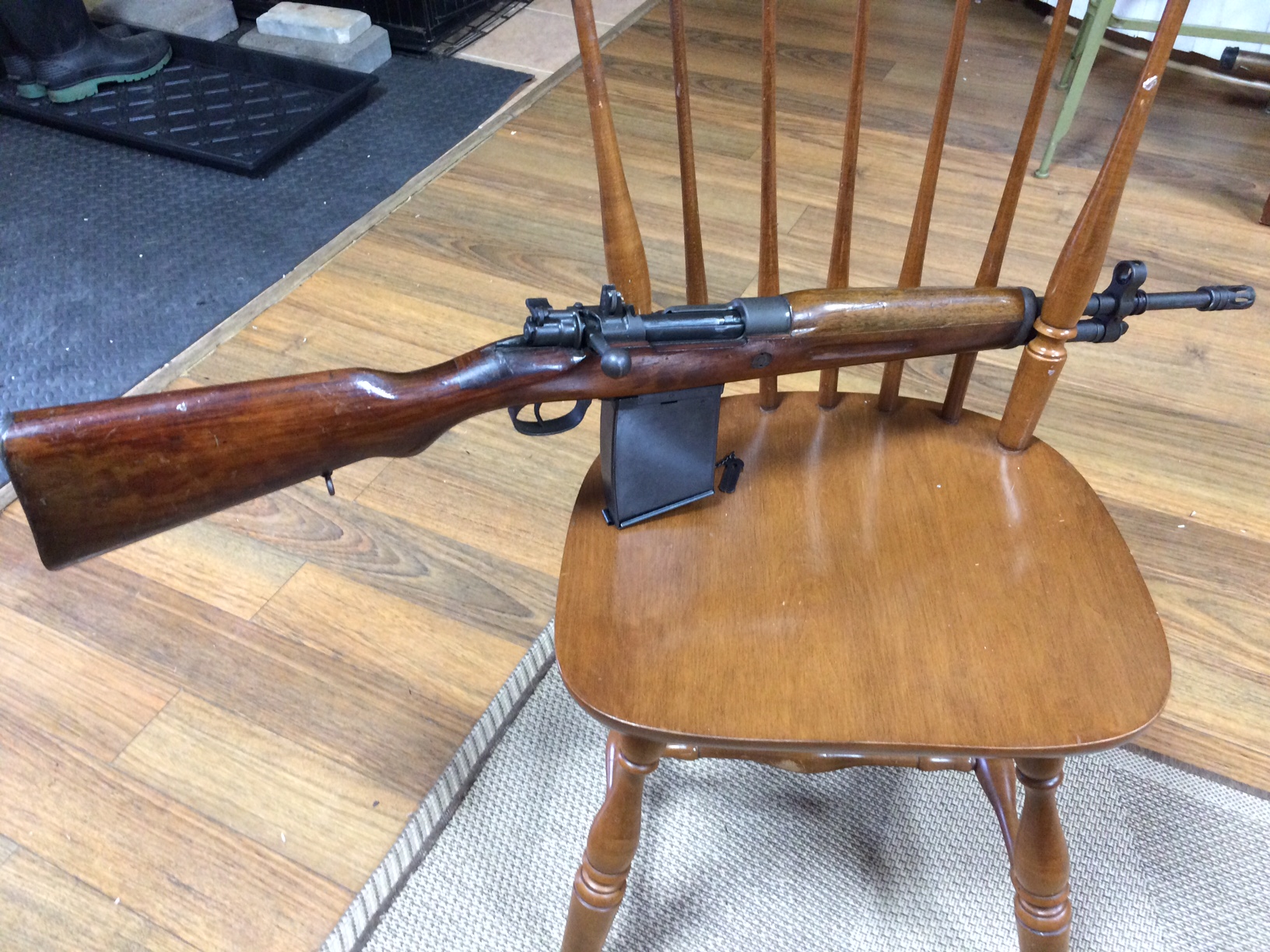
Mauser 98 (FR8) with 18" barrel. Unknown chamber and barrel dimensions
Muzzle blast. Neither I nor anyone around me noticed anything unusual about noise. The shorter barrel was a bit louder, but not obnoxious. I was wearing good muffs.
I have had several short-barreled rifles: A 17" 30-06, a 18" 30-06, a 17" 308 and a 18" 308. The muzzle blast can be either the usual load bang or a painful bark. The painful bark occurs when a cloud of gasses ignites. This has nothing to do with the speed of the powder or unburned powder. It is a characteristic of some powders to cause an exploding fireball.
No fireballs were noted today.
I tested two different bullet weights. The Sierra 125gr spitzer and the Sierra 180 gr Match. These were chosen because I had enough of them for the test.
The "fast" powder used to test the theory that it would be better than a slow powder in a short barrel was Winchester 680. My jug is not a canister grade, so I do not know how it would compare to retail 680 and 1680. Both bullet weights were loaded with this powder.
To test that a conventional powder is best in any length barrel (and to compare to the Win680 loads) I loaded the 125s with 4895 and the 180 with RL15.
It would have been nice to run this test in rifles equipped with pressure strain gauges. Then the velocities at the same pressures could be compared. But I no longer have those rifles.
So I loaded a string of loads in increasing increments, with the intention of stopping when I got sticky extraction. In my M54, that occurs around 80,000 psi. (At that level, the brass is trashed.)
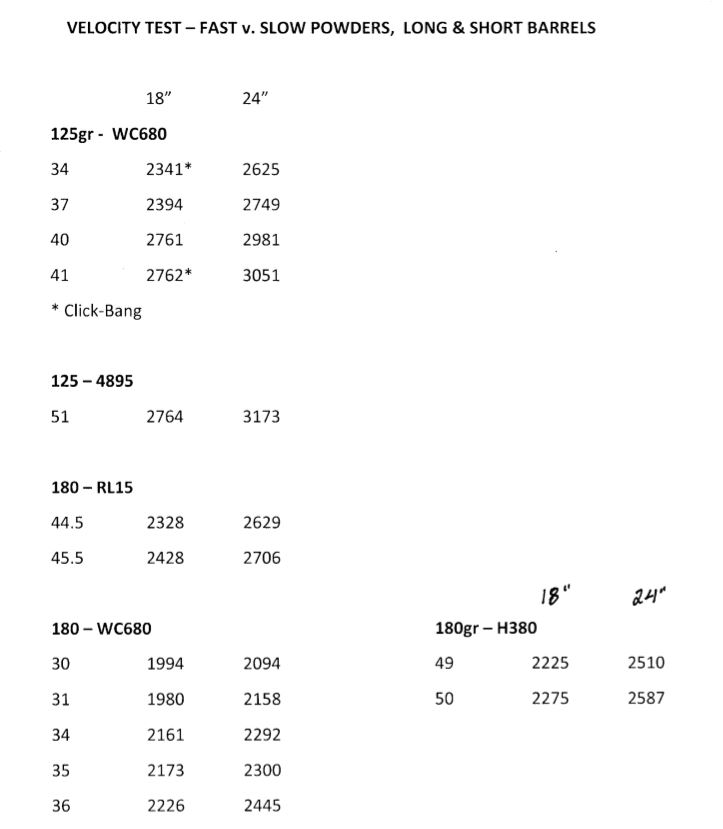
The loads in this table are not recommended loads. Most are way over maximum. I was trying to see if there was anyway to get WC680 in a short barrel to shoot a similar velocity as a slow powder.
The book Max load of RL 15 under the 180gr bullet got 2328 fps in the 18” barrel. I loaded 680 under that bullet up to 36gr, which destroyed the brass and got 2226 fps – 100 fps LESS.
I tried to load the book Max of 53gr of H380 under the 180 gr bullet, but even with a drop tube and compression I could only get 50 gr. 49 gr was 3 gr under published Max and it got the same velocity as the brass destroying 36 gr of WC680.
There was another issue, that I should have thought of. Ball powders are harder to ignite. A lighter bullet makes ignition worse, as does a lot of airspace. The 680 loads sometimes gave me the click-bang I am familiar with when loading ball powder with light bullets.
I should have used 4198.
Anyway, in conclusion: The Max load of RL15 and a load of H380 3gr (slower than RL15) under book max produced high velocities than the fast powder, even at 80,000 psi. When loading for a short barrel, use the same powder you would use with a longer barrel. Work up and develop your accuracy load as per usual.
As for muzzle blast, if your short barrel is making a painful ball of fire, change powders. Some powders do it. Some don’t.
Another issue is the muzzle blast in a short barrel. Would the unburned powder from a shot barrel increase the muzzle blast?
I made up about 100 rounds of ammo (2 of each load - 1 for each barrel length) and shot them for velocity.
The Rifles
Shultz Larsen M54 with a Sportco 24" barrel, 0.300 x 0.307". SAAMI Minimum Match Chamber
This is a very heavy action with thick receiver walls and 4 lapped locking lugs. It will take brass to destruction (80,000 psi) without issue.
Mauser 98 (FR8) with 18" barrel. Unknown chamber and barrel dimensions
Muzzle blast. Neither I nor anyone around me noticed anything unusual about noise. The shorter barrel was a bit louder, but not obnoxious. I was wearing good muffs.
I have had several short-barreled rifles: A 17" 30-06, a 18" 30-06, a 17" 308 and a 18" 308. The muzzle blast can be either the usual load bang or a painful bark. The painful bark occurs when a cloud of gasses ignites. This has nothing to do with the speed of the powder or unburned powder. It is a characteristic of some powders to cause an exploding fireball.
No fireballs were noted today.
I tested two different bullet weights. The Sierra 125gr spitzer and the Sierra 180 gr Match. These were chosen because I had enough of them for the test.
The "fast" powder used to test the theory that it would be better than a slow powder in a short barrel was Winchester 680. My jug is not a canister grade, so I do not know how it would compare to retail 680 and 1680. Both bullet weights were loaded with this powder.
To test that a conventional powder is best in any length barrel (and to compare to the Win680 loads) I loaded the 125s with 4895 and the 180 with RL15.
It would have been nice to run this test in rifles equipped with pressure strain gauges. Then the velocities at the same pressures could be compared. But I no longer have those rifles.
So I loaded a string of loads in increasing increments, with the intention of stopping when I got sticky extraction. In my M54, that occurs around 80,000 psi. (At that level, the brass is trashed.)
The loads in this table are not recommended loads. Most are way over maximum. I was trying to see if there was anyway to get WC680 in a short barrel to shoot a similar velocity as a slow powder.
The book Max load of RL 15 under the 180gr bullet got 2328 fps in the 18” barrel. I loaded 680 under that bullet up to 36gr, which destroyed the brass and got 2226 fps – 100 fps LESS.
I tried to load the book Max of 53gr of H380 under the 180 gr bullet, but even with a drop tube and compression I could only get 50 gr. 49 gr was 3 gr under published Max and it got the same velocity as the brass destroying 36 gr of WC680.
There was another issue, that I should have thought of. Ball powders are harder to ignite. A lighter bullet makes ignition worse, as does a lot of airspace. The 680 loads sometimes gave me the click-bang I am familiar with when loading ball powder with light bullets.
I should have used 4198.
Anyway, in conclusion: The Max load of RL15 and a load of H380 3gr (slower than RL15) under book max produced high velocities than the fast powder, even at 80,000 psi. When loading for a short barrel, use the same powder you would use with a longer barrel. Work up and develop your accuracy load as per usual.
As for muzzle blast, if your short barrel is making a painful ball of fire, change powders. Some powders do it. Some don’t.


 .....
.....






















