Finding the right ammunition

horseman2

CGN Ultra frequent flyer
Rating - 100%
163   0   1
Location
Fraser Valley
One problem solved then some unexpected results.
A Bushnell 6-24x scope on my pre A Winchester model 52. The bolt knob struck the power ring so the best setting was 22X.
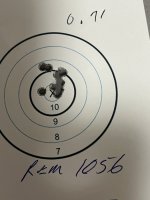
Bought a used Sightron 8-32X scope and installed it. Sighted in for 100 yards and testing different ammunition. A lot of REM Eley Match with a velocity of 1056 produced a ten-shot group that measured 0.71” c-c. None of my other rifles like that lot number.
1786164986636.jpeg
 
Other than the group shown in the first post, you didn't shoot any other groups with that ammo?
I'm a bit new into precision 22lr so am learning as I go. I started taking my Garmin with me for testing. ES and SD are just as telling as group size.

Shot some Eley Sport and Club in my Walther last week. The results on paper and the Garmin were less than stellar.

.
 
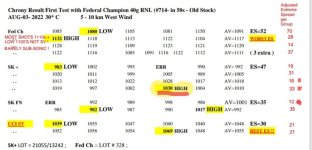
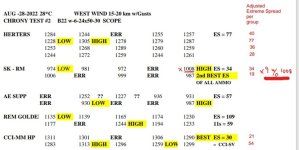
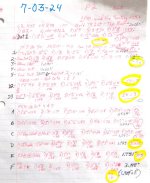
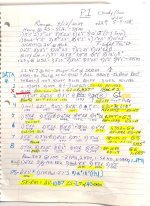
Just some base info from when I did extensive chrony with my Sav-B22 and my CZ457-VMTR. I realize it doesn't mean a lot for 'other rifles' but will give a general idea of the diff brands data.

zz 2022 Chrono Tests in B-22  #1.jpg

zz 2022 Chrono Tests in B-22  #2.jpg

z Range Notes 7-03-2024 CHRONO.JPGz Range Notes 9-12-24 Pg-1  CHRONO.jpg
 
Last edited:
I'm a bit new into precision 22lr so am learning as I go. I started taking my Garmin with me for testing. ES and SD are just as telling as group size.

Shot some Eley Sport and Club in my Walther last week. The results on paper and the Garmin were less than stellar.

.
Rimfires are rolling dice. You can have shots with same velocity land a inch between each other.

While I got a Garmin, I doubt Im going to chrony every round out of my rimfire.
 
That was the 1st time I ever used the Garmin to check 22lr. I wouldn't do it on every round but it did point to the flyers with FPS changes outside the average.

I would do it again for interest sake
But one of Glenn post that showed the shot and velocity, there were difference. Simular velocities shot was spaced out. Some lower velocity were higher, higher lower, basically all over, made no real sense. Other than must be wind and other factors. So low ES/SD in rimfire doesn't mean the same hole.

Why I just shoot. Waste a brick just trying to find the right ammo. Then stuck trying to find more.
 
But one of Glenn post that showed the shot and velocity, there were difference. Simular velocities shot was spaced out. Some lower velocity were higher, higher lower, basically all over, made no real sense. Other than must be wind and other factors. So low ES/SD in rimfire doesn't mean the same hole.

Why I just shoot. Waste a brick just trying to find the right ammo. Then stuck trying to find more.
I guess for me, I'm more used to using ES/SD for centerfire and am in that same frame of mind for rimfire. I'm learning.

We do get a lot of wind at our range overlooking the Bay of Fundy. Drives the "Old Guys Rimfire Shooters" crazy. :)
 
Rimfires are rolling dice. You can have shots with same velocity land a inch between each other.

While I got a Garmin, I doubt Im going to chrony every round out of my rimfire.
And if you shoot enough shots in a test, and keep track of the muzzle velocity for each POI, you can determine whether or not this is happening because of the ammo itself or because of how the ammo/barrel pairing is behaving. Two shots with the same muzzle velocity can have a fair bit of variance in barrel time. Variance in firing pin force on the rim, variance in rim thickness, variance in brass hardness, variance in primer compound amount and mixture, variance in powder amount and mixture, variance in lube amount and mixture, and maybe some other stuff can all have an effect on barrel time. And a difference in barrel time results in a different launch angle.

If you know which areas of math can help you in given situations then you can figure out why various things are likely happening. You can determine how muzzle velocity and POI are correlated with each other. Then you can figure out whether or not that ammo is suitable for that gun. If you see a significant positive correlation then you know to steer clear of that particular lot of ammo because it will never shoot because it is exiting the muzzle during a downswing. If the correlation is close to zero, and preferably close but slightly on the negative side, then you know you could have very good luck with that lot number. If the correlation is really negative then you know you can probably tame it with a muzzle device of some sort, preferably an adjustable one, and move it towards zero.

You can also figure out how quickly the barrel is swinging at average muzzle exit time with that particular lot of ammo. That lets you figure out the target distance at which you'll see the smallest amount of dispersion for that ammo/gun pairing. The barrel is largely doing the same thing with every shot regardless of the ammo, but the ammo's behaviour determines when in that cycle of barrel movement muzzle exit happens, and that changes the average behaviour you'll see with that ammo/gun pairing. I've brought this up several times with regard to silhouette shooting. You want to find ammo that pairs with your gun to give you an optimal target distance that's as close as possible to the turkeys at 77 m in order to give you the smallest overall amount of dispersion for all four animals, 40 m, 60 m, 77 m, and 100 m. Or if you're shooting 50-yard benchrest then you probably don't want ammo that shoots best out of that gun at 95 yards.

Math can tell you a ton of different things, as long as you don't mind learning some math. You can learn some of the same things without bothering with math, but it can take a lot longer to get there, and more ammo. Which can also be fun. But it might be more fun to arrive at the answer sooner so you can get more enjoyment from living with the better results for a longer amount of time. :)
 
The best way to figure out whether an ammo is suitable for a rifle is not so much with math but with target results.

Shorty is absolutely correct that two shots with the same muzzle velocity can have a fair bit of variance in barrel time. MV alone doesn't determine POI. While the bullet goes down the barrel, the muzzle is in motion. The motion is imperceptible to the eye, but it moves, usually in an elliptical motion. Barrel time (the precise time the round is in the barrel before it exits the muzzle) determines where in the motion cycle the muzzle happens to be. The angle of the muzzle is the launch angle.

The unknown is always the barrel time. Shooters don't know the barrel time. With typical match barrels about 25" in length barrel time will be about 2.5 milliseconds (a millisecond is 1/1000th of a second). How much variation there is in round-to-round barrel time is the unknown part of the problem. A poorer lot will have more barrel time variation than a better one.

Barrel time consistency is dependent on the uniformity of the ammuntion. The more uniform it is, the more identical the components and how they are assembled, the more consistent barrel time will be. If ammo was always absolutely uniform to specifications -- identical from round-to-round -- it would shoot better than any other ammo in every good barrel because each round would behave the same way with the same barrel time.

A lot with more barrel-time inconsistency will produce more launch-angle variation and conversely, a better lot (lower barrel-time variation) produces tighter launch-angle consistency.

Math can be used to estimate barrel time variation by evaluating vertical spread on the target. Unfortunately vertical spread is not always a consistently reliable input as there are factors in addition to launch angle that can influence POI.

While no one should shy away from using math to help solve problems, it can be awfully difficult when there are key unknowns in the equation.
 
Unfortunately vertical spread is not always a consistently reliable input as there are factors in addition to launch angle that can influence POI.
Yes, but it all tends to be normal data. And stats lets you see the magnitude and shape of that normal/bell curve. A certain amount will perform within +/- 1 SD, and a certain amount within +/- 2 SD, and so forth, which also accounts for the fliers. The fliers simply live in the extremities of the curve. There's nothing we can do about how well the ammo is manufactured, or environmental effects, but we can measure what a given sample does in our gun(s) and get predictions from those obervations with enough of them.

I'll give an example. Here's a test I did a long while back with my Win52D's factory barrel and the mid-barrel tuner that came with the gun when I bought it. The Spearman's rank correlation coefficient between delta Y (elevation on target) and velocity for Win52D mid-barrel tuner:

test-1-without.csv is: -0.528 (p-value = 0.007)
test-2-without.csv is: -0.317 (p-value = 0.122)
test-3-with.csv is: 0.138 (p-value = 0.511)
test-4-with.csv is: 0.208 (p-value = 0.319)

With the first ammo tested in test 1 the barrel was clearly in an upswing, which is what the negative correlation value tells you, with a very trustworthy answer, which is what the p-value tells you. Lower p-value is more trustworthy. The second ammo in test 2 also exited during an upswing, but was slightly more erratic, as seen by the higher p-value. The higher that value gets, the less you can trust the correlation value because it seems to be more noisy data. Then test 3 is with ammo 1 again, but with the mid-barrel tuner installed at some particular location. The p-value is much worse, so noisier data that's much less trustworthy as a result, and now the barrel is in a downswing since the correlation value is now positive. And test 4, still with the same tuner location, shows something similar for ammo 2.

My suspicion in this case was that the barrel's motion was near one of the reversals in the motion cycle where it goes from downswing to upswing, and the installation of the mid-barrel tuner at that location slowed the overall motion down enough such that bullet exits were now on the other side of the upswing trough and into the downswing portion of the motion cycle. Possibly with some exiting very near or slightly on either side of that trough, and this is probably what's causing there to be a lot more noise in the data making it much less trustworthy. If it had been solidly on the other side of the trough rather than perhaps sometimes straddling it then I believe the p-value would be a bit lower, showing more trustworthiness that all shots were leaving during the downswing. Overall, the noise that the ammo's characteristics bring to the picture should be more or less stable, so substantially more noise in the data would tend to indicate something different on the side of the gun's behaviour.

Is that something you could determine with just shooting? Well, you would definitely be able to tell something was wrong due to the increased vertical stringing. It might be harder to tell where to go from there without this kind of data, though. In this case, I would know that the barrel was being slowed down too much because bullets were no longer exiting during an upswing and I would have to search the middle ground to find the optimal region, as it clearly goes from an upswing that's a bit too fast to a downswing between the two tests. Since it was already in an upswing, which is what you want, you wouldn't want to stray too far from that. The goal would be to get the upswing into a favourable speed range for that target distance. It gets tricky when you're in the neighbourhood of a crest or a trough since you instead want to exit during a stretch of time where the motion is always in the same upward direction. Get everything just right and that correlation value drops near zero, indicating it can't tell if muzzle velocity is making any difference in elevation on the target anymore because more and more shots just go into the same spot.

 
Finding the “right” ammo is a crap shoot. Can’t find any Center x or 10 x around here. Even SK+ is not stocked local. Everything is online. I do agree that the target group is my deciding factor.

 
Finding the “right” ammo is a crap shoot. Can’t find any Center x or 10 x around here. Even SK+ is not stocked local. Everything is online. I do agree that the target group is my deciding factor.


Yeah, the ammo situation has been bad for so long now. Sucks. Miss the days of actually being able to lot test even the cheapest Eley for silhouette. We need a billionaire/trillionaire to get interested in 22 LR. haha. Seems like nobody is even trying to improve the ammo anymore.
 
Back
Top Bottom