











































Fire Bluing? Anyone performed this lately?

tokguy

CGN Ultra frequent flyer
Rating - 100%
94   0   0
Location
Buffalo Republic
I am a wood Butcher, do not let me near anything wood.
That confession having been made, to the heart of the matter.
But I do enjoy metal working, in any form that I have time to do. Still an amateur, but a careful amateur.
No power tools, a file and a vise to build parts, etc. Can temper little parts, simple stuff like that.
Case hardening is awesome, but it seems like a lot to accomplish correctly.
I have a small crucible, I'm pondering fire bluing some previously pitted revolver parts. 'Previously' has to be said, lest some old curmudgeon awaken from his slumber and begin hollering about antique & diminished value!
Some sources say the Potassium Nitrate is tricky to get into solution, gives off gas, possibly self ignites.
Easy to ask if anyone has done it or seen it done.
Thanks for your time.
Tokguy
 
I had read that you could just drop.parts heated with a propane torch into a can of used motor oil.
A few years back, I heated some polished SMLE butt plate screws to slightly glowing and dropped them into used motor oil from my 70 ish BMW motorcycle.
The results impressed the LGS owner, who had never heard of such a thing.
I tried it again with oil from my Tacoma this spring and the result was underwhelming.

Perhaps, the source of the oil is important, and I'd like to learn of any refinements to this technique.
 
Flame bluing takes place at very low temperatures screws and small parts can be done with a torch. Larger parts and parts with uneven cross sections are very hard to control even temperature across the whole part but can be done. Oil type/quality/age has nothing to do with the final colour.
For cylinder parts it should be possible with a torch, but a tempering oven (knife making/stained glass) might be much easier... if your part is heated unevenly your colour will be uneven. If you overheat past your target colour you have to polish it back up and try again - no do overs.

basically you are oxidizing the surface of the metal

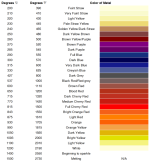
easy to look up some youtube videos on flame bluing and some temperature colour charts.

Unless you are talking about charcoal bluing - then I got nothing for ya! ;)
 
Tokguy, you post the most interesting posts.

My understanding of fire bluing is using heat to draw the steels carbon to the surface. Intentionally rusting also does this, but that process has to be neutralized. Fire bluing, heat it, cool it, done.

If you cast your own boolits, lead melts at 330 degrees centigrade, ironically, the same temperature that steel will change to blue/purple. Conceivably, the next time you're casting, throw your polished bits and bobs in the melt pot. Lead is denser than steel, so your screws etc will float on the lead, requiring you to stir them and dunk them to get the colour you're looking for, but they're easy to retrieve. The benefit of heating the steel with molten lead, is a controlled temperature. One could leave the steel in the lead for hours and not have to worry about altering the temper of the steel.

The lead shouldn't stick to threads of a bolt, but if it does and can't be easily picked out, either dunk it again, or heat the piece an flick the lead off.

1791902693409.png
 
Last edited:
Tokguy, you post the most interesting posts.

I'm 'Patch... spend a lot of time in a chair sometimes.
Last night whilst drilling, I polished all the main internal parts of an antique to an almost mirror finish.
I have an acquaintance whom has a bag of Potassium Nitrate... main ingredient to use the Colt method.
Seems like an easy enough process, melt it to liquid at 650 F... give the small parts a bath.
If you saw my parts box...you would be amazed.
Lots of stuff to play with.
Too much time to ponder I suspect.
Thanks for all the replies folks.
 
Last edited:
As to quenching in used motor oil... some prankster is rolling in their grave over that.
How so? - I've heard that one myself, but I have never seen any difference for oil type or just removing the part from the heat source.
Good link BTW - never tried the brass shavings myself though.


The benefit of heating the steel with molten lead, is a controlled temperature. One could leave the steel in the lead for hours and not have to worry about altering the temper of the steel.
I have heard this one too - seems like overkill for a few screws that take less than 30 seconds with a torch - that being said a controllable heat source is an asset!
 
How so? - I've heard that one myself, but I have never seen any difference for oil type or just removing the part from the heat source.
Good link BTW - never tried the brass shavings myself though.


I have heard this one too - seems like overkill for a few screws that take less than 30 seconds with a torch - that being said a controllable heat source is an asset!
I assume the shavings act as a heat sync, similar to the lead. Aside from providing an even heat to the piece, it imparts nothing.
 
I recall from High school Welding Class, when tempering a chisel, quenching in oil is preferable to water.
But that was about 40 years back, so that needs considering too
Oil is carbon rich, water, not so much. Quenching in oil will force some additional carbon into the heated steel, whereas quenching in water will set up a crystalline structure to the steel (brittle).
 
I don't believe it has anything to do with forcing carbon into the steel. The oil provides a slower more controlled cooling rate than water, which cools at a faster rate that can sometimes cause damage, such as cracking.
 
Many years ago I worked in an auto-electric plant where we made spark plugs among other things. Some plugs had blued shells. Degrease, rinse, immerse in molten sodium nitrate, rinse, oil. I assume this was niter bluing.
 
use an oven, I consider a cheap old BBQ an oven.
the lead and oakum and body soldering guy in me says don't throw steels in the lead pot.
water makes too many steam bubbles to keep good contact with the steel, used motor oil has too much water and detergent in it.
 
I don't believe it has anything to do with forcing carbon into the steel. The oil provides a slower more controlled cooling rate than water, which cools at a faster rate that can sometimes cause damage, such as cracking.
I don't believe a part at around 300° or slightly less will be affected either way by oil or water - nor do you actually need to cool it quickly.

what I do believe is that at some point some blowhard said "burnt motor oil" and everyone took it as gospel for some reason or another.
 
I wouldn't call that flame bluing; the steel should get color from reacting with oxygen at high heat, not the oil used to quench. there is very little oxygen inside the flame and very little oxygen when in the oil bath. there is more oil polymerization than bluing with that process, air/oxygen needs to circulate around the heated steel to form the oxide layer.
 
Thanks for all the replies.
Yeah, I could use AI, seems kinda sad and lonely though.
"I am not going to bother interacting with humans... I'll use my Cell phone!"
This seems much more satisfying.
Not smarter than AI, but forces a fella to think as opposed to getting spoon fed data.
 
Back
Top Bottom