














































So I finally got around to firing some shotshells through a rifled shotgun to determine how badly the rifling affects the pattern.
To recap, a few weeks ago there was some discussion on the subject on this forum, and I decided to actually do some testing and report back. So with the help of my lovely and talented assistants Alice (my 870 Marine Magnum; 18" cylinder barrel) and Marla (870 Super Magnum, dressed in her slug barrel for this occasion), I did some shooting and took some pictures.
My conclusion: shooting shot through a rifled barrel is a really bad idea if you are concerned about properly shooting your target. Here's why:
First target: from ten meters, I fired one round of Remington OOO buck (2-3/4", eight pellets) through Alice, and another round of the same stuff through Marla. The pellets from Alice are circled; the pellets from Marla are marked with X's.
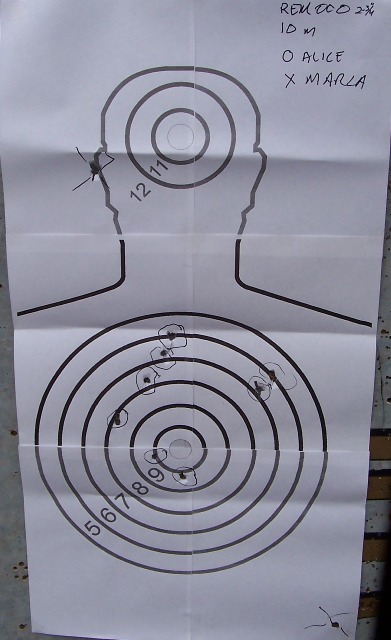
As you can see, all eight pellets shot through Alice impacted the target in the effective zone. Had I been shooting at a live target, say, it would have been quite effectively neutralized (unless, hypothetically, it was wearing ballistic protection).
On the other hand, one pellet from the round fire through Marla's rifled slug barrel struck the target in the ear. The other might have hit the target in the hip if the target had been moderately overweight. Barring freak ricochets from hypothetical earrings, this would not have neutralized the target.
And that was at ten meters; prime range for a shotgun. These results caused me to radically scale back the scope of my experiment.
Next, I fired a Winchester Super-X no.8 target shell through Alice, also from ten meters:
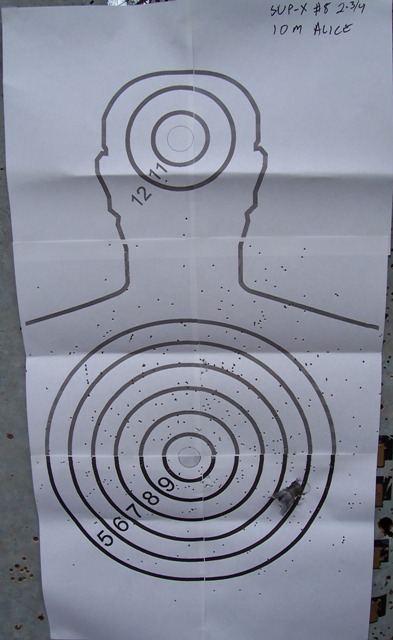
Note the shot cup embedded in the target. It took a fair tug to pull it out of the Masonite target backing. It kind of makes you feel for #### Whittington; this would have been extremely painful, if not, perhaps, completely incapacitating. Note that the pellets all seem to have struck the torso area of the target.
I then fired another round of the Super-X no.8 at a fresh target from the same distance, and then fired another round of the Remington OOO at the same target from five meters (please disregard the annotation saying the buckshot was fired from ten meters; that was my mistake):
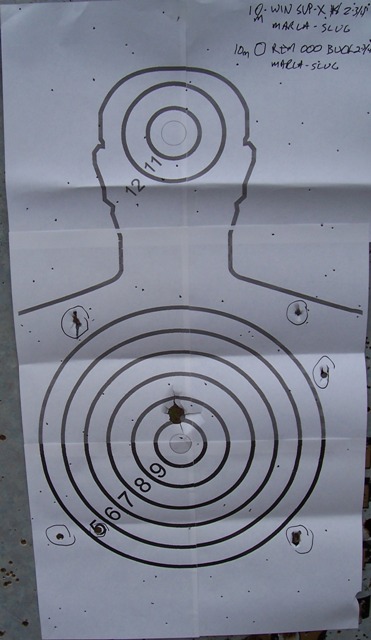
As you can see, the birdshot, when fired through the slug barrel, dispersed much more rapidly than the same shell fired through the cylinder barrel; many struck the target at head height or beyond. And of the buckshot pellets, even at five meters they've already dispersed to the point where two pellets out of the eight (25%) are off the target, and the remainder have already scattered towards the edge of the target and hit in locations that probably would not have completely neutralized the target.
I'm thinking that the guys who say that the spin imparted by the rifling spins the shot cup, so that the pellets are dispersed into a donut-shaped pattern due to centrifugal force, are right.
As for me, I'm not going to use my rifled barrel for anything other than slugs.
To recap, a few weeks ago there was some discussion on the subject on this forum, and I decided to actually do some testing and report back. So with the help of my lovely and talented assistants Alice (my 870 Marine Magnum; 18" cylinder barrel) and Marla (870 Super Magnum, dressed in her slug barrel for this occasion), I did some shooting and took some pictures.
My conclusion: shooting shot through a rifled barrel is a really bad idea if you are concerned about properly shooting your target. Here's why:
First target: from ten meters, I fired one round of Remington OOO buck (2-3/4", eight pellets) through Alice, and another round of the same stuff through Marla. The pellets from Alice are circled; the pellets from Marla are marked with X's.
As you can see, all eight pellets shot through Alice impacted the target in the effective zone. Had I been shooting at a live target, say, it would have been quite effectively neutralized (unless, hypothetically, it was wearing ballistic protection).
On the other hand, one pellet from the round fire through Marla's rifled slug barrel struck the target in the ear. The other might have hit the target in the hip if the target had been moderately overweight. Barring freak ricochets from hypothetical earrings, this would not have neutralized the target.
And that was at ten meters; prime range for a shotgun. These results caused me to radically scale back the scope of my experiment.
Next, I fired a Winchester Super-X no.8 target shell through Alice, also from ten meters:
Note the shot cup embedded in the target. It took a fair tug to pull it out of the Masonite target backing. It kind of makes you feel for #### Whittington; this would have been extremely painful, if not, perhaps, completely incapacitating. Note that the pellets all seem to have struck the torso area of the target.
I then fired another round of the Super-X no.8 at a fresh target from the same distance, and then fired another round of the Remington OOO at the same target from five meters (please disregard the annotation saying the buckshot was fired from ten meters; that was my mistake):
As you can see, the birdshot, when fired through the slug barrel, dispersed much more rapidly than the same shell fired through the cylinder barrel; many struck the target at head height or beyond. And of the buckshot pellets, even at five meters they've already dispersed to the point where two pellets out of the eight (25%) are off the target, and the remainder have already scattered towards the edge of the target and hit in locations that probably would not have completely neutralized the target.
I'm thinking that the guys who say that the spin imparted by the rifling spins the shot cup, so that the pellets are dispersed into a donut-shaped pattern due to centrifugal force, are right.
As for me, I'm not going to use my rifled barrel for anything other than slugs.


 .
.
























