Flat Metplate Machine Turned Projectiles - Update!

Brobee

CGN frequent flyer
Rating - 100%
536   0   1
Location
Alberta
Hi there everyone...

PART 1:

It's been a while (Jeez time flies fast...those two little kids are growing like weeds!) since my last post on my machine-turned-projectile project. For folks reference here is the original thread from about 18 months ago:

http://www.canadiangunnutz.com/forum/showthread.php?t=414000

Lots has been going on since then, but I've been slowly picking away at my project. You'll recall from the first thread that part of my initial motivation was to have some lead free centerfire rifle projectiles to shoot at my private rifle range...along these lines I was researching/prototyping solid copper bullets made by turning on high speed/high volume Swiss CNC lathes.

One of the offshoots to the project was a hollow point hunting bullet. I've since abandoned this as a diversion as there are now more big industry players supplying products in this market: In addition to what used to be the only game in town (Barnes), Hornady and Nosler both have solid copper offerings that are increasingly available.

The second objective (have lead-free cannon fodder for my .308 and .223 rifles) is also being addressed by the commercial guys: Barnes has the varmint grenade for the .223 which they sell for far less money than what I can crank them out on the lathe, and now the Hornady and Nosler guys are offering similar powdered copper/zinc core bullets with a swaged copper jacket that also satisfy the lead-free requirement.

But the one offshoot from the project that continues to be of interest to me is the flat-metplate solid machine turned projectiles. There was another thread recently in the hunting forum titled "what kills" where I illustrated some of my surprising gelatin tests with these projectiles as well as talk a bit about my hunting experience with them the past few years. For reference sake, here is that thread:

http://www.canadiangunnutz.com/forum/showthread.php?t=566172

So...with all that out of the way here is my update:

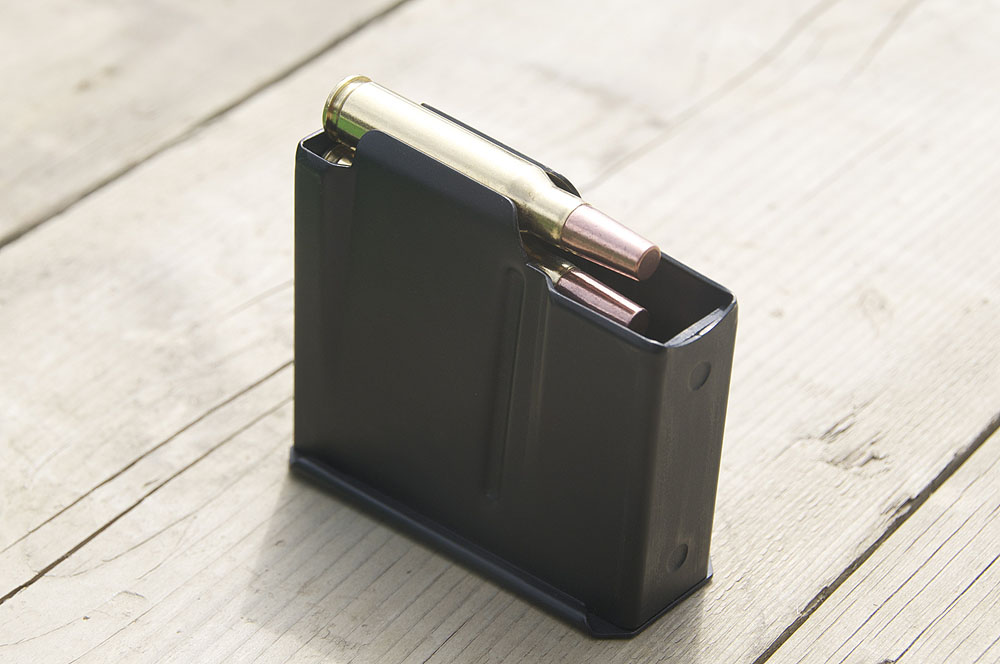
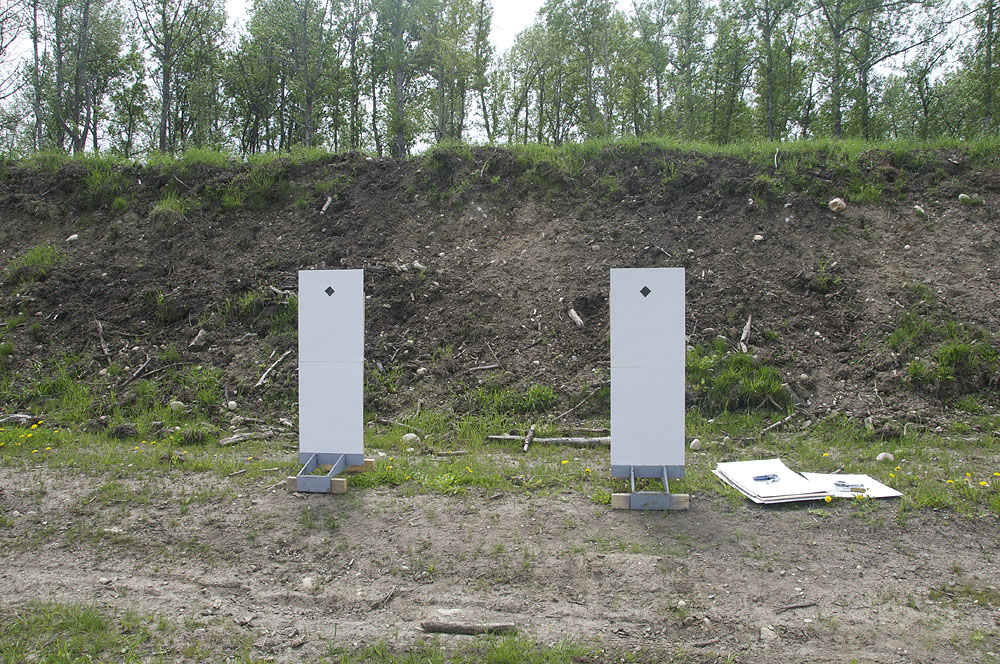
I got out to the farm yesterday and did some trajectory testing on my 155gr Flat Metplate Machine Turned Projectile.
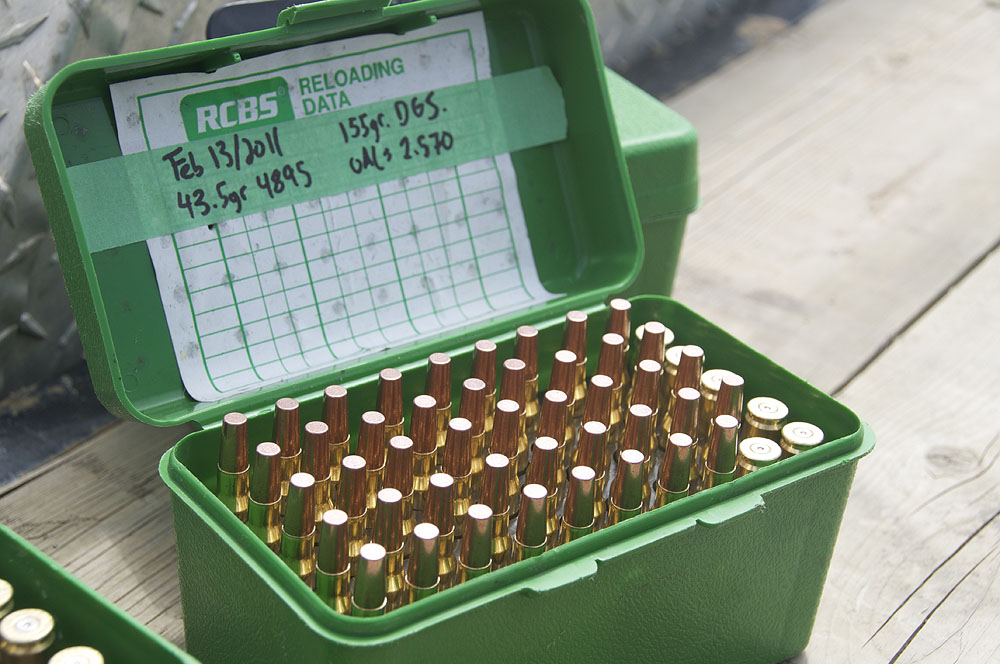
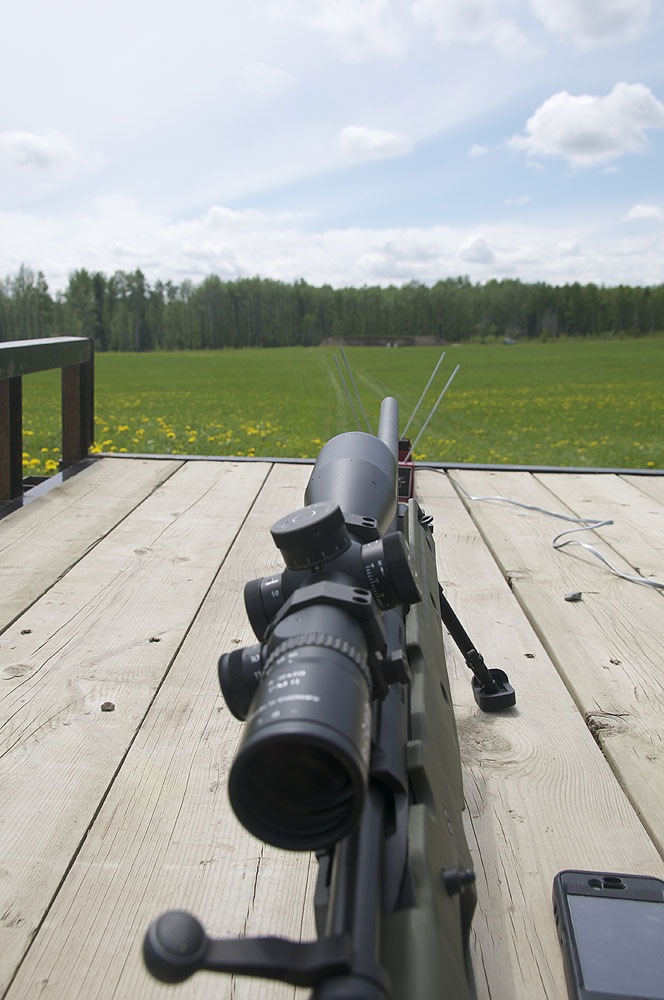
unfired_rounds_a.jpg


setup_c.jpg


unfired_rounds_b.jpg


setup_a.jpg
 
PART 2:


The objective of the test was to collect empirical trajectory and velocity data for use in calculating a useful balistic coefficient.

I also wanted to do this in a way that I could also create a meaningful visual representation of these bullets trajectory so that rather than just presenting a bunch of numbers I could also show folks what the trajectory looked like.

The plan was to set up a tall vertical target, zero the testing rifle at 100 years, and then progressively back up to 200 and 300 yards - shooting to the same point of aim with no changes to the elevation turret making sure to record the muzzle velocity and shot placement of each round fired.

I had been planning this day for a long time - had the day booked off work as well as a kitchen pass approved by the wife and kids. While the long term forecast was looking great when I was doing my planning, in reality yesterday saw two fairly different weather systems collide immediately above our little farm! The net effect of this was some seriously gusting winds...it would be steady at 20km/hr for a few minutes, then die to nothing for a few secs, then gust up to 40 or 50km/hr, sometimes blowing the screens off my chronograph! As a result windage was REALLY REALLY difficult, and on the best of days it is something I am not very good at.

Initially I was pretty choked at the weather, but then I remembered that I was out to collect elevation data and did not really care about windage (unless it caused me to miss the paper...:)) My plan also called for shooting three targets simultaneously, however I elected to stagger them throughout the day in the hopes the wind would die and I'd have at least one with teeny-weeny little groups (no such luck!).
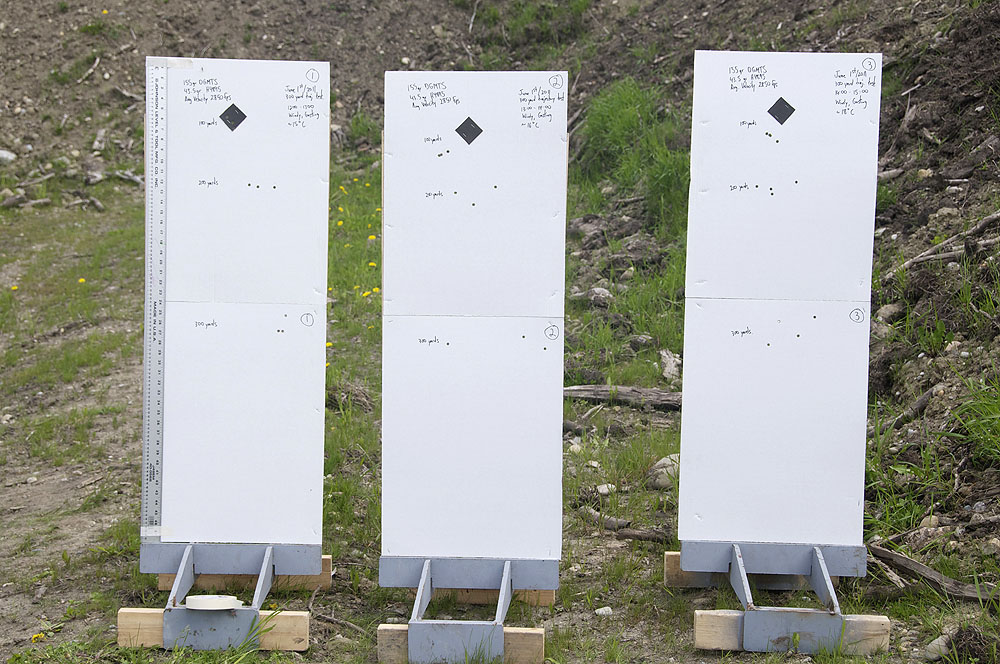
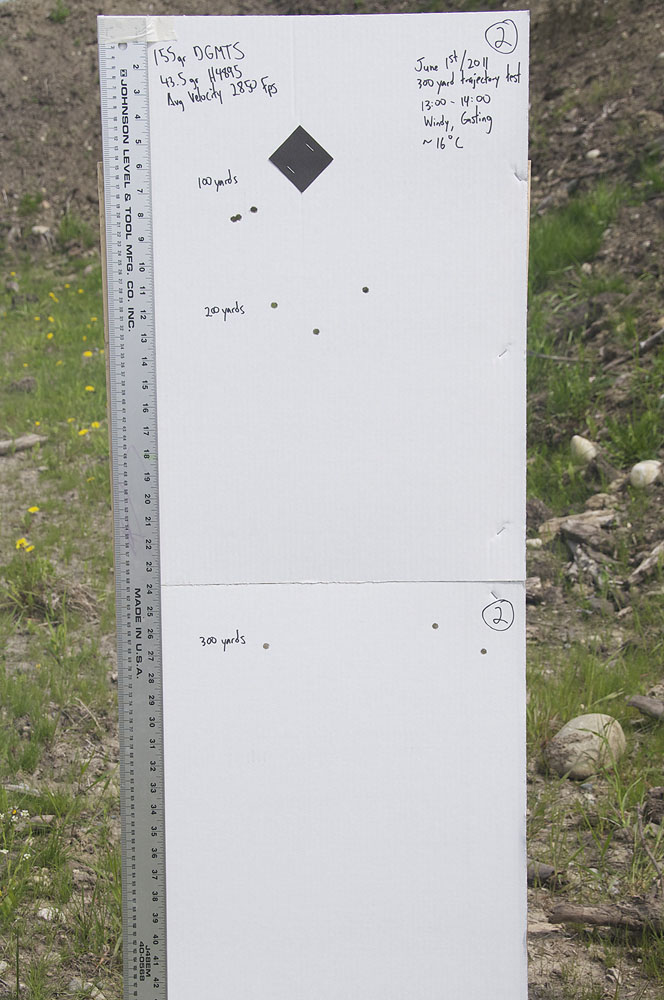
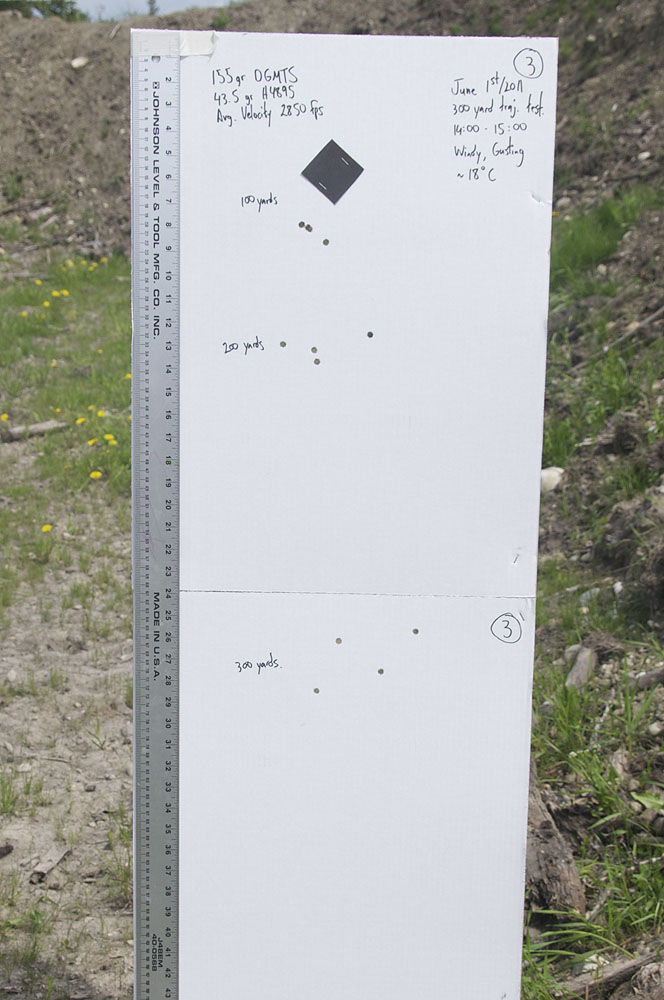
My test rig was a new rifle I'd had put together over the winter. It was a Left Handed Remington 700 with the factory varmint barrel and bedded into an Accuracy International Version 2 Chassis. For glass I was using an S&B PMII 4-16x50. In retrospect I would have been better off sticking with my tried-and-true sniper rifle as I suspect this rifle needed a bit of a break-in before settling down, however this was more of a worry in the tight-group department and not relevent to the outcome of the elevation data I was looking to collect.

target_summary_a.jpg


target_2.jpg


target_3.jpg


I recorded the muzzle velocity of each round fired, and have good correlation between rounds that impact high or low as they relate to high or low deviation in muzzle velocity. Average muzzle velocity was approximately 2850 fps (might be a bit lower, will advise once I get a chance to compile and crunch all the data). I had planned to also set up a chonograph just infront of the target, however I decided against this because of the wind and my lack of confidence in trashing the chono.

I still have to carefully measure each shot from a common reference point and come up with an analysis that factors into the equations velocity deviation, however my quick-and-dirty preliminary observation is that we're talking about approximately 19 inches of trajectory drop at 300 yards.

Appropriately tweeking all the knobs in my poorboy excel spreadsheet Pejsa ballistics calculator and goal-seeking trajectory path to equal -19.0 inches by varying ballistic coefficient it spits back 0.177 as the bullet's BC and approximately -4.6 inches as the predicted POI at 200 yards, which seems to fit well with my test data.

While I was expecting a poor BC...I was surprised to see it crunch out as low as it did! Thinking on it a bit I suppose it makes good sense that the attributes I find favorable in it's terminal performance in gelatin (and game) also function to create a large amount of in-flight drag...:)...what should be surprising is that I was surprised by this...ha ha!

Anyway...Using my measured average muzzle velocity and the BC derrived as per the above method I played around a bit with the ballistics calculator until I had a zero range that, IMHO, optimized in-flight trajectory for a hunting round which ironed out at 225 yards. With a 225 yard zero the ballistics calculator suggests a maximum trajectory above line-of-sight of 3.5 inches (at 125 yards where velocity is 2200fps) which falls to -2.4 inches below line of sight at 250 yards (velocity at this point is 1700fps). Past 250 yards it falls like a rock and becomes less-than-useful.

Next step?? Will have to wait until this coming winter season when my garage cools off enough to make more Gelatin! The test I'm interested in now is to see what penetration and the wound profile looks like at 2200 fps and 1700 fps....I'll get to work on some loads that allow me to simulate these velocities so Im ready when winter comes around again.

In the meantime I figured I'd stick my neck out a bit and I ordered enough material to make a decent run of .308, .284, and .277 projectiles that I could possibly make available to folks who might be interested in trying some this upcoming hunting season. I'll be hunting with the .308 for elk and the .277 for deer...:)

As a refresher - here's what the .277 and the .308 look like in ballistic gelatin:

6.8_danger_game_block_composite_b_annotated.jpg


308_danger_game_block_composite_b_annotated.jpg


6.8_danger_game_slug_comparison.jpg


308_danger_game_slug_comparison_b.jpg


Signing off until next time....

Brobee
 
Thanks for your very interesting approach to the viability of a wide meplat solid copper bullet.
If it is not designed to expand, I believe it would be illegal to use on a game animal here in BC, but would need some more research to make sure that this would apply to your "flat nosed solids" Regards, Eagleye.
 
"designed to expand" is a bit vague IMHO...I would argue that I always have intended them to expand (with "expand" taking on the textbook dictionary definition of increasing in diameter) albeit in a much more tempered fashion than a traditional soft point or hollow point. The finished diameter of both the recovered slugs is larger than that of their pre-fired state, so they definitely meet the absolute test of whether or not they did expand. The degree to which they expand relative to the rest of the conventional hunting bullets is certainly less but any of the laws I've looked at don't specify how much expansion is required...just that they have to be designed to expand.

Cheers,

Brobee
 
Very, very, cool. I love the that large meplat is so exposed for the splatting. What would happen if you made that meplat slightly concave? I could imagine that projectile on something like a 35 Whelen.
 
IMHO unless you make those for your self only the 7mm class lightweight copper FP bullets aren't making a lot economical sense. " A little expanding" bullets like yours are needed in much larger calibers with SD no less than .250 when expansion is not that critical. Neither Barnes nor Nosler ( and they are like $4/per) are selling 35 cal solid bullets for instance and the one in min 225gr weight range would sell like hot cakes IMO.
 
I have taken alot of game with very large, cast flat points, usually .45 or .50 caliber with very wide meplats. Without a doubt, the same bullet cast hard enough to not expand, does not kill as well or as quickly as the same bullet cast soft enough to get at least some expansion. Where this becomes most evident is on lung shots on large animals such as buffalo or moose, where a bullet that expands can be the difference between a quick kill or a tracking job.
 
I have used solid copper bullets very similar to yours in researching for a 308 sniper bulllet that would penetrate glass without deflection. The hope was that the flat edge would bite and break glass.

It did no better than the Sierra 175gr matchking.
 
Good to see that progress is progressing!

Gotta agree a fair bit with the assessment of the marketplace, as far as the availability of lead free bullets. Becoming more available, and you can't really compete on price.

But you can charge pretty much what you want, for bullets nobody else makes. The .35 cal suggestion is a good one. Dunno what is out there in the .338 cal, for lead-free, but that would be worth looking at too.

'Course, if the goal is to pursue some personal knowledge, rather than a cash payback, that can be an end in it's own right too.

Cheers
Trev
 
Are you aware that flat meplat solids are manufactured by GSCustom in South Africa. Lots of good info about how they cause most damage from all bullet shapes.

Andrew
 
If you ever get to the point where you're making these in .416 and .458 I would be a customer.

I've been hoping to run into some GSCustoms for the last couple of years but they're not easy to find in Canada.

You're project is very interesting and always a good read.

Thanks for sharing.
 
I put up a poll in the hunting forum to try and identify which other diameters folks might be interested in...I have the machine shop cued up to make my next batch of experimental bullets for this upcoming hunting season and I can likely afford to add a short run of one or two more diameters:

Go here to vote in poll!

Thanks for all your feedback....

Brobee
 
Ja, the What Kills thread was pretty interesting, I'm glad that RoA suggested I start it.
I do hope you haven't abandoned your idea of trying the solids in your TrapDoor. I'm playing with the idea of buying a .45-70 and some of your bullets would rock it.
 
Back
Top Bottom