Flight 140 TTSX

I concluded that the Rhino was the bullet I wanted when the chips were down due to its moderate impact velocity

In other words you ran an Apples to Oranges test against the old X bullet, and applied that new found knowledge to ALL TSX/TTSX bullets......Interesting
 
In other words you ran an Apples to Oranges test against the old X bullet, and applied that new found knowledge to ALL TSX/TTSX bullets......Interesting

Not at all.

At the time I conducted that test, there was no TSX bullet, it hadn't been invented yet. The purpose of the original test was to see what bullet would be the best as a stopper in a close range emergency. The Rhino won and the reasons are obvious from the first picture in my earlier post.

The old X's had a larger hollow point opening in the nose, while the TSX has a small entry into a larger tear drop shaped cavity. The TSX also retains its petals better as there is more metal holding them to the shank due to the smaller hollow nose cavity. This design is the reason that fluid opens the bullet efficiently and reliably. The large hollow point of the older X's causes those bullets to plug and expand in a similar fashion to a closed nose bullet. There were frequent complaints on CGN that when the older X bullets would fail to expand when loaded to moderate velocity.

The purpose of posting the pictures was to demonstrate that the Rhino bullet, which is also a petal style bullet albeit a petal style bullet with a bonded core, expands best in an aqueous material. The bullet showed no expansion at all in a dry medium. This was said to be impossible in a previous post, yet the proof is here for all to see.
 
RiverOtter said:
In other words you ran an Apples to Oranges test against the old X bullet, and applied that new found knowledge to ALL TSX/TTSX bullets......Interesting
Not at all.
Really......

Boomer said:
Here we have a 270 gr XLC, a 300 gr X, a 380 gr Rhino
Have you seen an apple and orange side by side???

Boomer said:
The old X's had a larger hollow point opening in the nose, while the TSX has a small entry into a larger tear drop shaped cavity.
Have you even looked at an X, side by side with a TSX?????
You can hardly tell the difference between the two hollow points, as they are nearly identical in size.
 
Really......


Have you seen an apple and orange side by side???


Have you even looked at an X, side by side with a TSX?????
You can hardly tell the difference between the two hollow points, as they are nearly identical in size.

I showed that a petal style bullet expands in an aqueous medium and does not in a dry medium. No apples or oranges although I suspect a TSX would expand in either if they were ripe. The point was not the old X bullets which IMHO failed, so just pay attention to the Rhino bullets in the pictures.

The old style X's had a cavity that was similar in length to the TSX but was a different shape and volume. It was interesting that for a few years almost every box of X's I bought had a different style of hollow point. Some were large and open, others were more closed, but none were as small at the opening as are the TSX's.
 
Curious, how do lead tipped cup'n'core bullets expand, without the hollow point tip to allow "aqueous medium" in???

I've expanded many X's, XLC's, and TSX's in dry gravel; to the point where they sheared their petals and had just a shank left. Pretty good results considering gravel is a far harsher medium than flesh and bone- and the same weight/velocity cup'n'core bullets(bonded and regular) all disintegrated under the exact same conditions.

Apples to Apples.....
 
Last edited:
How dare you compare apples to apples...

I'm pretty sure that Rhino bullet failed in dry medium for the simple fact that it failed...Built by man, has the potential to fail....

But I would have to surmise from simple physics, that the rhino did not try to swap ends due to it being too long.....If that were the case, long armed bowhunters would have a problem with arrows turning around Boomerang style..........grin
 
And I would have to say, counting on a bullet "when the chips are down" that expands in snow, but not in wood, is how buttons end up in grizzly ####....
 
Boomer. why in the wide world of sports is everyone plugging their hollow points with plastic tips if your "theory" is the correct one?

I've also pulled dozens of TSX's from berms and every last one of them had expanded. I'll try and throw up a picture or two sometime.
 
Boomer. why in the wide world of sports is everyone plugging their hollow points with plastic tips if your "theory" is the correct one?

I've also pulled dozens of TSX's from berms and every last one of them had expanded. I'll try and throw up a picture or two sometime.

I think from Barnes perspective they are attempting to win customers away from Nosler and Hornady. What I don't understand is why their new manual suggests that the TTSX and the MRX have different expansion properties when the noses of those two bullets are identical.

Plastic tipped bullets aren't new. They have been around since the '60's and bronze tip bullets were available prior to that. Its not that they don't work, but they work differently than the TSX. I am quite happy shooting Nosler Ballistic Tips, they are very accurate and quite destructive. If I was shooting big game at very long range, I would consider the MRX for its high BC, but that style of hunting isn't my thing.

I'm not doubting that the TSX's can expand in a gravel pile, the hollow cavity is more prone to damage than the nose of a closed tip bullet. But the inside of a game animal is wet, not granular and dry; therefore the bullet is not designed to perform in a dry medium.
 
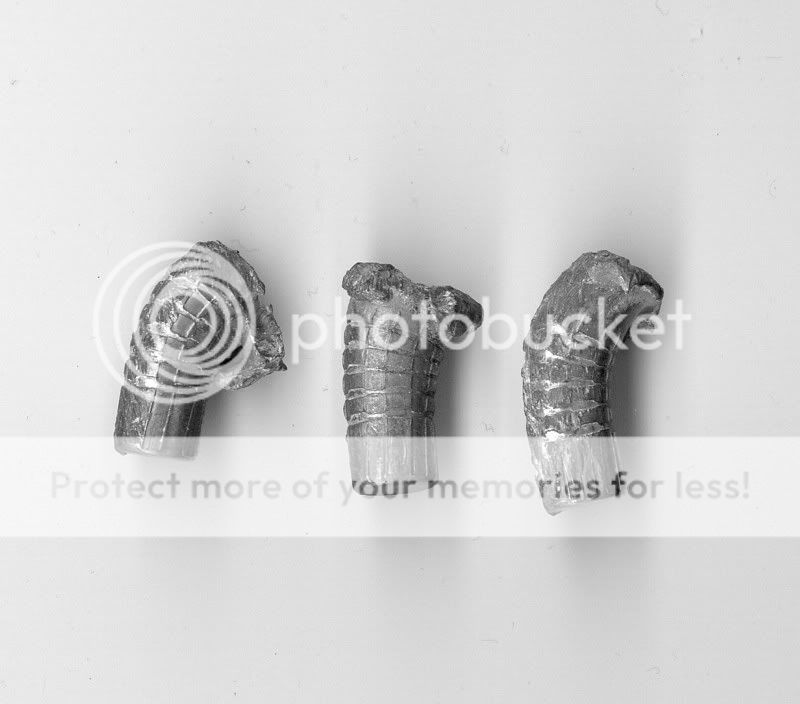
Here are 3-300 gr TSX's I scanned that show the typical results of being fired into a dry medium, in this case a gravel back stop. Each bullet has been bent from the force of impact in a similar fashion to the 380 gr Rhino I recovered from the dry timber and that I posted earlier. The nose cavity of these bullets has been damaged in varying degrees from no damage to the nose of the bullet on the right to significant damage to the bullet on the left. The bullet in the center which appears to have expanded somewhat, this expansion does not extend to the bottom of the nose cavity despite the high impact velocity. The nose damage is more accurately described as being smeared rather than expanded. This of course has nothing to do with how the bullet behaves on game, but it is evidence that when impacting a dry medium the TSX may not expand as designed. It does expand as designed with almost 100% reliability in an aqueous medium.

Untitled-Scanned-02.jpg
 
I'm not sure where you get it in the new manual that the expansion properties are different?

Bullets are designed to expand when encountering resistance...Plain and Simple...
 
Weigh them Boomer...

Not sure how you think the one in the middle has been smeared as opposed to expanded, as in YOUR picture you can see that the shank is now wider (aka expanded) .......
 
I'm not sure where you get it in the new manual that the expansion properties are different?

Bullets are designed to expand when encountering resistance...Plain and Simple...

On page 3 of the new Barnes manual they make the inference that the TTSX expands faster than the TSX then on page 4 they say the MRX produces controlled expansion. Controlled expansion for the last 50 years has referred to bullets that expand gradually as they penetrate a big game animal. The TSX is fully expanded after a couple of inches of penetration. That to me sounds like a contradiction, but never let the truth get in the way of good marketing.

I don't think that this represents the kind of performance we would want to occur on game. A bullet could indeed be designed to penetrate a dry medium, but outside of military requirements to shoot through barriers, what would be the purpose of of this in a game bullet?
 
Last edited:
Back
Top Bottom