Forging of damascus barrels

I have always appreciated damascus barrels. I have several examples in my collection and have never had a failure. Mind you, I make sure to use shells appropriate for the gun, inspect the guns carefully when initially acquired and annually thereafter. And, I clean them regularly. Nothing special about that, though - I do the same for all my guns, regardless of the barrel technology or year of manufacture.

Interesting article with invaluable historic references. Thanks for the link, Steve.
 
Go to Youtube, and search for "damascus barrels". You will find the b&w film showing the making of these barrels, with most of the processes featured. The film is from the musee de la vie wallonne - the Walloon Museum, Walloons being French Belgians. My brother has visited that museum and has inspected the "Zenobe Gramme" and "Prince Albert" barrels. The letter pattern is forged/welded into the matrix of the barrel walls; not an applied surface treatment.
 
Go to Youtube, and search for "damascus barrels". You will find the b&w film showing the making of these barrels, with most of the processes featured. The film is from the musee de la vie wallonne - the Walloon Museum, Walloons being French Belgians. My brother has visited that museum and has inspected the "Zenobe Gramme" and "Prince Albert" barrels. The letter pattern is forged/welded into the matrix of the barrel walls; not an applied surface treatment.

When I first started paying attention to Damascus about 18 years ago, there were “rumours” based on news reports from back in the day, that Henri Pieper had, in his barrel factory, produced at least one set where the pattern read “Henri Pieper” in cursive. Shortly after, a barrel surfaced, confirming the rumour. A few years after that a fellow in the US contacted me for advice about a Pieper he was buying. The barrels were blued so he thought they were early fluid steel. Upon buying the gun, he sent the barrels out for refinishing. As a result he discovered that his newly purchased gun had a set of the “Henri Pieper” barrels. Incredible to imagine what was required to achieve that writing.
 
Double Gun Journal had an article about an 1894 or 1900 Remington, with barrels that read "REMINGTON". Previous owner was going to have them reblued, but the gun was rescued before that happened.

American doubles with Damascus barrels usually used Belgian barrels.
 
American doubles with Damascus barrels usually used Belgian barrels.

Indeed. But what is less well known is that most 19th Century British sporting guns used Belgian barrel tubes as well. The author Richard Akehurst (Game Guns & Rifles, 1969) notes that in the 1870s, John Marshall (Monway Iron and Steel Works, Wednesbury, Staffordshire) "supplied the majority of damascus shotgun barrels to the Birmingham gun trade, and while generally of sound quality, they contained a lot of 'greys.' These greys were caused by small pieces of scale becoming embedded in the metal during the fire welding. They did not materially effect strength, but they left marks when the barrels were polished, which rendered them unfit for the barrels of best guns." In muzzle-loaders, you could not see down the barrel, so greys were of no consequence; with breech-loaders, it was another matter. It was because of greys in British barrel tubes that the trade sourced barrel tubes from Belgium (mostly) and France. They were much clearer of greys, but were softer.

To quote J. H. Walsh in “The Modern Sportsman’s Gun and Rifle” (1882) regarding the use of Belgian tubes: “We were, in common with our competitors, excepting for first and second quality, using a large proportion of these tubes; in fact, we think that quite three-fourths of the tubes used in Birmingham are Belgian make, and nearly all the London trade use them, with this difference, that they use the best quality, which are no doubt harder than the cheaper kinds, but are still softer and less durable than those of English make, and cost as much.” And, “For many years we have been almost entirely dependent upon one maker for Damascus, stub Damascus, and laminated steel iron [a reference to the Monway Iron and Steel Works]; he, having a monopoly, has not cared to trouble himself to keep his iron up to its original good standard, notwithstanding the fact that, in consequence of its high price and want of clearness (freeness from greys), his trade has been gradually leaving him and going to Belgium... One reason for the cleaner forging done by the Belgian smiths was that they used a smaller forge fire composed of a mixture of powdered clay and small coke that kept the work cleaner than the big coke fires of Birmingham.”

I seem to recall I have some numbers somewhere about the number of tubes imported from Belgium, year by year... In any case, it would seem that the most beautifully figured Damascus tubes used in British guns were of Belgian origin, made into finished barrels by British smiths and proofed in Britain.

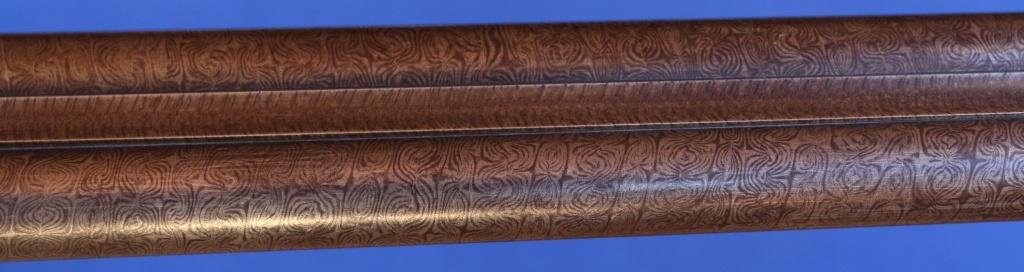
Damascus steel:
ULo28ka.jpg


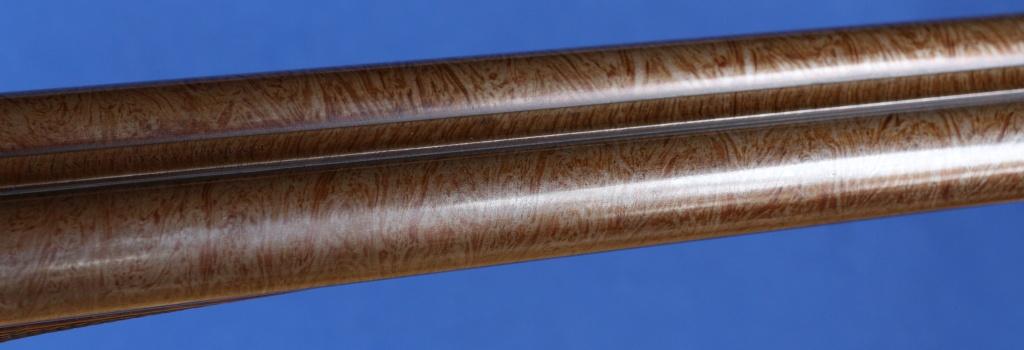
Laminated steel:

atCU1sL.jpg
 
Beautiful barrels!
I understand that many fine British guns (like Farquharson single shot rifles) were imported in the white from Belgium. More recently Spanish shotguns were imported to be finished in the UK.
There was quite a difference between best guns and perfectly good guns produced in vast numbers for the trade and export.
A modern example is that of Parker Hale Mauser rifles. A Spanish barreled action installed in an Italian stock with some British diecast parts, finished off in the UK.
 
The link to the old B&W video
Was very interesting, and loved the fact that people even back then, when a camera is stuck in their faces, don't know what to do with themselves. Incredible skill though
 
The Farquharson action made in Belgium were the action used after the Gibbs patents expired, the original Gibbs action were made by Gibbs

Great articles Steve
 
Back
Top Bottom