Freebore: Does Accuracy Generally Suffer?

South Pender

CGN frequent flyer
Rating - 100%
75   0   0
Location
Vancouver
I've often wondered about the effects of freebore on accuracy. It sort of seems logical, I guess, that having the bullet jump that far before engaging the rifling will, if anything, reduce accuracy a little. Often best accuracy if achieved by having the bullet just kissing the rifling, so that freebore is a step in the opposite direction.

What have you guys noticed re accuracy with rifles having freebore?
 
That's an interesting read, diopter. Thanks for posting it. A couple of points:

(1) the discussion is in terms of VLD bullets. I wonder whether this phenomenon also applies with bullets not having a secant ogive.

(2) the amount of jump examined does not appear to exceed .130". Freebore generally results in a considerably greater jump than that.

Still, the info in the piece is worth considering.
 
Have a ruger mk2 in 300wm, with bullets seated just off the lands it was very accurate but were too long for the mag. 2" groups at best with 3 different bullets when fitting the mag. Finally tried Barnes TSX and bingo 1" and better, when I'm on.
 
In a recent podcast, one of the better PRS shooters said he tested lots of jump distances in my 6mm CM and ended up running way more jump than anyone would think because it gave best results.
 
Good link, thank you. I am thinking about shooting say .45 Long Colt in .460 S&W, .45 ACP in .45 LC, and .38 Special in .357 Max, .45LC in .454. The 38S in .357Mag is done all the time, there is 0.13 inch difference so within the outside limits in that article. Take 38S in 357 Max and it is 0.43 inch gap. I think this would affect accuracy. 45 Colt to 454 is 0.1 inch so within the article but 45 colt in 460 S&W is 0.51 inch difference...and so on.
 
I remember speaking with Brian Litz from Berger regarding the difficulties I was having getting the 90g .223 VLDs shooting at 800m. Common thought at the time was that these bullets needed to be jammed to shoot. My experience was different. Jumping 20-30 thousands seemed the way to go. Many shooters now have had the same experience. In my experience consistancy in everything you do with regards to reloading is the key.
 
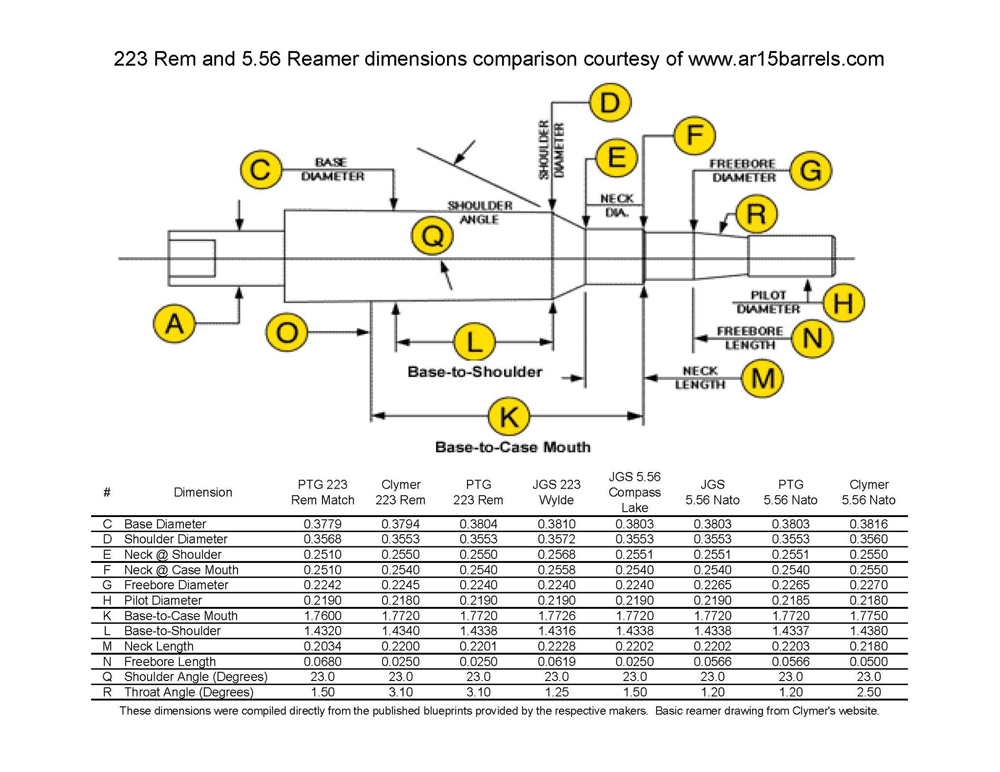
Below are chamber reamer dimensions for .223 and 5.56 chambers, look at the throat diameters (G) and the freebore lengths (N). And the PTG .223 Rem Match chamber has the longest throat.

wjAOlWq.jpg


Below a surprising link about accuracy with a Wylde chamber AR15 with mixed Lake City brass with the second longest throat.


Preparing Once-Fired GI 5.56 Brass for Reloading (Part 1 of 3)
https://bulletin.accurateshooter.com/tag/usamu/

Accuracy Potential of Mil-Surp 5.56×45 Brass

So, how accurate can previously-fired GI surplus brass be in a good National Match AR-15? Well, here’s a data point from many years ago that might be of interest. A High Power shooter who wrote for the late Precision Shooting magazine took a Bill Wylde-built AR match rifle to a registered Benchrest match. His first 5-round group ever fired in a BR match was officially measured at 0.231″ at 200 hundred yards. This was fired in front of witnesses, while using a moving target backer that confirmed all five rounds were fired.

He recounted that his ammo was loaded progressively with factory 52gr match bullets and a spherical powder using mixed years of LC brass with no special preparation whatsoever. Obviously, this was “exceptional”. However, he had no difficulty obtaining consistent 0.5-0.6 MOA accuracy at 200 yards using LC brass and a generic “practice” load that was not tuned to his rifle.
 
I suspect it is one of those things easy enough to just prove to yourself if, or how much, it matters in your rifle. Make up identical loads - vary the jump - shoot enough 5 shot groups of each to have statistically valid data, and you will know, for your rifle. I satisfied myself a number of years ago, that loading "straight" - minimum runout - is probably more important - in several of my commercial hunting rifles, I can see group size difference between groups shot with .003" runout or less, versus .004" runout or more. Have to actually measure it to know; have to actually shoot several 5 shot groups of it in your rifle to see if it is worth it. Then, hunt down what in the loading steps was creating the runout that was not there in the cases at the start... Snug fit in chamber, brass that is consistent thickness from case mouth to case head, sized straight, balanced bullets, seated straight: your rifle will probably shoot as good as it can with that.
 
Below Eric Cortina starts load testing at .020 off the lands, and then fine tunes from .003 off the lands to .040 off the lands.


Long range load development at 100 yards.
Discussion in 'Reloading Forum (All Calibers)' started by Erik Cortina, Team Lapua USA, May 5, 2013.
http://forum.accurateshooter.com/threads/long-range-load-development-at-100-yards.3814361/

Update: 9/17/14
Some of you have asked for more detailed instructions on how I do this. Here they are:
1. Find Jam by seating a bullet long on a dummy piece of brass (no primer nor powder) and apply die wax to the bullet ogive and record it's base to ogive length.
2. Chamber the round and close the bolt.
3. Snap the bolt open and measure the base to ogive measurement. If it is shorter than previous measurement, this is your jam. Do it a few times with different cases to make sure.
4. Load a known powder/primer/bullet combination. I load 4 of each powder charge in 0.5 gr. increments and seat bullets at jam - .020". I use one shot of each to get barrel fouled up and also keep an eye for max pressure at the same time. You can also use these rounds to break in a barrel if you are inclined to. If I encounter pressure on the hotter rounds, I will not shoot groups with the other loaded rounds and will pull bullets when I get back home. Do not shoot in round robin style because position and natural point of aim will be compromised.
5. Shoot 3 shot groups starting from lowest to highest. All groups are shot over a chronograph.
6. Examine target and find the place where consecutive groups line up vertically and ES is the lowest and speed increases the least from one group to the next.
7. Load to the middle of the powder node and do a seating depth test.
8. Load 3 shot groups starting from Jam - 0.005" all the way out to Jam - .040" in .003" increments.

9. When you find the seating depth test that shoots the best, load towards the longest side of the node to allow more room for throat erosion.
10. Final step is to load the new seating depth and load 5 shot groups in 0.1 gr. increments 0.5 gr. on each side of node (if pressure limits are not reached). This will cover an entire grain of powder and you will be able to pinpoint where the powder node starts and ends. In the summer, load towards the low end of the node, and do the opposite in the winter.

HAPPY SHOOTING!

 
I have found that while I can get very good accuracy with longer jumps to the lands with some loads/cartridges/rifles, others do better when seated close to or even on the lands. I tend to start close to the lands with all but monometal bullets, because on average,I usually find the best accuracy when seated closer to the lands.
 
If you are talking Weatherby style free-bore, I have less luck getting those cartridges really shooting than the ones that I can make the lands. That doesn’t mean I won’t get it happening but the barrel will definitely be telling you what it likes for bullets, not the other way around. I’ve had some that defiantly refused to shoot rather ordinary boat-tails, and something in a VLD pattern is an interesting fantasy. Those cartridges made their reputations with NPTs and Hornadys, both rather forgiving bullets for COL.

Ever wonder why standard factory loads always seem to have flat-based bullets? They are more forgiving for the long jumps that factory rifles are going to make sure they have. If it didn’t matter they would all be boat-tails.

On a related subject; manufacturers that crank out rifles with magazine lengths that won’t allow reaching the lands with most hunting bullets need their collective asses kicked.
 
I can say one thing with great certainty, nothing is certain.

At the end of it all we don't 100% know exactly what one seating depth will do compared to another until we actually do it.Some will say use this bullet seated at this depth and you are golden and that is hardly the case for everyone , you may have similar components and results but at the end of the day that is why we have to test.It's not like buying a 1/2 bolt and half inch nut from two different stores, one made of stainless one made of galvanized mild steel, they are both going to thread together regardless, we don't get this kind of compatibility unfortunately.

https://www.canadiangunnutz.com/for...t-Well-Sheet!!!Update?p=16987924#post16987924

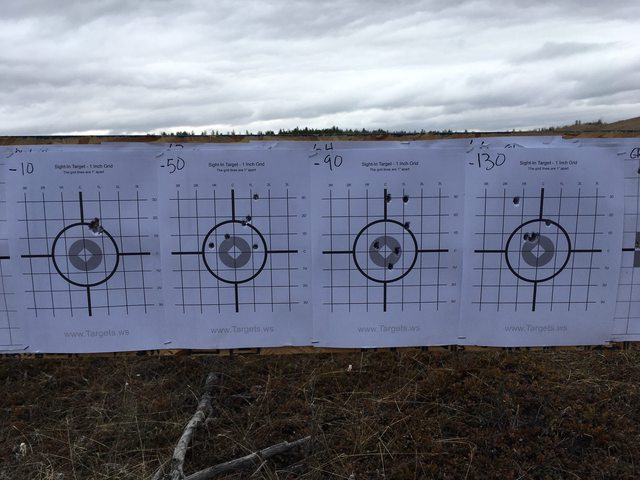
There is my latest struggle , I always post everything I can when doing load development to help others and myself learn , I tried the seating depth test as outlined by Berger and as I could of determined my COAL in 12 shots I did it in 24 which validates things even better and is thier suggestions.This was done of course with a charge that wasn't showing pressure signs previously.

Here is a photo of the 4 targets , you can also follow the link to the entire process.This is a hunting rifle so I did a 0.010" , 0.050" . 0.090" and 0.130" jump. 3 shots per target, and then repeated the three shots per target with corresponding loads.


For a hunting rifle I will almost always seat for using the magazine and then test charge weights, this case for this particular bullet I had to do the seating depth test and after charge weight tests as the bullets did not like where I was seating them.

SO, I don't think accuracy suffers, only if you don't utilize all the tools at your disposal with full testing, but we can be limited and turn something into a single shot if we are trying to squeeze the very most out of a rifle, OR you can "accept" a level of accuracy if you can't optimize or that also could get you into a component change and testing all over again.
 
When I first started reloading in 1973 all I had was a plastic Lyman vernier cailper and two reloading manuals. So I kept things simple and bought Hornady bullets with cannelures and seated them to the cannelure. Then it wasn't a big deal as the average deer here in Pennsyltucky was shot at 40 yards in the woods and I was using a Remington 760 pump. (Amish machine gun) :)
 
Eric is not referring to hunting rifles when he is talking about jam/jump. His rifles are custom made single shot match rifles usually built on Kelby Stolle actions and Kreiger barrels using custom reamers. However, the principle is the same. I normally start at .020" jam and move inwards in .010" increments. Work from .020" jam to .060" jump. Most of the time rifles like either .010" jam or about .030" jump. However I have had 2 identical barrels different in one prefers .010" jam and the other .010" jump. Again I have the same style of rifles as Eric.
In hunting rifles freebore is normally used by manufacturers to reduce pressure and is longer than you can normally seat a bullet where it fits into a magazine. In these cases you have very little options.
 
I've often wondered about the effects of freebore on accuracy. It sort of seems logical, I guess, that having the bullet jump that far before engaging the rifling will, if anything, reduce accuracy a little. Often best accuracy if achieved by having the bullet just kissing the rifling, so that freebore is a step in the opposite direction.

What have you guys noticed re accuracy with rifles having freebore?

Burned out/worn out barrels have excessive freebore.....

Jerry
 
Back
Top Bottom