Front sight acquisition

grimreefer

Regular
Rating - 100%
50   0   0
Location
Vancouver Island
Any tips for acquiring the front sight as quickly as possible when presenting the gun? Those occasional times when I start to come up on target and the front sight is too low and obscured by the gun, it leads to some hunting around. Should I always try to present the gun with the front sight too high on extentension so that it is always in view and drop it into the rear notch? Am I overthinking it and just need to dry fire practice for 8 hours a day?
 
Last edited:
Someone with much more experience than me will chime in, but I believe if the grip angle of the gun is appropriate for you, the front sight should line up almost by itself. For me the grip angle of the 1911 does that, as do a few others. But some are just not as printable.
 
A white dot painted on the sight or a fiber optic replacement sight helps a lot.
Just note that if you replace the front sight with one of a different height, you will likely need a new rear sight as well.
 
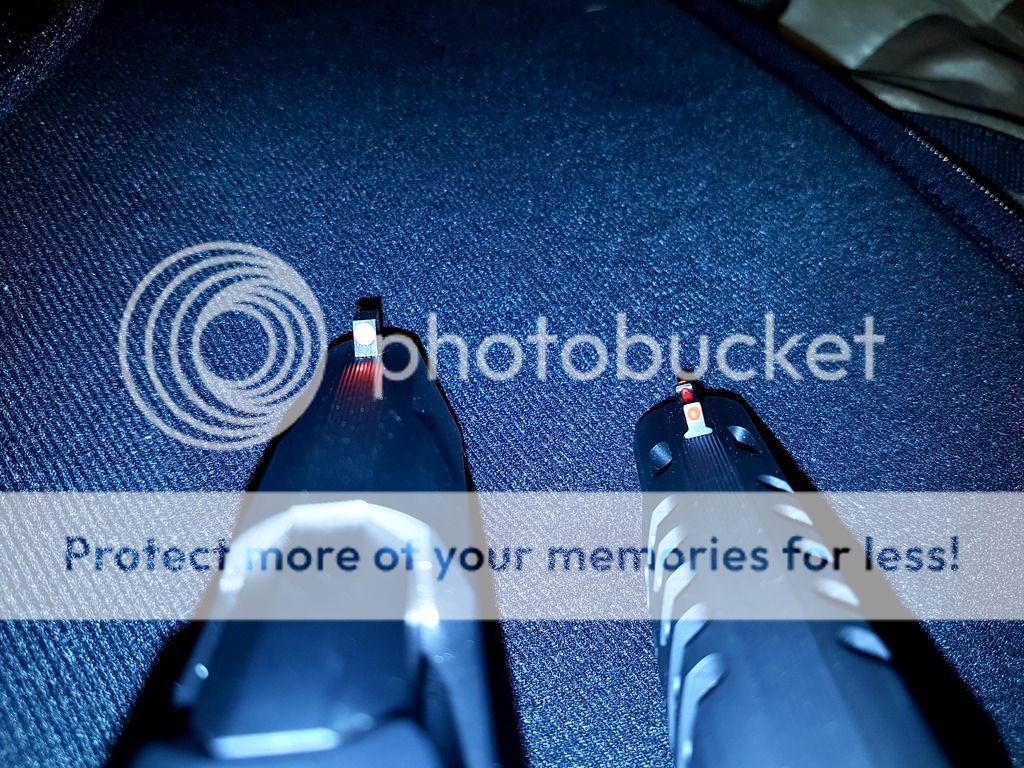
Okay, so I just did some dryfire drills and I think my problem is that I am just used to a much brighter (and WAY bigger) front sight dot that I can easily track with the gun just about anywhere in front of me. I have been using Trijicon HD sights, which are insanely bright (hard to capture in my pic below because it just looks white, but check out the reflection on the top of the slide). I'm moving to a fiber optic which is much smaller. So I think I just need to get used to subconsciously tracking that front sight...

20170326_105418_zpsw7wlisuo.jpg
 
Also as another note on the sight brightness...

I just started looking for brighter fiber optic inserts, and I had to remind myself of the downsides of the Trijicon HDs. The brightness made it very difficult to focus on the front sight. It "blooms", and it makes the sight seem out of focus. It is sort of visually confusing...often I cannot tell if I am actually focusing on the front sight as it is always a bit blurry. This, combined with the overall size of that dot, and the wide notch in the rear makes them a pretty poor choice for anything more than combat accuracy, IMO.


I wonder if painting the top of my fiber optic sight would provide the best of both worlds...
 
Also as another note on the sight brightness...

I just started looking for brighter fiber optic inserts, and I had to remind myself of the downsides of the Trijicon HDs. The brightness made it very difficult to focus on the front sight. It "blooms", and it makes the sight seem out of focus. It is sort of visually confusing...often I cannot tell if I am actually focusing on the front sight as it is always a bit blurry. This, combined with the overall size of that dot, and the wide notch in the rear makes them a pretty poor choice for anything more than combat accuracy, IMO.

I'm glad to have stumbled upon this post...exactly the setup I'm looking at. I love how bright and easy to pick out TrijHD are and was thinking of putting them on my 5" ppq but for daytime target shooting problem not the right choice.
 
Any tips for acquiring the front sight as quickly as possible when presenting the gun? Those occasional times when I start to come up on target and the front sight is too low and obscured by the gun, it leads to some hunting around. Should I always try to present the gun with the front sight too high on extentension so that it is always in view and drop it into the rear notch? Am I overthinking it and just need to dry fire practice for 8 hours a day?

I used to have the same problem.
My hit factor went up quite a bit in a short period of time.
I had started dry firing 20 mins a day, which really developed that muscle memory to present the pistol at the right angle.
So when i bring up the gun to aim, eveything is already lined up with very little adjustments to be made.

Once that was accomplished, i even started painting all my fiber optic rods blacks, since i now present the gun with good sight alignment and have excellent eye sight, i find a black sight more accurate.
 
The sight (tritium, black or Fiber) doesn't make a difference in this case. It's presentation and repetition.

The draw should be up, (to when your hands get together in front of your chest on the gun) then straight out to the target - which will ensure you're lining up sights on the way.
Then dry fire the crap out of it to lock it into your program.
 
I used to have the same problem.
....
I had started dry firing 20 mins a day, which really developed that muscle memory to present the pistol at the right angle.
So when i bring up the gun to aim, eveything is already lined up with very little adjustments to be made.
...

Yup. Muscle memory is the only answer. No amount of hardware will change bad habits.
 
The sight (tritium, black or Fiber) doesn't make a difference in this case. It's presentation and repetition.

The draw should be up, (to when your hands get together in front of your chest on the gun) then straight out to the target - which will ensure you're lining up sights on the way.
Then dry fire the crap out of it to lock it into your program.

What he said.

Make a deliberate effort to "push out" from having the pistol very close "in front of your chest" and watch (and guide) the front sight to where it's supposed to be as you push out and put the sights where they're supposed to be on the target.

Start super-slow and deliberate, increase your speed as the motion becomes ingrained in your muscle memory.
 
I am in no way doubting the experience of anyone here, but I am not ready to buy into the theory that sight alignment is all muscle memory. Hear me out here...the difference between perfect sight alignment and the rear sight obscuring the front is what...maybe half a degree? Less? And then of course, there is aligning those sights on target which are at different positions vertically. So if muscle memory was all that was at work here, you should be able to look at a spot on the wall, close your eyes, align your sights, and have them perfectly aligned when you open your eyes, repeatably. I am honestly curious if this is possible from the experienced guys.

I'm not doubting the value of training muscle memory, and it's obviously important to all aspects of the sport. I am more so wondering if our eyes are playing a bigger part in presenting the gun than we realize because it is likely happening subconsciously as a result of training.

..and continuing on as if I have any idea what I'm talking about...I suppose it doesn't really matter either way. We still have to put in the reps to get the result we want. Muscle memory would still play a huge part in taking our visual reference points and moving the gun efficiently from point A to point B.
 
Last edited:

The sight (tritium, black or Fiber) doesn't make a difference in this case. It's presentation and repetition.

The draw should be up, (to when your hands get together in front of your chest on the gun) then straight out to the target - which will ensure you're lining up sights on the way.
Then dry fire the crap out of it to lock it into your program.

Exactly! Focus on that front sight when your hands come together and keep the focus on it as you push out to the target.
 
I fully trust in muscle memory
In the winter of 2015, i really wanted to climb the ladders in ipsc standard
I was dry firing more in that 3 months more than i ever had in my life

One of the drills, align sights on target patch on the wall, close eyes, reload, realign gun, click, open eyes
Sights were spot on even if aiming in the dark, gun was an SV 2011 with full black sights, not even a fiber optic insert

So yes, in my case, muscle memory will align these sights way before hardware will, and fully believe in it

Do the challenge, aim and click the gun 5 mins a day without getting into belt setup and routine
You will already aim it better at the range
 
I fully trust in muscle memory
In the winter of 2015, i really wanted to climb the ladders in ipsc standard
I was dry firing more in that 3 months more than i ever had in my life

One of the drills, align sights on target patch on the wall, close eyes, reload, realign gun, click, open eyes
Sights were spot on even if aiming in the dark, gun was an SV 2011 with full black sights, not even a fiber optic insert

So yes, in my case, muscle memory will align these sights way before hardware will, and fully believe in it

Do the challenge, aim and click the gun 5 mins a day without getting into belt setup and routine
You will already aim it better at the range

That's impressive. I think I do pretty good for a new competitor, but I don't think I will be blacking out my front sight any time soon, lol.
 
A tip given to me by a very good ISSF (one-handed) shooter.
It also applies to two-handed grips.
As you know we focus on the front sight since we cannot focus
on more than one distance at a time.
His advise was to get your body to always present to target in such
a position that if you close your eyes and bring your arm up, your
barrel will be pointing at the target. Then with the gun held at the 45 degrees
angle required by ISSF (I shoot mostly one-handed, as a matter of preference)
look at and focus on the front sight. Bring your arm up without changing your focus
until your in-focus front sight which is aligned in your sight picture comes up
to the grayish blackish blurry bullseye. Your eye will not have to be varying its
focus distance throughout this exercise.
 
I had already written my post a few posts earlier, but

I am in no way doubting the experience of anyone here, but I am not ready to buy into the theory that sight alignment is all muscle memory. Hear me out here...the difference between perfect sight alignment and the rear sight obscuring the front is what...maybe half a degree? Less? And then of course, there is aligning those sights on target which are at different positions vertically. So if muscle memory was all that was at work here, you should be able to look at a spot on the wall, close your eyes, align your sights, and have them perfectly aligned when you open your eyes, repeatably. I am honestly curious if this is possible from the experienced guys.

We have a few shooters at the RA who do this. They can close their eyes and raise their gun
and be spot on. They never adjust their arm or shoulders if they're not on target, but swivel
the positions of their feet. They've told me the theory but they have years and years more
experience than me.
 
"Practice" does not make "perfect".

"Perfect practice" makes "perfect".

It is (unfortunately) incredibly easy to ingrain bad habits. Repeating them over and over just makes it harder to correct.

Correcting bad habits can be done by deliberately slowing things down to a crawl.
Have a friend watch and comment or, record yourself from different angles and analyze what you're doing.
 
"Practice" does not make "perfect".

"Perfect practice" makes "perfect".

It is (unfortunately) incredibly easy to ingrain bad habits. Repeating them over and over just makes it harder to correct.

Correcting bad habits can be done by deliberately slowing things down to a crawl.
Have a friend watch and comment or, record yourself from different angles and analyze what you're doing.

That here is excellent advice
Start very slow to insure repetitive "correct" movement, not to ingrain bad habits
Freedom Ventures did point out roughly how to push to gun out and start viewing sights
 
Correcting bad habits can be done by deliberately slowing things down to a crawl.
Have a friend watch and comment or, record yourself from different angles and analyze what you're doing.

Video cameras aren't just for making ### tapes. Set them up and practice drawing on an object 10 meters away with the camera on the strong side.
I bring a camera out to IPSC practice every so often so I can see what I do live fire vs practising. I find I can change the way I draw or move in real time versus what I practice and go over in my head.. either due to fatigue or laziness.
 
Back
Top Bottom