FRT for Bulldog revolver?

Slowbalt

CGN frequent flyer
Rating - 100%
42   0   2
Hi,

Could anyone give me a ballpark idea of how many FRT # are out there for a 380 Bulldog revolver?

Can't seem to find much on proofmarks and such and would like to make sure to have all info before trying the letter thing. (Or are they prescribed?)

Thanks.
 
Need more info. There are several revolvers that go by the name/term bulldog. What specific 380 type? Several are restricted.

There are two different antique FRT listings for bulldog revolvers. Only one FRT shows a caliber close to what you want... 38RF.

Need a make, and a barrel length to be sure of which child frt you need.
 
Would be 380 centerfire.

I'm at work so I'll check the barrel lenght tonight.

Make is a good question, there does not seem to have much markings, need to dig them up.
 
Photos photos and more photos.

There is more than one type of 380 center fire. I only found one antique "bulldog" named revolver in 38rf. Anything else 38/380 named bulldog was restricted or prohib.
 
Last edited:
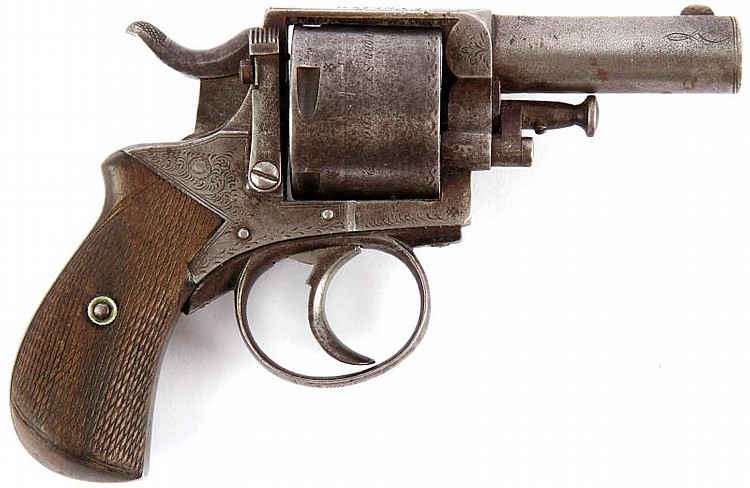
I'm seeing a lot of similarities with yours and this...

H1069-L42778967.jpg


Description: English Bull Dog revolver, made by E. M. Reilly & Co. of London. Two British proof marks on left side of barrel, as well as on each chamber of cylinder. Britain and France addresses on cylinder, and "ENGLISH BULL DOG" on top of frame. Checkered wood birds beak grips. Mottled grey patina to surfaces, with light flattening to checkering on grips. Fair bore. Overall good example. Caliber: .44 Serial #: None

Maybe same maker, but different models.

Will dig more.
 
Well, that's my first step in antiques so my knowledge is limited...

Was told it was a belgian bulldog so off I went thinking it was..

What do you think mine would be?
 
The caliber is likely .380 Revolver

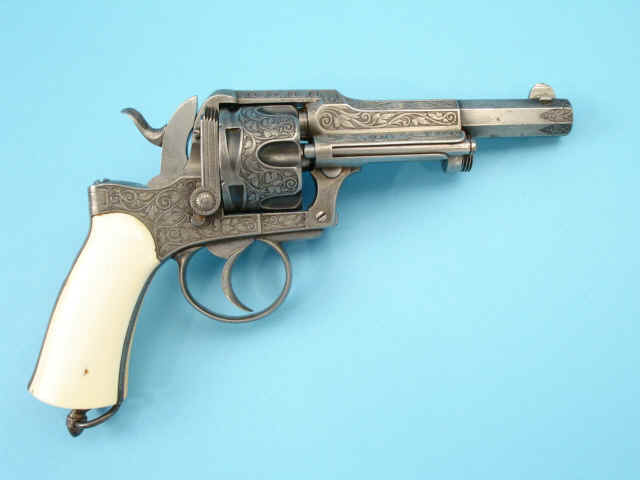
That looks more like a RIC copy than a bulldog to me.

Barrel length is a bit more than most "bulldogs" as a "bulldog" has a snub nose, hence the name.

Bulldogs were often stamped "Bulldog" on the top strap.

the sights and fixed ejector are different from most Belgian Bulldog type revolvers I recall

You need to look it over very carefully for markings. The back of the cylinder is a good place to start. If it is indeed Belgian it should have proof marks there.
 
I don't think you'll find an FRT for that - unless it has a manufacturer engraved into it somewhere it'll be tough as there are almost no records on turn of the century producers - many were part of larger manufacturing conglomerates or made guns or parts on contract for a larger wholesaler. Generally each maker had some sort of distinctive appearance of their parts because of their skill set, the intended quality or manufacturing process.

That said, if you can prove it won't chamber any of the no-go cartridges (based on what will fit, not what it's nominally chambered for) and has a proof or markings that date it to pre-1898 you don't need an frt number and can get an antique letter.

From appearances I would say it's probably a good quality belgian gun, or possibly french? I haven't seen a ton of independently produced french guns so it's a tough call... I'd hedge my bets on belgian
My thoughts are:
1873 MAS style ejector
1873 MAS style loading gate

Belgian bulldog style trigger guard - both shape and fitting

Grip - angled like a pinfire, but profiled similarly to the pryse.

Above average belgian style cylinder, frame and barrel
- Frame is a little more contoured than your average bulldog - a lot more along the lines of the 1873
- Barrel almost looks like a pryce
- Front sight looks a lot more like those seen on belgian pinfires
- Cylinder - slightly more contoured than the usual with fluting rather than dished walls. Similar to British RIC's and pryse guns of the era.


Considering that the belgians produced both contract guns for other manufacturers/arsenals and also made knock-off firearms of questionable quality it doesn't surprise me that this gun shows characteristics from several different guns. My general thought is that it shows a lot of early cartridge gun designs - pinfire, 1873 mas, pryse... all of these fell out of favor as better designs and faster manufacturing processes were developed. Then again... maybe the maker built this later on using designs that were no longer patented to avoid legal infringement.... oh the joys of antiques :p

End of the day only way you'll be able to prove its status is by showing a pre-1898 proof mark and proof it can't chamber no-go cartridges. Hope this helps!

 
Last edited:
How do I get around to that? I'll need to buy dummy rounds for all the no-go calibers??

It's what I do :p Often antique dealers will have some to test in the chambers if you can't see them directly. Otherwise you only need 11 of them really - probably cost $30 all told at $3 or so/cartridge. - empty case with no primer is an easy way to do it. If you're only buying certain guns then you can just buy the cartridges that fit the given bore diameter.

I should also note, a lot of people simply go by what the gun is listed or said to be chambered for and don't check other calibers, however the antique regs will leave you high and dry, even with antique paperwork if you don't check because the regs state: " capable of discharging centre-fire cartridges, other than a handgun designed or adapted to discharge 32 Short Colt, 32 Long Colt, 32 Smith and Wesson, 32 Smith and Wesson Long, 32-20 Winchester, 38 Smith and Wesson, 38 Short Colt, 38 Long Colt, 38-40 Winchester, 44-40 Winchester, or 45 Colt cartridges."

This means that if your 380 revolver chamber is cut with loose tolerances and will take say...38 short colt, you're buggered. In my limited experience the techs consider any cartridge to chamber and allow the gun to function normally to be capable of being fired - obviously there are limitations to this what with excessively undersized cartridges, but the short is that if it'll fit, load and cycle, it's considered to be capable of being fired. If you can prove that say, the gun would explode due to say, the original chamber being heavily necked, then you might have a chance, but the vast majority were only lightly tapered or straight wall so probably no luck there. If in doubt, research and call to ask for clarification.

Fortunately you may find that some of these guns shot heeled bullets, so while their bores mic to a standard 38 cal diameter, the chambers are far too tight for the no-go cartridges. Alternatively the chambers might be cut quite short, not allowing other no-go cals to properly seat.
 
take off the wood grips the makers initals should be there on the side of the grips frame.
then we can help you more. take pics of the makers initals to.
being belgian its likely 380 if theres a taper to the chamber you can see with your eyes good chance its a 380.
get a factory 380 cartridge first or a resized 380 case and try it you will see right away if its 380 or something else before you get into a dozen cartridges you will never need.

Its for sure pre 1894 so your good there.
 
Here are the undergrips pics.

As for the taper, there seems to be a slight one, no micrometer here to confirm but it looks like it.


Back
Top Bottom