












































Frustrated

icecold

CGN Regular
Rating - 100%
14   0   0
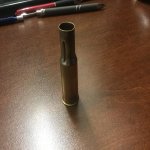
The result of taking a 24 gauge shot shell to resize to the .577/450 martini henry.
The cases have been machined down to the proper length of 2.34, annealled to a slight purple hue, lightly lubed. And ran through sizing die slowly, several times going a little farther each time making sure there is still a slight film of lube present.
Out of 36 cases only 12 were useable.
It seems that the annealing may be the problem. Thoughts. Looked at many different YouTube vids nothing jumps out.
Lanolin and 99% alcohol a 10:1 ratio. Rub lightly with finger tips. Also tried the lee lube that comes with some dies.
Help appreciated. Going to go broke at this rate wasting cases, and loosing hair faster than loosing cases to the recycle bin.
Thanks 5AAC9880-338B-40C3-A0CE-FAB9D877AFE0.jpg

 

Attachments

  • 5AAC9880-338B-40C3-A0CE-FAB9D877AFE0.jpg
    5AAC9880-338B-40C3-A0CE-FAB9D877AFE0.jpg
    94.8 KB · Views: 615
Anneal the mouth. Size that area. Anneal again and size again. Repeat until fully resized. If all of the annealing is done in one step the brass is to soft. Small steps. Each annealling should be farther from the mouth for each step. Don’t fully resize the case in one go. The other way is to have bushings made to reduce the neck in steps.
 
That happened to me aswell. But i was making 25-20 brass out of 32-20. I never did figure it out as before i did i bought some brass of the EE. Im interested to see why
 
My experience leads me to believe those creases are the result of too much lube.
I would back way off on the amount of lube that is on the neck/shoulder area of
those cases.

I have formed a number of cases over the years, and creases were almost in-
variably caused by lube. If you are forming just the neck and shoulder, [not the
body] you should actually need very little, if any, lube. Dave.
 
hate to say it but I would be tempted to fire that anyways :)

I am fortunate to have a small pile of 577-450 brass but every one is precious.

and what do you have to lose... oh and a light load.
 
My experience leads me to believe those creases are the result of too much lube.
I would back way off on the amount of lube that is on the neck/shoulder area of
those cases.

I have formed a number of cases over the years, and creases were almost in-
variably caused by lube. If you are forming just the neck and shoulder, [not the
body] you should actually need very little, if any, lube. Dave.
Tried the just a whisper of lube trick, was about to rip the turret mounting bolts from the bench. It just wouldn’t go at all.
 
Anneal the mouth. Size that area. Anneal again and size again. Repeat until fully resized. If all of the annealing is done in one step the brass is to soft. Small steps. Each annealling should be farther from the mouth for each step. Don’t fully resize the case in one go. The other way is to have bushings made to reduce the neck in steps.
Well doing the annealling in small steps sounds reasonable. Will give it a go.
 
I to would fire those cases and see what you get. I've it happen to other cases I've formed and the wrinkle will come out but you can still see it was there. I do think that you annealing is what caused it. See how much can be done without annealing and if you get them down anneal after swedging them.
 
Had a bit of debate tonight about annealing temps. Most often I have heard was 750F. Others say 500F. Who is right?
Also does anyone have any thoughts on saltbath heat treating? Looks fool proof.
 
well first off comeing from a guy that's done lots of them, you cant go it all in one step. 4-5 steps are whats needed. like has been said u must use other dies and bring them down a few calibers at a time. its been a long time since ive done it I cant remember what I used, but that's how its done. RCBS at one time sold a die set for doing this. as to annealing, I do it in the dark and as soon as I can see red in the brass it drops in the water bucket
 
My experience is that any annealing of brass before a large down -size as is being discussed here is the start of problems.

I have formed a hundred or so 38-56 cases from 45-70 (basically the same amount of re-mods as the OP). I agree with Beater that it must be done in small increments with whatever die bodies you have available until real close to finished size, then use your final sizing die ( My final sizing die was cut with the chamber reamer I cut the chamber with). The first 5 I did I just used cold un-annealed "many times fired" brass. They required a lot of press pressure to form but came out satisfactory so I thought that annealing would lessen the force required and would be a good thing...but after annealing I started getting a lot of wrinkles same as the OP shows...so back to using un-annealed cases, and my success ratio returned to 100% usable cases.

As I said earlier, sizing pressure is considerable and I have an old 1960's era Herters C-press that is built like a Russian tank that can take the force required ( I could use a snipe on the handle without worrying I think). I think any of the cast iron complete "O" presses now used would handle the chore but I wouldn't use my Dillon or Lee rotary in such a fashion.

Another tip I found works is to downsize a bit "past" chamber size and then fire form as a last step. Every round will chamber doing it this way. If you try to just size & shoot some of the cases have a bit of "spring back and will be very hard to fully chamber...in my experience anyways.
 
Have you got any other dies you can use to make smaller reductions in the case necks?

Think outside the box. Maybe 300 Ultra Mag, 460 Weatherby, 375 RUM, something big to take it down from 0.577" in stages, not all at once.

I agree with this ,if you have the usual amount of odds and ends that seem to collect on a loading bench. In the past I have used an rcbs bullet puller for this very job. Remove the collet and polish the inside of the body a bit, use case lube sparingly, and carefully run the case into the body of the puller as you would a die. This brings the shotgun case a lot closer to the diameter needed and gives you a good start on the resizing job.(just don't go past where your shoulder will be or....!) catnip
 
You can dig around online and find out what a Drill bushing looks like. They are really cheap, they come in accurate sizes, smoothly polished and round, and can be had with a really nice radius on at least one end.

They make a pretty nice resize die, I am told.

You can make your own with a drill press and some sandpaper. Not as hard, not as round, as smooth as you have the patience for...

I would be exploring the idea of taking the neck down in several steps with annealing between steps or every second step down in size before tryuing to run the brass through the final size die.
Watch the neck wall thickness too. As the case gets smaller diameter, the brass has to end up somewhere...
 
Back
Top Bottom





















