Full length vs. Neck sizing for hunting

BH, you have what is known as an aberration in that long chamber, but you are correct in your observations.
Once in a while, there is an exception to the rule, and then you have to act accordingly.
That is where an experienced reloader can adjust to the specific rifle. Partial sizing does work for your 30-06,
and that is the best way to make it work. ;) Dave.

If he has a rifle that can't shoot FL resized ammos it probably can't shoot newly manufactured ammos either. That's called a defective rifle.
 
..... There’s been enough testing and groups posted showing the gains of neck sizing to be negligible. ...

This and the more and more you read you see that neck sizing is hardly worth the effort in accuracy gains. I got all caught up in this and when I decided to call it quits on NS my accuracy suffered
next to NIL.
The only advantage is working the brass less increases the #'s of reloads you get from a case but eventually you will have to FL size them all.

Hunting rounds always FL size!
 
If he has a rifle that can't shoot FL resized ammos it probably can't shoot newly manufactured ammos either. That's called a defective rifle.

Not always the case: I saw a rifle work flawless with all factory loads and several different reloads but would not chamber reloads with nickle cases at all. All loads done by the same person, with the same press and the same dies.
Nickle cases can have a certain amount of rebound meaning you need to size them twice or more to get "true" sami dimensions or run them through a small base die.
 
I do not neck size, ever. No point.
Just full length size every round but instead of adjusting the sizing die to cam over start high and adjust the die tighter and tighter testing the brass in the chamber till it chambers smoothly without any tightness (you'll feel it when it's right). This will be about .002 shoulder bump, you'll get the same brass life and it will chamber reliably every time.

One thing that hasn't been mentioned yet is that for hunting rounds make sure you're not trying to load out really close to the lands. Since hunting typically involves removing an unfired round the last thing you need is a bullet stuck in the lands and an action full of powder when you're in the field.
Hunting loads don't usually require the same level precision so loading like it's a 1000yd precision rifle is not required.

However.
If you are an established reloader and you have your favorite load that your rifle likes and you've put a couple hundred loads through the rifle without any issues and you can fill a magazine and shoot a couple then chamber and remove the third without problems I would just keep doing what's working.

This is all dependent on a lot of factors and in the end only you can judge if what you're doing is reliable and the best way to load for your particular rifle and situation. Do not go hunting with untested rifle or cartridges and you should be fine.
 
Partial fl size with a bushing die is the best method I've found for consistency, reliability and working the brass the least.
One pass and done, what could be better?
 
Not always the case: I saw a rifle work flawless with all factory loads and several different reloads but would not chamber reloads with nickle cases at all. All loads done by the same person, with the same press and the same dies.
Nickle cases can have a certain amount of rebound meaning you need to size them twice or more to get "true" sami dimensions or run them through a small base die.

But that's a problem with nickel cases, not a problem with FL resizing.
 
However.
If you are an established reloader and you have your favorite load that your rifle likes and you've put a couple hundred loads through the rifle without any issues and you can fill a magazine and shoot a couple then chamber and remove the third without problems I would just keep doing what's working.

This is all dependent on a lot of factors and in the end only you can judge if what you're doing is reliable and the best way to load for your particular rifle and situation. Do not go hunting with untested rifle or cartridges and you should be fine.

I agree with this. For most people, the answer seems to be "always full length resize", but that doesn't mean it is the only answer for all circumstances.

For 3 years I reloaded .270 Win with a Lee Loader (it only neck sizes) and used the rounds in 2 bolt action rifles (same brand) indiscriminately/interchangeably. Several hundred rounds through each rifle without a problem at all. I had no reason to do this other than the fact that the Lee Loader was all I could afford at the time. I am not saying this is the right way, or that it proves anything other than the fact that in some cases neck sizing is not a problem at all (until it is, I guess).

I have a press and full dies sets now. I full length resize new brass, load it, shoot it at the range once, and neck size after that. Eventually I will need to full length size it again. The only reason I have chosen this process is to increase brass life (minimize work hardening). If I ever get an annealing system set up, I'll reconsider. I guess if I ever have an issue with stuck rounds, I'll also reconsider. So far, so good.
 
Yes but not a defective rifle as you suggested. The rifle I witnessed continues to run flawless.

If it can take FL resized and newly manufactured ammos, it's not defective. bearhunter's rifle can't shoot those, therefore it is defective imho. Your flawless rifle is entirely different from his defective rifle.
 
If he has a rifle that can't shoot FL resized ammos it probably can't shoot newly manufactured ammos either. That's called a defective rifle.

I don't know what you missed, that's pretty much exactly what I wrote, with the fix rolled in :)

It will only chamber the odd factory loads and only from specific lots and as I wrote, I don't know how that rifle got out of the factory. It's basically got a match chamber that needs proper neck sizing, achieved by turning down the outside of the neck and using a special insert in the die.

This rifle will shoot select loads as well as most match rifles.

One thing about rifles today, they're made on CNC machinery and most tolerance are right on nominal spec. Same goes for factory ammo, which is also manufactured to tighter tolerances than it was a decade ago. This bodes well for both hand loaders and people that only shoot commercial ammo. In many rifles today, factory ammo shoots as well as the rifle is capable of.

I have a lot of friends that no long reload because of this.

FL resizing is hard on brass. I started reloading to save money and make accurate ammo. When any component of a handload changes, usually accuracy changes as well. I tend to hold onto my favorite firearms, especially those used for hunting. I normally keep the handloads for each rifle separate and set aside for that rifle. This makes partial resizing very attractive and I get a lot of reloads out of my cases. I have some old Dominion brass that has over 60 reloads on them and they're still just fine for more. Won't happen with FL resizing.

I don't see any problems with FL resizing at all, especially if it gives you some comfort that you've alleviated a potential problem.
 
Last edited:
I only hunt with brass that I have full length sized. I once had a barrel that had a chamber that was slightly non-concentric. I think the finishing reamer was not run in straight and left a small "ridge" on one side of the chamber. Because of this fire-formed brass was not perfectly round. When I neck sized my hunting loads they would chamber BUT ONLY IF they were chambered in the same orientation in which they were formed. If they weren't in that same orientation they would sit proud of the chamber by about .010", preventing the bolt from closing (like a no-go gauge).

I discovered this crappy chamber at the worst possible time and it cost me the largest whitetail buck I've ever seen on my hunting grounds. Even though this rifle has been remedied by rebarreling and chambering (and every one of my other rifles inspected) I now only hunt with full length sized loads.
 
My hunting rounds are either factory rounds or FLS'd once fired brass from that gun. I have never had issues while hunting with handloads, I have with guns, but not the loads, didn't own those guns much longer after that, either.. I loaded 100 rds for my 7-08 and 100 for my 338wm once I had the load worked up, put them off to the side, used 3-6 each year to recheck sighting. Rest of the year I shoot neck sized. I leave the sights set for the hunting round all year, worked up loads for plinking that are close on POI with different bullets and don't worry too much about where they hit on paper, as long as it's within an inch or so. Most of the time it's closer than that.
 
Why is everyone so worried about working their brass?
Unless I'm shooting something like my 7 SAUM which is $100/25 pieces of brass or some other super expensive brass I don't care if I work it a little more than I absolutely have to. When the brass gets tired I buy some more. My 308's get FL sized every load, I don't care if I only get 8 reloads instead of maybe getting 10, it's a consumable part of shooting and it's not that expensive to buy 100 more pieces.
The increase in accuracy from FL to neck sizing is what? Is it even measurable? 1/16 moa improvement? Is it worth the cost of annealing equipment or the time spent adding more to the reloading routine? Not to me, maybe if I was competing or if I was shooting 1000 yards regularly but for me and the shooting I do these days I can't be bothered to worry about extending my brass life by a couple loadings or potentially improving the accuracy by an amount that my shooting ability is not going to be able to utilize consistently.

And even my 7 SAUM is getting FL sized, I just adjust the dies for the least amount of forming to get smooth chambering.
 
Nothing nicer than having a neck sized brass refuse to eject meanwhile you have a hit elk stumbling around the field 1/4 mile out.
 
I prefer full length resizing, but I will neck size only for my milsurp rifles with long fat chambers for shooting at the range. And chambers and dies vary in size and sometimes the sizing die is not a good match to "your" chamber. Example I have a standard Lee full length .223 die that will reduce the body diameter and push the shoulder back further than my RCBS .223 small base die.

"BUT" the quality of the brass also has a effect, in another forum a reloader bought some high quality Peterson 308 SRP cases and has full length resized them over 35 times. He is saying the cases are becoming hard to resize and is asking if the cases are at the end of their useful case life. And in a Enfield forum years ago one member got 32 reloadings out of his .303 British cases by just neck sizing before the necks started to split.

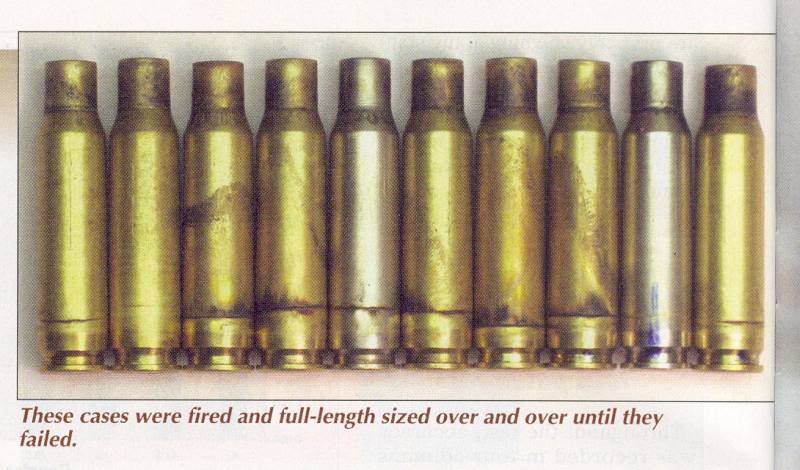
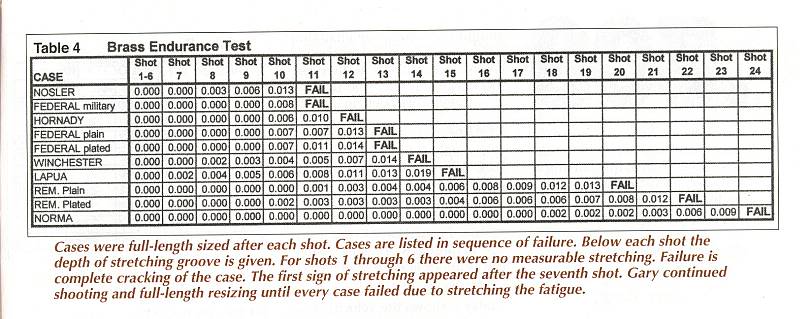
Below is a endurance test of .308 cases fired in a new Savage rifle and full length resized over and over until they failed. Look at the bottom chart and note when the cases started stretching in the base.

TDwPD1Q.jpg

XEuny9C.jpg
 
I think a lot of the brass stress i have seen is from poor die setup. There isn't really a need for 5-10thou resize, all that does is fatigue the metal sooner than it should.
 
Oversizing is a common issue, I was guilty of it in the beginning, around 1980. Lots of beginners just screw the die down to touch and ram the brass in there, not taking into account the fired brass only needs to be bumped maybe 2 thou to work and extend brass life. CF5 has a good point, we tend to want to make brass last forever, when it really is relatively cheap for most of what people shoot. Me, I'm lazy, I hate doing the lube prep and cleanup on FLS. If I can avoid it, I do, neck is way simpler, but, I will make the extra effort for a hunting round.
 
Back
Top Bottom