Fun first reloading experience

csteeves

Member
Rating - 100%
3   0   0
Location
Edmonton, AB
I just wanted to post so that everyone can point to my mistakes at the same time.

I’m new to reloading. My brother in law had a full kit that he was given but wasn’t opened. The deal was he’d give it to me if I reloaded for him. Seemed like a great deal. I shoot 270, him a 270 wsm.

Over the winter I very carefully load up 40 rounds for my 270. I buy the appropriate gear when I need it. I want to not mess up the seating depth so I buy the Hornady measuring tool. Then life happens (I become a father) and I don’t get to fire my rounds. They chamber properly.

Hunting season approaches so I load up the rounds for the brother in law. I carefully keep the similar but different components far apart to avoid confusion. I load up 25 rounds for him. It’s done, I’m pumped.

I decide to make sure they chamber before I send them back to him an hour and a half away. The bolt won’t close. Weird. I measure them to the ogive again and reguage the rifle. Totally fine. .02 off the lands. Perfect.

I check the factory ammo I have for it, it’s measuring way less. Almost .1 inches. I check the overall length of the brass. It’s past the trim length. I check the next one, then the next, then the next. All over. I didn’t trim them.

Off to the store to buy a bullet puller. An hour and a half later, I’ve got all the bullets pulled. I trim them all to just below 2.09. I decide I’ll run them through the resizing die with the ejector backed out to the last thread. I prelube the case. I run the first one up and boom, uncontrollably stuck. Rim tears off. I’m now holding a paperweight which used to be a resizing die.

Worst part? I’m still not even sure that I needed to resize them or if that was the problem.

Reloading is fun.
 
If a case is fired in another chamber and resized it may not fit in your chamber due to brass spring back after sizing. You need your brother-in-laws rifle to check the case fit, but if you measured the fired cases before sizing and set the die for the correct shoulder bump you should be OK. "BUT" the OAL for your brother-in-laws rifle is unknown so his ammo should be set to book OAL. Bottom line I learned the hard way, and today I would not load for someone else's rifle unless I had it in my hands. Trust me, if your reloads do not fit in your brother-in-laws rifle it will make you look bad. And if I had a choice I would not load for anyone else just for liability and safety reasons today.

I had a .270 Remington Gamemaster pump and my uncle has a .270 bolt action made in Czechoslovakia but it had a very tightly headspaced chamber.

Even the cases fired in his rifle and sized with a FL RCBS die would not chamber. And I had to lap the top of a shell holder and remove .003 to get his cases to chamber. So I had egg on my face when my uncle gave me the reloads back and said the bolt was hard to close. Luckily after deer season he let me take his rifle home and got the problem ironed out.

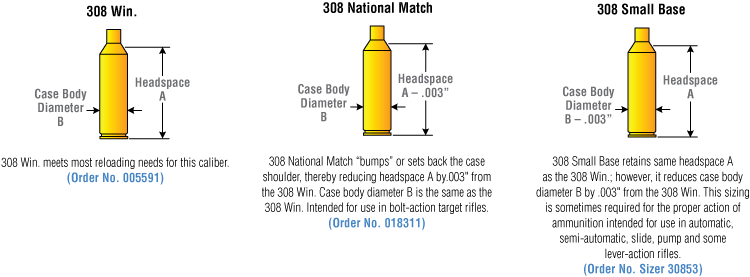
Below chambers and dies can vary in size and when you full length resize the case is squeezed and the brass flows upward in the die. And the case shoulder must be pushed back below the red dotted line below if the case is to fit in the chamber.

wm05ArY.gif


Below Forster sells three types of dies for the .308 Winchester to match the type chambers.

gFCObJR.png
 
I also load for 270win. What type of brass did you use? Once fired from his gun, or new, or range pickup? If its new brass then it should be ok, but it doesnt hurt to run it through a full length die. If it's range pickup or fired through another gun, definitely run it through the full length die. I just use a collet die for my brass after they have been fired through my rifle and then bump the shoulder back once the headspace changes too much. Then trim it when it grows too long.

Seating the bullet right off the lands can be good, but it doesn't always need to be that close. I always start far enough off the lands that it chambers easily in any rifle while I determine my optimal charge weight, then later on I play with bullet seating depth (slowing moving towards the lands while watching the chrony data and group size).


Just curious, what are you loading the 270 win with?
 
If you're not making mistakes you're not learning. Believe me when I say that I have learned a lot the hard way. But it's also been over 2 years since I've used a factory round so not all bad. Buy some spare parts, wreck stuff, redo stuff, enjoy the ride.
 
In regards to the stuck case, you can drill out the primer pocket/flash hole and then tap the hole and use a bolt with washer stuck over top of the correct size of wrench socket and pull it out (by screwing in the bolt). I got a 300wm case stuck once and managed to get it out after ripping the base off.
 
Basic # 1. If brass is not new virgin brass or brass that came from being fired in the same rifle - it MUST be full length sized. That means the die base has to come down and hit the shell holder.

If you were loading fired brass, failure to FL size would be the problem.

You should be able to lube the case overnight and then tap it out with a cleaning rod or brass/steel rod bought at Home Depot. Do not use a wood dowel.

Edit: Sorry. I thought case was stuck in the chamber
. Remove the decapper pin assembly, put die in the press, drop in a 4" 3/8" bolt and hit it with a hammer.

If the brass does not re-enter the sizer, ic an see why it did not go into the chamber. It was not adequately full length sized in the first place.

Next time, check the sized brass for chambering BEFORE loading it. One of the lessons most of us learned the hard way.

What bullet and powder charge did you use in each caliber?
 
Last edited:
Start at the beginnning and use a process of elimination. A case fired in a rifle should go back in it. Size it and try to chamber it. If that goes; seat a primer and check again. Good? Charge and seat a bullet with the die screwed out far enough that there is no possible way the crimper is touching anything. Lots of problems are caused by crimps people didn't even know they were making. Chamber that is a safe area, or with the bolt taken apart or whatever you need to do to avoid shooting anyone. If that works; think about setting the crimp if you want to.

Once you know where the wheels fell off, finding them is easier.
 
Lets go back to the very beginning..

From what I am seeing you just randomly picked a charge weight out of a book and loaded up a bunch of cases for both yourself and your BIL without working up to a safe pressure level.

It may be that if this is true the fact the cases didn't chamber may have saved you from a blown-up rifle.
 
Lots of possibilities here. First, the Hornady bullet comparator tells you nothing about whether or not the brass will chamber. You need a headspace comparator and brass that was fire formed with full power loads. Now if I had to geuss I would say you may have set your FL die up wrong. An easy newb mistake is to not have it turned in far enough. The die instructions will tell you to turn it in till it touches the shellholer plus X percent of a turn. You may have missed that step to have shoulders pushed out past the rifles headspace. But to be sure you're sizing all the way you need to run the case into the die and look between the shellholder and die. Often using the die's instructions will leave a small gap between the die and shellholder due to flex in the press. Make adjustments until the shellholder actually touches the die when FL sizing a case. It takes a lot of force with some cases and each press has varying amounts of flex. Now for your stuck case, which brand of die is it? Some are designed to make stuck case removal a PITA, some are designed to make it easy. The bottom line is you didn't use enough lube. Figuring out which brand of die it is will determine how the case is removed.
 
I have a full workout for both rifles starting at minimums for both. I loaded a bunch of middle of the road, in terms of charge, rounds on the assumption that the workup wouldn’t show any pressure signs for the 270 wsm.
 
Lots of possibilities here. First, the Hornady bullet comparator tells you nothing about whether or not the brass will chamber. You need a headspace comparator and brass that was fire formed with full power loads. Now if I had to geuss I would say you may have set your FL die up wrong. An easy newb mistake is to not have it turned in far enough. The die instructions will tell you to turn it in till it touches the shellholer plus X percent of a turn. You may have missed that step to have shoulders pushed out past the rifles headspace. But to be sure you're sizing all the way you need to run the case into the die and look between the shellholder and die. Often using the die's instructions will leave a small gap between the die and shellholder due to flex in the press. Make adjustments until the shellholder actually touches the die when FL sizing a case. It takes a lot of force with some cases and each press has varying amounts of flex. Now for your stuck case, which brand of die is it? Some are designed to make stuck case removal a PITA, some are designed to make it easy. The bottom line is you didn't use enough lube. Figuring out which brand of die it is will determine how the case is removed.

Thanks for your reply addressing my issue. I’m actually pretty confident that I set my resizer properly as this was an area I was unsure on and spent a lot of time making sure I got right. In terms of the stuck case, you are totally right, I’m sure it was a lube issue. They are Lyman dies.
 
Basic # 1. If brass is not new virgin brass or brass that came from being fired in the same rifle - it MUST be full length sized. That means the die base has to come down and hit the shell holder.

If you were loading fired brass, failure to FL size would be the problem.

You should be able to lube the case overnight and then tap it out with a cleaning rod or brass/steel rod bought at Home Depot. Do not use a wood dowel.

Edit: Sorry. I thought case was stuck in the chamber
. Remove the decapper pin assembly, put die in the press, drop in a 4" 3/8" bolt and hit it with a hammer.

If the brass does not re-enter the sizer, ic an see why it did not go into the chamber. It was not adequately full length sized in the first place.

Next time, check the sized brass for chambering BEFORE loading it. One of the lessons most of us learned the hard way.

What bullet and powder charge did you use in each caliber?


Thanks for the advice. I use 130 gr accubonds in the 270 win. I’m using H4831 with it. and 140 gr accubonds in the wsm. I have workups with both and also loaded some middle of the range 270 wsm rounds. I’m using IMR 4350 with the 270 wsm.
 
Some thing nobody seems to have specifically addressed is the sizing. With regard to WSM cases, I have had two different WSM calibres, .270 Win. and .300 WSM. In both cases I found it necessary to "cam over" in order to get the cases to chamber. I had never previously found this to be necessary in non-WSM cases. In case you are not familiar with the term "cam over" it means to set the sizing die down so it touches the shell holder then continuing to set it down even further. When working with the WSM cases I found it necessary to do a normal sizing and then stop and try entering the unloaded case in the chamber of the gun the cartridge is intended for. If the case will not enter then turn the sizing die down a little further. The idea is to set the base of the neck down enough to allow the case to enter the chamber.


To get enough "cam over" the press handle may become quite hard to take through a full rotation. As I said before I had never experienced this problem with other than WSM cases. At first I thought I had the sizing die screwed in too far. Eventually I learned that without doing this the cases would not fit into the chamber of the gun involved. Am not saying this would be necessary in all cases but in my experience it was necessary in order to solve the problem with my two guns. Once done I found it possible to back the sizing die back out a little on subsequent resizing.

Just another option for you to try. Best of luck.

Jim
 
Some thing nobody seems to have specifically addressed is the sizing. With regard to WSM cases, I have had two different WSM calibres, .270 Win. and .300 WSM. In both cases I found it necessary to "cam over" in order to get the cases to chamber. I had never previously found this to be necessary in non-WSM cases. In case you are not familiar with the term "cam over" it means to set the sizing die down so it touches the shell holder then continuing to set it down even further. When working with the WSM cases I found it necessary to do a normal sizing and then stop and try entering the unloaded case in the chamber of the gun the cartridge is intended for. If the case will not enter then turn the sizing die down a little further. The idea is to set the base of the neck down enough to allow the case to enter the chamber.


To get enough "cam over" the press handle may become quite hard to take through a full rotation. As I said before I had never experienced this problem with other than WSM cases. At first I thought I had the sizing die screwed in too far. Eventually I learned that without doing this the cases would not fit into the chamber of the gun involved. Am not saying this would be necessary in all cases but in my experience it was necessary in order to solve the problem with my two guns. Once done I found it possible to back the sizing die back out a little on subsequent resizing.

Just another option for you to try. Best of luck.

Jim


Thanks for your valuable insight Jim. I’ll see if that’s required in my situation. I appreciate the insight that addresses my problem.
 
Verify lubing procedure
DO Buy the hornady headspace gauge (its inexpensive) - measure fired case. Then measured resized case and compare. Adjust die to give you 3-5 thou (ish) bump when sizing for hunting rounds. I adjust ALL my dies for proper press cam over - that assures me it is the same pressure/amount every time

Hopefully problem solved!

However, i had a set of Lyman 260 dies - i couldn't resize a 260 brass from any of my rifles in it - it was so tight nothing worked regardless of amount or type of lube. Promptly returned those and bought a Forster f/l resizer, never had an issue since.
 
Last edited:
Back
Top Bottom