












































- Location
- Western Manitoba
I am not sure what forum to ask - so will try here. The rifle is based on a Large Ring Mauser 98 action - complete with thumb cut-out along left receiver wall. It has double "set triggers" - so my best guess is that it is a post - WWI product, made in Germany, made up as a civilian hunting rifle - not sure. So trying to understand the proofing marks on it - to establish a possible range of dates that it might have been made.
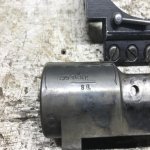
This is the picture of the markings on the left side of the receiver. From somewhere on Internet that I can no longer find, I had read that German proofing requirements were changed a number of times - what got stamped was required by their law - so, the stamping might be a guide to what year(s) the work was done.
It reads, "2,75 g G.B.P." on first line, then S.G. on second line. I understand that "G.B.P." is the name of the specific powder that was used to proof test the piece, so I presume that 2.75 grams of G.B.P. was the proofing load. The S.G. may refer to the bullet used, but as you can see, no bullet weight is given. So this format of "proof" stamping would have been required starting from a certain time until another time. Does anyone know what those years might be?
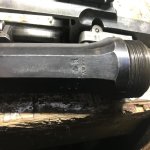
The barrel has it's rear section has a hexagon. Beyond the forearm tip, the barrel turns to round, although there is a continuous solid rib from the receiver to the muzzle. On one of the hex flats below the wood line I found two stamps - a "pentagon" shape under a cross and a Crown over an "N". I understand that second one was mandated after 1912 in Germany - a "nitro" proof, apparently. Those same two stamps are found on the receiver as well - below the wood line, near the front edge of the receiver front ring. On the barrel flat, below the stamps, it says "7.8 mm" which we would likely interpret today as 8x57JS? 7.8 mm apparently converts to .307" - so is likely the bore (the hole) size, not the groove or bullet diameter? Any help on establishing a date range would be appreciated. The original bore has been reamed out on this barrel - is currently a "smooth bore" - so I can not measure that original bore or groove to confirm.
This is the picture of the markings on the left side of the receiver. From somewhere on Internet that I can no longer find, I had read that German proofing requirements were changed a number of times - what got stamped was required by their law - so, the stamping might be a guide to what year(s) the work was done.
It reads, "2,75 g G.B.P." on first line, then S.G. on second line. I understand that "G.B.P." is the name of the specific powder that was used to proof test the piece, so I presume that 2.75 grams of G.B.P. was the proofing load. The S.G. may refer to the bullet used, but as you can see, no bullet weight is given. So this format of "proof" stamping would have been required starting from a certain time until another time. Does anyone know what those years might be?
The barrel has it's rear section has a hexagon. Beyond the forearm tip, the barrel turns to round, although there is a continuous solid rib from the receiver to the muzzle. On one of the hex flats below the wood line I found two stamps - a "pentagon" shape under a cross and a Crown over an "N". I understand that second one was mandated after 1912 in Germany - a "nitro" proof, apparently. Those same two stamps are found on the receiver as well - below the wood line, near the front edge of the receiver front ring. On the barrel flat, below the stamps, it says "7.8 mm" which we would likely interpret today as 8x57JS? 7.8 mm apparently converts to .307" - so is likely the bore (the hole) size, not the groove or bullet diameter? Any help on establishing a date range would be appreciated. The original bore has been reamed out on this barrel - is currently a "smooth bore" - so I can not measure that original bore or groove to confirm.
Attachments


Last edited:






















