Good, bad, and ugly reloading today

Zedbra

CGN Ultra frequent flyer
Rating - 100%
45   0   0
Location
Squamish
With two little munchkins burning down the house, it isn't always easy to get time to dedicate to reloading - but I decided earlier in the week today was the day. I have a new Redding T7 I wanted to put in action and I have a new 7mm Rem Mag rifle that I need to find 'the right' load - the fun part. I also wanted to top up my .270, so I set up all those dies on my first turret plate.

The good - most of my 7mm brass had been sized, trimmed, and cleaned already, so it was just a matter of choosing which powders to dip and what bullets I wanted to push down the barrel. I pulled out some RL17 and some H100 and got ready to get ready.

The bad - as I was working through the 50 pieces of brass I thought were good to go, one, then two - turned into many of the necks were too large and the bullets were dropping in - of course, I find this out after adding primers (I'm not sold on the Redding primer tube feeder) and the hand-weighed powder. So, dump the powder and then hand test each piece of brass before I go any further. Loaded what I could, lubed the rest to resize.

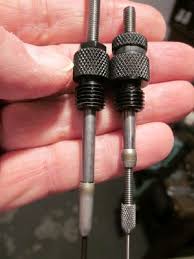
The ugly - Let's just say, I have never felt the love with RCBS dies, and today was no different. After lubing 25 brass and getting ready to resize again, as the necks were toast on some and I had a bucket more to run through, on the very first case the blood inner neck sizer/decapping pin bends and breaks (this is not the first time it has bent). Great. I am throwing in the towel on these RCBS dies: the pin bends, it is necking the brass too large, and no matter how you adjust the dies, they wiggle themselves a little loose and you are always needing to adjust and measure each OAL as you go.

Somewhere, somehow, I lost 100 pieces of .270 so instead of having an epic session at the press, I managed about 30 7mm RM and about 75 .270 in various loads. I was grumbling about it all a little when my wife got home and she says, "oh - you have some brass in this box over here (points to a cabinet in the house)." It turns out I bought dies/brass off hoytcannon a long time ago and totally forgot about it. So, I lost 100 cases and found 200 and a FL die set. <-- more goodness.

I don't reload to shoot the moon, just for hunting 300 yards or less. So unless the collective minds can persuade me otherwise, I am going to pick up some LEE 7mm dies, as all my other LEE dies have been flawless for my needs, never breaking and punching out consistently accurate round after round. More good - I was reminded on Friday that Monday is a holiday here in BC, the range beckons these new reloads and I shall certainly follow.
 
I've never been a fan of decapping and sizing using the same die. I usually punch out primers separately, then resize in a separate operation. It takes more time, but I'm rarely in a hurry and don't load in any kind of volume.
Forgetting that I already have something, let alone where exactly it is sounds familiar though.. lol.
 
I'm also not a fan of RCBS or Hornady dies for that matter, my lee dies have always served me well..., cheaper than the others and comes with the shell holder and some reloading data.
 
I've never been a fan of decapping and sizing using the same die. I usually punch out primers separately, then resize in a separate operation. It takes more time, but I'm rarely in a hurry and don't load in any kind of volume.
Forgetting that I already have something, let alone where exactly it is sounds familiar though.. lol.
^^^^ I have to say this is what I do as well I like the primers gone so I can clean the cases well including the pockets
 
I've never been a fan of decapping and sizing using the same die. I usually punch out primers separately, then resize in a separate operation. It takes more time, but I'm rarely in a hurry and don't load in any kind of volume.
Forgetting that I already have something, let alone where exactly it is sounds familiar though.. lol.

Same here I use the lee decapped and hand prime my cases. Work 100% and all I do after I’d feed, powder seat the bullet and crimp and factory crimp one the old Lee 1000 pro and I am Ready to go

I find this is way safer and eliminates 99% of the problems most people have.
 
Why would you leave the decapping pin in if the brass was already sized and trimmed, no need to punch the primer out, never had trouble with RCBS dies and have necked down 3006 and 270 to 2506 neck with primer still in place.

As mentioned, the necks on some were too large and the bullets were dropping in after I had already primed some - and I had another 50 brass that I hadn't sized yet. Anyways, the pin and the internal neck sizer are now toast - again - they almost bend with enough telepathic thought, so the RCBS dies have just bought their retirement on my press; I'm glad they work for your needs. Do you need to readjust your bullet depth often on yours?
 
You don't need to deprime, just adjust the stem so the decap pin isn't protruding below the die and the primers will stay put. I suspect something is wrong with your setup if you're breaking a lot of pins. I haven't broken one in ages. Last time was on a lot of .308 brass with tiny little undersize flash holes. Broke & bent a couple of pins before I finally clued in.
 
Like 9.3 said, something is wrong. I suspect the decapping stem has been bent. If the stem with the decapping pin and expander button is adjusted to protrude too far out of the die and you try and resize a case the expander button will bottom out on the bottom of the case and you will bend the decapping rod. Once bent the stem is ruined. They are only about $8 to $10 to replace. When setting the die up have the decapping pin protruding from the die just enough to push out the spent primer. Also make sure the decapping rod is centered in the die body when everything is tightened up. If it is off just a bit the decap pin will not line up with the flash hole in the case and you will break pins. Hope that helps.
 
You don't need to deprime, just adjust the stem so the decap pin isn't protruding below the die and the primers will stay put. I suspect something is wrong with your setup if you're breaking a lot of pins. I haven't broken one in ages. Last time was on a lot of .308 brass with tiny little undersize flash holes. Broke & bent a couple of pins before I finally clued in.

I have only broken a few pins over 3 years but I resize about 100 or more shells at a time. I am suspecting that maybe some of my brass' flash holes are getting stretched or not quite where they used to be - not sure. As for the necks being oversized, maybe there was some dried lube on the inner neck sizer? I now use a spray lube and the die looked clean. Nothing else is 'wrong', other than my lost faith in RCBS dies. Laugh2

Like 9.3 said, something is wrong. I suspect the decapping stem has been bent. If the stem with the decapping pin and expander button is adjusted to protrude too far out of the die and you try and resize a case the expander button will bottom out on the bottom of the case and you will bend the decapping rod. Once bent the stem is ruined. They are only about $8 to $10 to replace. When setting the die up have the decapping pin protruding from the die just enough to push out the spent primer. Also make sure the decapping rod is centered in the die body when everything is tightened up. If it is off just a bit the decap pin will not line up with the flash hole in the case and you will break pins. Hope that helps.

Yeah, I may not have had the die adjusted properly on my new press - but as you detail - the RCBS dies have to be set just perfect or things bend. You can buy replacement pins at almost every shop - so it must be pretty common. Thanks for the advice, I may buy the new pin and then just hold onto these 'just in case'.
 
I use mostly all RCBS dies and the biggest issue is,the pin always loosens up.
Gotta check it often.

Having said that, I use lee dies for my 7mm.
No issues at all.
 
I haven't used the decapping pin in a rifle die for years. I actually tap them out with a Lee pin and base. Maybe not the most efficient way, but it is trouble free. I prime rifle by hand with one of the Lee square priming tool. I like that tool. I found that if I release the handle briskly, it never fails. Just my experience. :)
 
I use mostly RCBS dies and have in 40+ years have only broke 3 decapping pins. The Lee universal decapping die I bought recently for 223 has #### the bed twice already doing crimped primers. Just saying not all products from a given company are good or bad.
 
I use mostly RCBS dies and have in 40+ years have only broke 3 decapping pins. The Lee universal decapping die I bought recently for 223 has #### the bed twice already doing crimped primers. Just saying not all products from a given company are good or bad.

I would agree - I do not to paint all of one brand/people with one brush stroke because of the actions of one. But for 7mm MAG, the RCBS dies, for me, have been nothing but frustrating. I have a LEE decapping die for my .270 that has punched hundreds of rounds without a glitch. I would suspect that the quality of .223 brass may have something to do with the pins busting - I didn't think it was worth reloading .223 yet, though I have been saving brass now for a few years.

Anyways, I already bought some LEE 7mm dies of the EE. Problem soon to be resolved.
 
I also have a Lee set in 30-06 that won't size the neck enough to hold bullets firmly, no I don't crimp. I acquired those dies used and only tried them once, but other lee dies I have work as advertised. I do wonder about the quality of some of the equipment manufactured these days, especially with stuff made off shore that was previously made in house.
 
Zedbra

There is nothing wrong with RCBS dies and I have been using them for over 47 years. All my RCBS dies are now retro fitted with Forster expanders and spindle assemblies to reduce neck runout.

There are several reasons that can cause the decapping to break or bend.

1. Cases with off center flash holes.
2. Locking down the expander off center.
3. Dirty or off center shell holder that does not hold the case centered with the die. The shell holder has some slop built in to allow the case to self center with the die. I use a tooth brush to clean the top of the ram and the shell holder. Some reloader remove the metal clip in the ram that holds the shell holder and use a rubber o-ring that will allow the shell holder to float more.

What bother me is you stating the bullets fell into the case after sizing. If the case held a bullet before "why" did the case fail to grip the bullet the second time the case was sized? Meaning "what" made the case necks larger in inside diameter. I normally polish the expander and then measure the expanders diameter. Normally the expander should be .001 to .002 smaller than bullet diameter.

I use a universal decapping die first and then tumble the cases before sizing to reduce the chances of scratching the die and case.

Below Lee dies have the expander clamped in a collet and when tightened it centers the expander. "BUT" on a RCBS die it is possible to lock the expander down off center.

QC9xK5D.jpg


Below on the left is a RCBS .223 expander raised as high as it will move. On the right is the Forster high mounted floating expander, and there is a thick rubber spacer under the knurled lock nut. This allows the expander to float and self center in the flash hole and neck of the case. And center this prevents the expander from pulling the necks off center inducing neck runout.

5kfnKwd.jpg


Bottom line, do not blame the die until you find out what is causing the problem. I have never had a defective die "but" I have overlooked or missed problems that caused the expander pin to break or pull the necks off center.

I spent half my life working on aircraft and the other half as a inspector in Quality Control. And the first thing they taught us about being a aircraft inspector in Quality Control is the following.

97% of all aircraft accidents are caused by human error and only 3% are caused by actual mechanical failures. So ask yourself what is the actual problem with the die and fix the problem.
 
^ thanks for taking the time to embellish a bit about what the issue may be, I appreciate learning more about reloading. I don't have the luxury of having anyone close enough that I know, other than a few long distance shooters I know that insist that if it isn't Sinclair this or Sinclair that, it just won't hit the target. I am sure the issue may be fixed and that many have used RCBS for years with success - I just can't get myself to like the idea of even trying to make these work better by constantly throwing money into them. It isn't just the sizing die, the seating die is always backing itself out and it doesn't like BT bullets at all, often deforming and changing the OAL.
 
^ thanks for taking the time to embellish a bit about what the issue may be, I appreciate learning more about reloading. I don't have the luxury of having anyone close enough that I know, other than a few long distance shooters I know that insist that if it isn't Sinclair this or Sinclair that, it just won't hit the target. I am sure the issue may be fixed and that many have used RCBS for years with success - I just can't get myself to like the idea of even trying to make these work better by constantly throwing money into them. It isn't just the sizing die, the seating die is always backing itself out and it doesn't like BT bullets at all, often deforming and changing the OAL.

First off, all makes of dies have their positive and negative points. Now, don't take this personally but, the most obvious negative points are usually user error. Again, don't take this personally but I think the dies are likely just fine, it is just that you are not giving yourself enough time to learn the nuances of actually making them work like they are designed to work. If you are having problems with neck sizing, make sure you have a Lee collet neck sizing die in your arsenal. They definitely work. Bushing dies work too but they require casing prep steps such as full length resizing prior to neck trimming prior to neck turning followed by the bushing neck sizing. Some excellent quality brass such as Lapua which was purchased new and fired ONLY in one firearm and only reloaded for use in that same firearm may not require as much prep work but almost everything else will. So, clean the brass, full length resize, trim, then use the Lee Collet die. Prime the case, charge the case, seat the bullet. If the bullet is getting deformed then the case is being sized too small, or there is too much powder in the case, or potentially both. If the case is getting deformed seating the bullet I can pretty much guarantee that the neck is being sized too small.

If a Lee Collet die is not working properly, take it apart and clean it up. NEVER close the ram on a Lee Collet die without a case in the die. It can do two things, closing the slots slightly on the collet after which the collet may not open wide enough to let the case neck enter which will crush the case near the shoulder in use, and it will eventually cause a ring to form on the outer portion of the collet taper effectively destroying the proper collet action. If the collet is in good shape but not doing its job, it is possible it has a rough surface and is not closing properly. It should be taken out and hand polished with some fine emery cloth. Make sure it is well cleaned and lubed prior to reassembly - absolutely no leftover grit in between the slots in the collet! They can and will eventually make their way out and make their way into a die in the wrong place. If this does not allow the collet to close down the neck properly to hold a bullet with a minimum of .002" to .003" tension for a bolt gun and up to maybe 0.005" for a gas gun, then the mandrel might be a little too big. You can order a smaller mandrel directly from Lee (Higginson or maybe Western Metal or others) or carefully turn it down in a drill with some fine emery cloth. This requires a great deal of care so that the amount removed is even and not excessive.

If dies are backing out then the locking ring isn't working. Hornady Sure-lock / Lock'n Load locking rings work great along with a proper wrench.
 
Back
Top Bottom