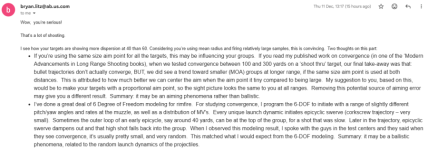
I was looking forward to how you'd pick and choose and misunderstand things he said, Glenn, and you didn't disappoint.  Perhaps that's not entirely your fault, as I did not share what I had written to him, so some of the things that he's saying in response to what I said might not even seem like it is in response to anything, exactly. He does, in fact, talk about both his own centrefire experience and the centrefire/rimfire questions I put to him. I do believe "In summary, I am open to positive compensation as a mechanism that barrel weights could perhaps influence, in general." is a direct response to when I was referring to Kolbe's tests and talking about specific aspects of it, such as adding weight to the barrel to serve as a tuner in order to favour the target distance. "Having said all that, convergence, aka positive compensation is a different thing. The concept of it is hard to argue, and there is historical precedent with the Lee Enfield rifle." Here, he literally says the concept of it is hard to argue, and the remainder of that sentence has to do with an instance of it from his own experience. This would seem to mean that he agrees it is a thing and that it is hard to argue against it. That the example he has first-hand experience with is a centrefire rifle is not confirmation that it does not happen with rimfire. In fact, he talks about how it is a thing with rimfire in that video when he brings up the Lapua test centre example. He does not say, as you think, that this is something that only randomly happens and is not repeatable. He simply says it is something they sometimes see. There's a big difference between the two. When you're only testing at 50 m and 100 m, as the test centre does, it is possible that there only seems to be convergence with some lot numbers in some rifles. I contend that if you repeat testing with the same rifle and lot number that it will always show the same behaviour. And if you tested at more distance increments you'd see it happening basically all the time. The only time it shouldn't happen is if shots are not all exiting on a barrel upswing. I have asked him a few more things in reply to what he said. We'll see if he takes the time to reply again or not. I'll gladly share a subsequent reply from him if one comes.
Eley Club Biathlon
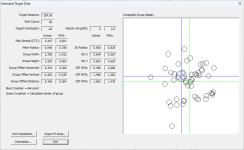
40 m - mean radius 0.536 MOA
60 m - MR 0.512 MOA
77 m - MR 0.575 MOA
100 m - MR 0.885 MOA
Eley Club
40 m - MR 0.769 MOA
60 m - MR 0.510 MOA
77 m - MR 0.500 MOA
100 m - MR 0.739 MOA
Eley Club Biathlon 40 m
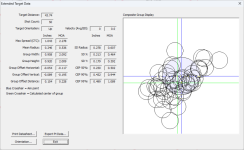
Eley Club Biathlon 60 m
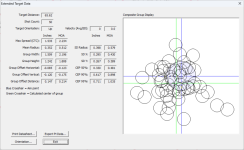
Eley Club Biathlon 77 m
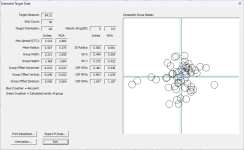
Eley Club Biathlon 100 m
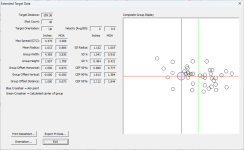
Eley Club 40 m
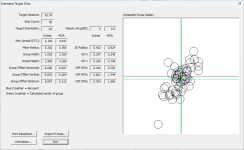
Eley Club 60 m
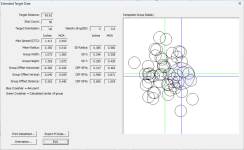
Eley Club 77 m
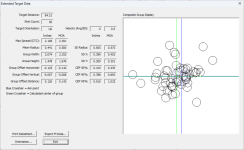
Eley Club 100 m
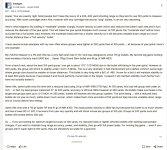
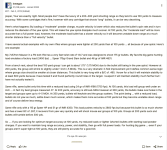
Perhaps that's not entirely your fault, as I did not share what I had written to him, so some of the things that he's saying in response to what I said might not even seem like it is in response to anything, exactly. He does, in fact, talk about both his own centrefire experience and the centrefire/rimfire questions I put to him. I do believe "In summary, I am open to positive compensation as a mechanism that barrel weights could perhaps influence, in general." is a direct response to when I was referring to Kolbe's tests and talking about specific aspects of it, such as adding weight to the barrel to serve as a tuner in order to favour the target distance. "Having said all that, convergence, aka positive compensation is a different thing. The concept of it is hard to argue, and there is historical precedent with the Lee Enfield rifle." Here, he literally says the concept of it is hard to argue, and the remainder of that sentence has to do with an instance of it from his own experience. This would seem to mean that he agrees it is a thing and that it is hard to argue against it. That the example he has first-hand experience with is a centrefire rifle is not confirmation that it does not happen with rimfire. In fact, he talks about how it is a thing with rimfire in that video when he brings up the Lapua test centre example. He does not say, as you think, that this is something that only randomly happens and is not repeatable. He simply says it is something they sometimes see. There's a big difference between the two. When you're only testing at 50 m and 100 m, as the test centre does, it is possible that there only seems to be convergence with some lot numbers in some rifles. I contend that if you repeat testing with the same rifle and lot number that it will always show the same behaviour. And if you tested at more distance increments you'd see it happening basically all the time. The only time it shouldn't happen is if shots are not all exiting on a barrel upswing. I have asked him a few more things in reply to what he said. We'll see if he takes the time to reply again or not. I'll gladly share a subsequent reply from him if one comes.It depends on how you're measuring things, now, doesn't it? 1 MOA at 40 yards is roughly 0.4". 1 MOA at 60 yards is roughly 0.6". 1 MOA at 80 yards is roughly 0.8". And finally, 1 MOA at 100 yards is roughly 1". While 0.4" is smaller than 0.6", and 0.6" is smaller than 0.8", and 0.8" is smaller than 1", they're all 1 MOA. So do they increase in size as you go further out or not? A measurement that doesn't take the distance into account says they get bigger at each step, with the size in inches simply growing each time. But a measurement which takes distance into account, an angular measurement like MOA, says they're all the same size. Here are two examples of 50-shot groups at silhouette distances of 40 m, 60 m, 77 m, and 100 m with an Anschutz 1712 silhouette rifle. In one case the smallest group mean radius is at 60 m, and in the other the smallest group mean radius is at 77 m. And if the same test were carried out over and over with the same rifle/ammo pairings the result would remain similar, since this behaviour is inherent to the pairing of that rifle and that lot number of ammo. That's how they behave when paired together. I've seen this over and over in my testing. This indicates the convergence distance with that rifle and that lot number of Eley Club Biathlon is closer than with that lot number of Eley Club. One looks to be happening somewhere near the 60 m region, and the other looks to be happening near the 77 m region. If you tested at smaller distance increments you could narrow it down even more if you wanted to. One thing to take note of with regard to your comment is that the 40 m Eley Club mean radius is the largest of the four distances for that ammo, despite being the closest distance.I bet if I shot multiple groups at 40/60/80/100 yards in zero wind, every Monday of the year, my groups would all average out to be smaller at 40 and larger beyond.
Rimfire ammo has so many variables out of our control.
Eley Club Biathlon
40 m - mean radius 0.536 MOA
60 m - MR 0.512 MOA
77 m - MR 0.575 MOA
100 m - MR 0.885 MOA
Eley Club
40 m - MR 0.769 MOA
60 m - MR 0.510 MOA
77 m - MR 0.500 MOA
100 m - MR 0.739 MOA
Eley Club Biathlon 40 m
Eley Club Biathlon 60 m
Eley Club Biathlon 77 m
Eley Club Biathlon 100 m
Eley Club 40 m
Eley Club 60 m
Eley Club 77 m
Eley Club 100 m