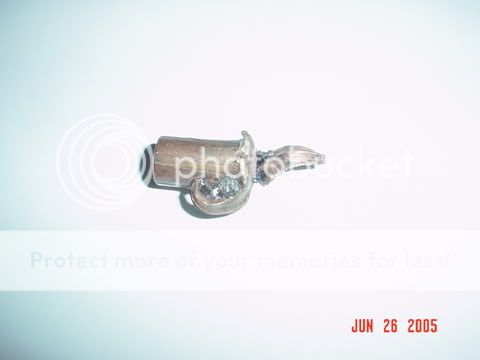
Guess the bullet that was responsible for this ... ..

Not sure that's true.
I have seen lots of bloodshot meat where there was no fragmentation.
It's generally a product of velocity.
The least bloodshot animals I have seen generally come from a 38-55 or lower powered 45-70 type rounds.

Blood shot meat with mono metal bullets? I have shot several deer with a 100gr tsx at 3650fps. There was hardly any bloodshot meat and they don't get much faster than that.

There is an 11 page thread on 24hour regarding bloodshot and mono/cup and core bullets if anyone is interested in reading it. Some good info there.

h ttp://24hourcampfire.com/ubbthreads/ubbthreads.php/topics/5684136/1
 
I'm not 100% sure but what is being discussed is "hydrostatic shock" and occurs at impacts velocity of 2300fps and above.
It's a huge killer and make high velocity cartridges so effective (think 270 Win 130gr 3100fps or 22-250 55gr at 3800fps).
Low velocity cartridges kill by trauma much like an arrow does.

Alex

Well I've seen some cast bullets mushroom pretty good from a 38-55 and can only assume that if they were to hit bone a fair amount of trauma from the big blunt bullet would be causing bruising of the meat. Mind you if the heart is struck solidly there is less bruising no matter what you hit it with.
Archery on the other hand usually kills due to extanguation not trauma. (Loss of blood)
 
http://www.gsgroup.co.za/22x64.html
I've posted this before about velocity, bullets and bloodshot meat. I too think that fragmentation is responsible for a large portion of bloodshot meat.

I the article they talk about a 22x64 (.270 Win necked down to .224") and how it performs on game. There are good pictures on the site too.


'Boo - have you tried the 80 or 100 gr TTSX? My old Barnes No.1 has several loads for the 100gr X that are listed at over 3000fps. I suspect that even with your short barrel you should be able to exceed 2800 fps. There are a couple of 115gr X loads that are listed at +2800 fps; I think it would make a fine load too.

For all the folks talking about velocity - that bullet, when launched at 2550fps, is only going 2250 fps at the distance the deer was shot.
 
One of the most badly bloodshot moose I ever got was using the 250 gr 375 Barnes X. Shot through the lungs, there was gelled blood in the neck and both shoulders. I'll bet we lost thirty pounds of meat from that shot.

Ted
 
One of the most badly bloodshot moose I ever got was using the 250 gr 375 Barnes X. Shot through the lungs, there was gelled blood in the neck and both shoulders. I'll bet we lost thirty pounds of meat from that shot.

Ted

Was that the one where 2 of the petals broke off?
 
No, that one came out of a woods bison I shot in 1999.

DSC04418.jpg


Ted
 
One of the most badly bloodshot moose I ever got was using the 250 gr 375 Barnes X. Shot through the lungs, there was gelled blood in the neck and both shoulders. I'll bet we lost thirty pounds of meat from that shot.

Ted

Ouch! That hurts.

My dad is a dedicated double-front-shoulder shooter. After getting grief from some hunting partners about supposedly "wasting meat", one year we shot a nice big bull with his .375 H&H and a factory 300 grain Silvertip and carefully gathered all the waste meat in a baggie to weigh it. Came in at under 5 pounds, and the damage was typical (we've butchered several moose shot exactly the same way with the same caliber etc).

I definitely won't be shooting any 250's in my 375 RUM based on your experience!
 
'Boo - have you tried the 80 or 100 gr TTSX?

Not yet but they are on the menu for sure. LoL (I am slowly working up loads for the Barnes bullets in all my centrefire rifles.)

Once Hunt 101 is back up I will post some pictures of a buck my daughter shot today. I loaded her 25 WSSM up with Swift Scirroco 100 grain bullets that leave the barrel at a sizzling 3250 fps. :eek: (I had originally bought the Swifts for the little Ruger but couldn't get them to shoot well in that rifle.)

Her bullet placement was nearly identical to mine yesterday - both lungs and top of the heart. (I must of taught her well. ;) ) Her deer was taken at nearly identical distance and traveled the same distance after the shot - under 10 feet.

While one would expect a massive amount of jellied meat with the little Swift bullet damage was less than what I had with my deer yesterday. :confused:

As I mentioned before everything I have shot with an Accubond died quickly I am just surprised that in my hands-on field studies ;) that the Accubonds provide as much - or more - blood-shot than the Nosler Ballistic Tips that I used to use as my main hunting bullet.
 
Last edited:
I have seen roughly 75 big-game animals die via TSX/TTSX bullets. Regardless of velocity, they tend to leave far less blood-shot meat than lead-core bullets with similar velocity and shot placement. The thread on 24hourcampfire is a good one, so I'm not going to repeat here what was said there.

I have used the 100gr TSX/TTSX out of the .25-06 a fair bit, and meat loss is minimal, even on shoulder shots or heavily quartering shots. I've punch a few bullets in the rear ham and out the brisket, and I normally just trim about the hole cored out by the TSX/TTSX bullet.
 
From what I read on 24 camp, this is what I deducted.
Bloodshot damage is done by hydro shock traveling up the veins exploding the blood vessals as it goes.
Higher velocity does that, but another big contributing factor is not only bullet shape but the shape it retains as it enters & passes thru the game. A lead core bullet generally mushrooms quite fast with a lot of initial shock. Your TSX bullets likely open in a more controlled manor, not delivering the big initial shock load that ruptures the vessels. Slower calibers like the old 38-55 generally don't produce big bloodshot areas because of the lesser velocities. I have seen big bloodshot areas from .44mags useing HP bullets, it seems obvious while velocities are lower that the almost explosive HP delievers a huge shock instantly.
There's also shot placment to take into acount.
While two shots may look the same on a game animal even a couple inches or the angle an animal was standing could have a huge effect. For eg, if a main blood vessal was hit directly I think it would be safe to assume the hydrolic shock & ruptured vessels would be much greater & a bullet that produces a lot of initial shock would be greater again.

That's my story & I'm stickin to it....well at least till a better one comes along:D
 
For the TSX fans here are some pictures of a mule deer doe I shot in 2007. The bullet was a 168 TSX launched at just over 2900 fps from a 30-06. (26" barrel Ruger #1) Distance was a touch over 200 yards.

While my experience with animals shot with the TSX and TTSX is limited to 3 animals - 2 deer and a moose - I have found that they may have less blood-shot than jacketed lead bullets but not always as these pictures show.


Entry.
126168TSX_entry2.JPG


Entry.
126168TSX_entry3.JPG


Exit.
126168TSX_exit5.JPG


Exit.
126168TSX_exit1.JPG
 
I noted 1st set of pics bullet hit no rib bone nor any muscle mass.

2nd set you hit a rib bone resulting in some bloodshot area.

I'd suggest you try your next shot dead centre of the meaty area on a hind quarter & see if you get any bloodshot meat results f:P::runaway: just kidding:D
 
100gr tsx impact velocity 3350fps through neck, neck bones, along back, through back bones, sideways through rib. One lung was blown up, liver and spleen were a mess. Deer was DRT. Bullet was found under hide all petals gone. Found one petal in liver. Bullet weighed 67gr without the petal.

wound1.jpg


wound2.jpg


wound3.jpg


barnes67gr.jpg
 
Back
Top Bottom