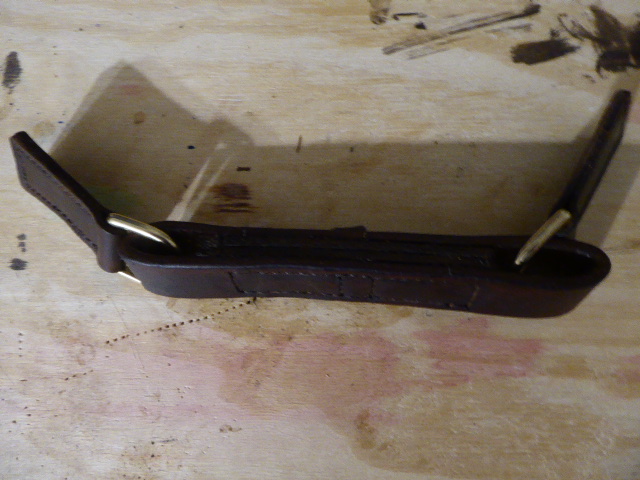
gun cases - work in progress

Londonshooter

CGN frequent flyer
Rating - 100%
62   0   0
Location
SW Ontario
I have a couple of cases that needed straps and handles. Today travelled to Sarnia to pick them up from Kevin at Sharkskin Weathergear. I knew the colour of the bridle leather he stocks was not going to be a match and still not sure whether to leave them contrasting like that or else dye or shoe-polish them. The style handle I wanted needs stitching through four layers of leather which his machine can't do. Now I'm wondering whether to buy some tools to complete them or find someone local with heavier machine or that can hand finish them. I'm liking the work he did though and recommend him.
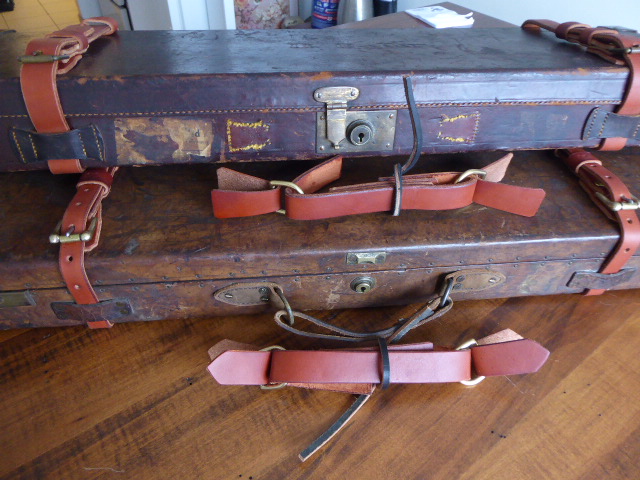

A9lLN2i.jpg
 
I'm sure there are machines that could go through 4 layers of thick harness or saddle leather but probably not many places would have them, you may have to learn how to use a stitching awl. I've used them for at least 3 layers of leather that thickness (and maybe 4) but I'm certain they would do 4. There's a tool for getting the spacing correct between the stitches too but I can't think what it's called. The real trick lies in getting the stitches to look even and it takes a bit of practice.
 
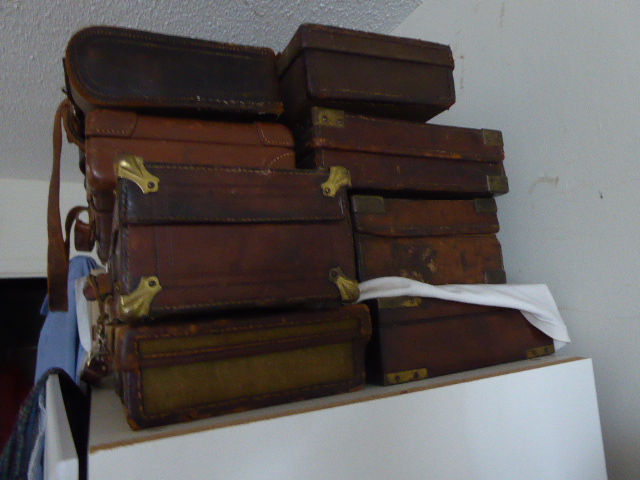
So far so good Londonshooter, nice straps. A shoemaker who does boot resoling would have a machine capable of the four layer stitching you need but as already mentioned , a stitching awl is a reasonable priced hand tool that can do the job, you can clamp the work for a third hand and pre drill the holes if necessary. A stitch spacer or spacer star wheel and a stitch spacing punch to match and you're good to go. Practice on scraps until you get the feel for it. Personally I would try to dye as close as possible, you might be able to buy small quantities of dye and leather from a well established shoe repair shop. Looks like a Westley Richards oak and leather case on the bottom?
 
I have a couple options nearby for cobblers to try but as suggested am leaning toward getting my own tools as have a number of leather items that need the odd repair. Have been laying down lots of hints to my wife that she could have a sideline as a case restorer (One, she's very crafty. Two, she's retired. Three, I can barely wrap presents. And finally, I have several she can practice on).
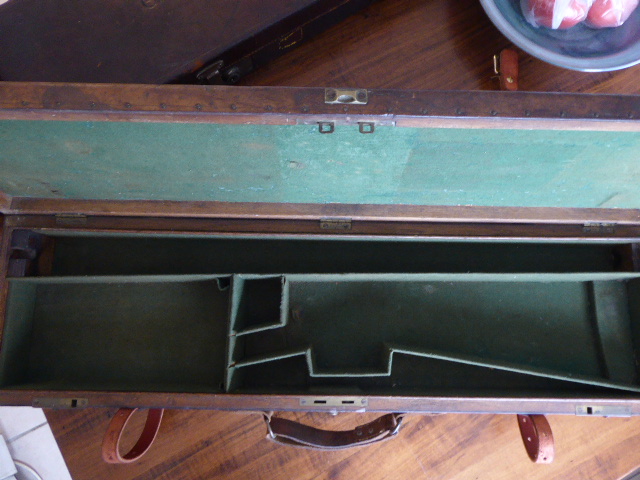
Ashcroft, the bottom one is leather over oak but no trade label. I got it empty at auction and don't know the history. Think you can ID it to a maker?
John
 
John, I've used saddle makers a few times. A highly recommended guy was down in Mennonite country west of St Jacob's. Very pleased with his work. Not much good at modern communication techniques though. LOL
 
I'm wondering how a saddle shop would be outfitted?

I could add to this a bit.
Years ago, kids in elementary school went on a field trip to the O'keefe Ranch just slightly north
of Vernon.
It was an entertaining trip as we were herded thru the buildings, old homestead and the one
that really caught my interest was the working saddle shop.
There was a gent in there in the process of building a saddle.
And a gorgeous saddle it was in the making to be.
I would consider this being a fine, well, very fine art.

Hence the suggestion of a saddle shop as the leather that goes into a saddle
is dang thick.

This thread sure cawt me interest for creativity, for sure.
Keep it updated with results.

Cheers
 
Londonshooter send me some pictures of that case inside and out, let's see what it tells us.
I've had case repairs by cobblers with varying results. Always sturdy, sometimes presentable, not always aesthetically pleasing or equal to the original quality of the case. I think the better ones can do the work to the standard required but it requires planning and improvising which takes up valuable time, running up the cost. These guys seem to be swamped with work, at least in my part of the world where many wear work boots or cowboy boots ( women too), so the trick might be to be able to sit down with them and explain exactly what you want and show them a good example or photos. If you can find a cobbler that does luggage repair ( antique luggage is leather and musical instrument cases were as well) you would be golden. Saddlemakers have the skills, tools and experience to do this work and might like to try this new to them challenge.
 
ALL British hard cases (NOT saddle cases) are constructed of leather (or canvas) over wood, in some cases oak, in other boxwood (aka linden wood).

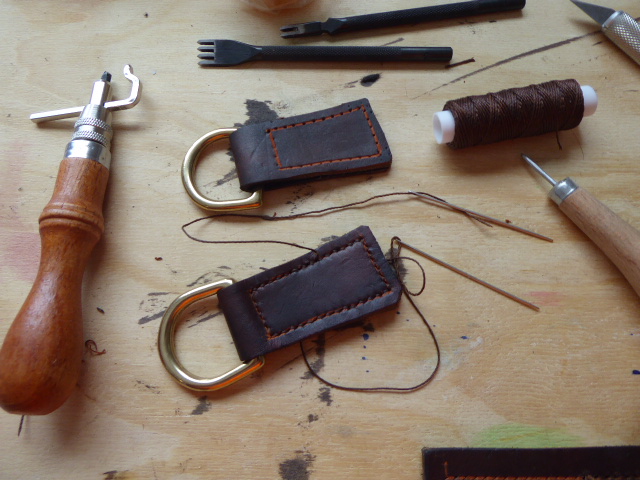
I've repaired some of my cases & always found that the easiest way is to first trim the handles to the shape you want, then use barge cement (see your bootmaker), then, after it has thoroughly dried, break out your tiny drills & start drilling holes all the way through around the edge of the handle's straps. Once that is done, break out your awl with the waxed cotton thread & start sewing. I would double lock stitch all the way around.
 
Forgot to add that you may be able to dye the straps in the top case, but I think the bottom straps are already too dark. When I need new straps made, I ask for them to be made in London tan, so that they can be dyed appropriately. You can always darken, but lightening requires harsh bleaches which damage the leather.

I like Fiebing's leather dyes.
 
Thanks James, for the dye recommendation and tips.
BTW, after seeing details of the bottom case Ashcroft knew exactly what it was. Unfortunate that I do not have Richards' best A & D appropriate to the case.
1LHlbzh.jpg


I do appreciate a vintage case. Here are the others.
 
If ud like i can talk with the guy in the sewing department at work. He does all the design patterns for the covers we use. Ive seen some of the custom interiors hes done. Top quality work. We do have several launches coming up though but as im on afternoons for the next couple weeks ill likely run into him
 
James harrison, you are correct regarding English gun case construction in later decades, but these cases went through evolution to get to the leather or canvas covered wooden case. In the flintlock era, the percussion era and even into the early pinfire and centrefire era of the 1850's and 1860's these cases were constructed of imported mahogany, rosewood or native oak as a finished wooden case or chest. They usually came with a removable leather protective outer case, most of which have succumbed to time serving it's intended purpose which was protecting the case. This two part arrangement appears to have evolved into the more recent leather covered case by the 1870's.
 
Screenshot_2020-01-27-06-09-56.jpg

No where near the same league and likely laughable to some fine gents but this is an idea i want to become a reality this spring. If all goes well ill try to build one for my charles daly hammer gun
 

Attachments

  • Screenshot_2020-01-27-06-09-56.jpg
    Screenshot_2020-01-27-06-09-56.jpg
    33.6 KB · Views: 232
Well, this is tedious.
VnlGeSV.jpg

Should be finished this weekend and will update then. Maybe a before and after in a new thread for others to contribute their projects - as VictoryXC suggested.
 
Back
Top Bottom