Harmonic balancer; voodoo magic or reality?

So your saying the best shooters in the world use the heaviest loads the rifles will take, and that gives them the best results?

Then you say they all the "teams of 10-200 in matches" just use the same match ammunition as anyone else in a shooting match. Are the shooting matches using the heaviest loads as well? Why wouldnt they do load development for a single rifle?

What the heck does a military armourer have to do with the regular joe wanting to try out the effectiveness of a harmonic balancer and load development?

Wherever you were going went over my head too. Maybe you could elaborate a bit.

Your first statement is exactly what I am saying!
One of the best shooters the world has ever known was Warren Page. Among his many achievements was winning the US National Match bench rest shooting championship, nine times.
He was the first to wildcat the 308 Winchester to 6mm, before Winchester made it commercially and named it the 243 Winchester.
I have copied a piece from Warren Page's book, The Accurate Rifle, where he is discussing long range target shooting. Please read it carefully.
On my first post here, #6, I copied a piece from the same book, by Warren Page, where he is discussing the bedding of rifles. Please go to post #6 and read it.
you will note he says how bedding the rifle, with considerable tension on the barrell, will dampen the barrel, taking out most of the vibrations that people are calling nodes.
Isn't this exactly what a harmonic balancer is supposed to do.

What the amourers did for their target rifles was to properly bed them. Then good quality match ammunition, which is loaded haeavy, will work just fine in all the rifles used in the match.
As far as the ordinary Joe is consernned, doesn't it make sense that if the action and barrel are properly bedded, yor rifle may perform like the military target rifles do, and be far less critical, as to what ammunition they are given?
Here is the article about the best shooters in the world loading their rifles for long range match shooting.
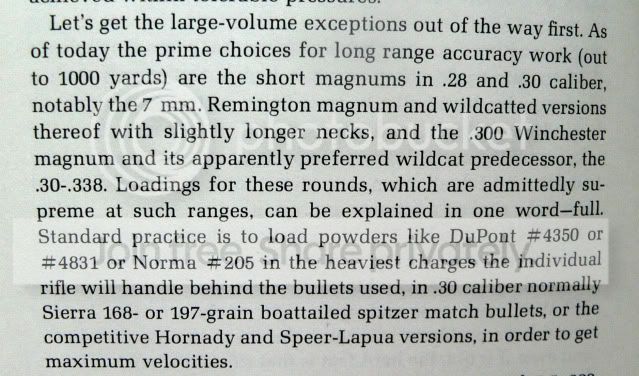
load001.jpg
 
OK, Im not familiar with Warren Page or any of the other best shooters in the world.

At the risk of starting a pissing match of "mr apples said this vs. mr oranges said that", that is one shooter out of many. And, his practise of "properly bedding" a rifle was to create tension on the barrel, which I am guessing is done by putting more material along the barrel then you would get by just pouring in resin and letting it cure (standard bedding), which would cause a slight warp in the barrel the way I understand it.

I could see bedding a barrel in a top and bottom full length stock taking vibration out of the barrel and changing/lessening the harmonics, and although one of the "best shooters of the world" apparently has had success at it, causing tension in a barrel by "proper;y bedding it" is a strange notion.

There is some good slow motion videos of Ak47's versus m-16s on youtube, which do better illustrate how the harmonics (frequency of vibration) in a barrel would effect the projectile, and can kind of give you an idea of why one powder charge versus another would change groupings not so much in size of group, but in terms of the group being higher or lower, potentially even higher on a less powerful round depending on range.
 
bedding the rifle, with considerable tension on the barrell, will dampen the barrel, taking out most of the vibrations that people are calling nodes.
Isn't this exactly what a harmonic balancer is supposed to do.

There is a subtle difference. A node doesn't have any vibration at all for a single frequency. Tension dampens all vibration, while the harmonic balancer moves the nodes up and down the barrel. Presumably moving the fundamental frequency node to the tip of the barrel would benefit accuracy.

Tension reduces the vibration, the harmonic balancer moves it around.

It is a bit like the difference between palm damping on the bridge of a guitar and putting a harmonic balancer (fat finger/fathead) on the headstock.

(Guitarists do exactly the same thing, with moveable brass weights to tune the neck vibration)
images
 
What do you mean by " a node doesnt have any vibration at all for a single frequency"?

Im not sure if nodes are really to be applied in the rifle harmonics situation, as they are more applied to multiple vibration sources or the effect of multiple sources, not that you cant have a wave travel to the end of the rifle barrel and back to create a node, but the projectile seems to be exiting before that seems to be occuring. Just my impression from slow motion footage.
 
Just to clarify, a "node" is a point with the least vibration.
The position of a node is related to the length of the vibrating object.

If I touch a vibrating string in it's middle, the pitch will go up one harmonic, and the wave ceases to vibrate at the point where the string is touched, which is the node.
There are many nodes which create a harmonic series at various fractional divisions along the vibrating object.
 
What do you mean by " a node doesnt have any vibration at all for a single frequency"?

Im not sure if nodes are really to be applied in the rifle harmonics situation, as they are more applied to multiple vibration sources or the effect of multiple sources, not that you cant have a wave travel to the end of the rifle barrel and back to create a node, but the projectile seems to be exiting before that seems to be occuring. Just my impression from slow motion footage.

If a perfectly free-floated barrel is ringing like a tubular bell, it will have a fundamental frequency and higher frequencies called harmonics.
For a given frequency a node, by definition, has zero amplitude of vibration.
The harmonics will not be as clear as a tubular bell, true.

For accuracy the muzzle should be in the same position every time the bullet leaves the barrel. If you fiddle about with weights or powder on a free floated barrel you will affect the consistency of the barrel position.

You can apply pressure to the barrel so it is not free-floating to affect the consistency of the barrel position. But this is a different process from the harmonic balancer. That was my point.

If I touch a vibrating string in it's middle, the pitch will go up one harmonic, and the wave ceases to vibrate at the point where the string is touched, which is the node.
The Rev. William Gibbons made a career out of this, despite the fur on the headstock :).
 
Google is your friend.Use it to find the video explaining the BOSS set up.A picture is worth a thousand words,or in this case 5 pages.There is a large difference between the the harmonic ballancer,and a floated barrel.Comparing, or quoting a 50 year old article when it no longer relevant,is like comparing Noahs arc to a speed boat.
 
Google is your friend.Use it to find the video explaining the BOSS set up.A picture is worth a thousand words,or in this case 5 pages.There is a large difference between the the harmonic ballancer,and a floated barrel.Comparing, or quoting a 50 year old article when it no longer relevant,is like comparing Noahs arc to a speed boat.

Noah's ark to a speed boat, Im still chuckling to this analogy as I type, well done.

I dont think your idea and explanation of a node are the same. A node is a zero or base point on the wave. Which in saying a "node doesnt have frequency or vibration", is saying that at the center point in a sinusoidal wave there is no frequency. There is frequency, just no energy or displacement at that point.

On a sinusoidal wave there is obviously many nodes, measured or created by many factors. Same goes for the barrel, there may be one or two or 20 waves/nodes on the barrel, I would guess most would see between 1 and 3.

Consider the acceleration of the barrel during the wave. It will accelerate to a high point, but as it reaches the top of the wave, the speed of motion decelerates to a point at the peak where for an instant it is not moving, then begins to accelerate in the opposite direction. As it accelerates back down, the "node" point or zero point will be when the wave or barrel is moving downwards the fastest. Kind of like a "whip effect" as the projectile exits.

What Im trying to illustrate is this: there may be many nodes and waves along the length of the barrel at the same time, and just because the end of the barrel is at a "node point" / straight as the projectile exits, doesnt necessarily mean that will be the point when accuracy will be at its best.

The Node point is also when the barrel is moving the most.

Having said this, it makes you think about how much effort goes into making a barrel perfectly perfectly straight, when at the most important time for it to be straight, its vibrating all over the place! It also makes me think that although Warren whatsisnutz may have had what would nowadays be considered a improperly bedded rifle, and have a significant greater amount of warp in it, it could have decreased the size of the waves induced during recoil, to a point where it could have been more accurate than some of the modern methods.

I guess if your not brave enough to attempt the ridiculous, you'll never accomplish the impossible. Warren whatsisface may have seemed the ridiculous back then for what I would think of as "over bedding" his stock, but it worked for him apparently.

Thats should keep you guys busy for at least a little bit!
 
Last edited:
The device formerly known as the "Accurizer"

This is what I was trying to recall:
http://www.rifle-accuracy.com/snpg2b.htm

Now sold as a component of the "Smart Stock", the device is basically a moveable attenuating block on a threaded shaft, installed in a rifle's forend. It accomplishes the same thing that adjusting bullet seating depth or powder charge does, by making it consistently leave the muzzle at a point of intersection between muzzle position and the true line of bore. The big advantage would be the ability to "tune in" most any properly assembled loads. The disadvantage is that handloaders can get the same results without the gadget, which seems like a good reason why we don't see more of these around.

The video depicts the tuning process.
http://www.youtube.com/watch?v=DhRIebOY4Jk
 
This is what I was trying to recall:
http://www.rifle-accuracy.com/snpg2b.htm

Now sold as a component of the "Smart Stock", the device is basically a moveable attenuating block on a threaded shaft, installed in a rifle's forend. It accomplishes the same thing that adjusting bullet seating depth or powder charge does, by making it consistently leave the muzzle at a point of intersection between muzzle position and the true line of bore. The big advantage would be the ability to "tune in" most any properly assembled loads. The disadvantage is that handloaders can get the same results without the gadget, which seems like a good reason why we don't see more of these around.

The video depicts the tuning process.
http://www.youtube.com/watch?v=DhRIebOY4Jk

Well, if you adjust the frequency of the barrel and dampen it at the higher loads, as opposed to finding "the sweet spot" at a lighter load, then I think youd be better off. But this is another way of adjusting the frequency of the barrel. The big difference in my mind is that its due to maybe making a contact spot in the bedding and changing its position.

In my minds eye, dialing in a harmonic balancer is like changing the length of a piece of plastic pipe that you are shaking so it is oscillating the same on both ends, where as changing the bedding is like keeping the same length of pipe, but allowing it to hit an obstacle at a certain spot to reduce the oscillations, so they are different but to the same effect I guess...
 
Google is your friend.Use it to find the video explaining the BOSS set up.A picture is worth a thousand words,or in this case 5 pages.There is a large difference between the the harmonic ballancer,and a floated barrel.Comparing, or quoting a 50 year old article when it no longer relevant,is like comparing Noahs arc to a speed boat.

It looks like you didn't read, or understand, what was in the quotes I posted.
No where was a floated barrel mentioned.
Here is a copy of the rear cover of his book. Read that, then tell us again why it is not relevant today.
Maybe you could explain to us why the information in the book as quoted, is like comparing Noah's ark to a speed boat. Come on, let's hear your explanation.
In short, maybe you could explain to us, why you think you know more about these shooting subjects, than did Warren Page.
Apr2012001.jpg
 
After reading this thread I have to think the CR boss system and a properly bedded rifle are two ways to achieve the same goal. That being said I'd rather have a rifle built by or to the specs of Warren Page than a boss equipped browning...
 
According to your article (post#6) warren is creating considerable tension on the barrel by his method of bedding. You could definately say that he is not free floating the barrel, especially if "it takes considerable force to remove the fore end of the barrel and action from the stock".

He is essentially clamping the barrel at two points, at the action, and on the bottom of the barrel pushing upwards. This is not the present conventional method of bedding, where epoxy is allowed to dry in place.

Its also strange that he mentions how a single action screw or slight change in humidity can change the groupings of a stock, when he is essentially applying pressure to it anyway in greater quantities.

That being said, creating tension in this way would do two things, reduce vibration (vibration damper) and warp the barrel.

The harmonic damper does and doesnt do the same thing, It essentially changes the shape and location of weight on a barrel (frequency adjustment), which is used to decrease harmonics but not necesarily vibration.

When I say harmonics Im not meaning frequency or vibration, but rather the buildup of energy/resonation.

Im getting a lot long winded but, Im not disagreeing with you regarding warrens methods increasing accuracy, I would say they are not commonly used, or that they work in the exact same manner as a harmonic damper, and I have no cards up my sleeve to show one or the other is superior. But I am inclined to say I would try other things before bedding the stock in the manner he does, actually I would like to own a mini 14 target and play with the harmonic damper to have some first hand experience instead of speculation, or maybe try and one up Warren on his .250" /100 yard accuracy.
 
The tension is on the barrel is at the front of the stock.
I have said it on here before, but in the hay day of shooting, that great period of about twenty years, following WW2, when there was no end of competetive shooting, along with every type of experiment going, this was the standard method of bedding the rifle. It was considered that it should take about six pounds, for an average, normal weight barrel, to be pulled from the stock. Some target shooters carried a spring scale in their gear, for testing this.
Any time you are at the range you can experiment with your own rifle. if you are not too thrilled with the way it is shooting, take some light, folded cardboard, or paper, and pusy it between the front of the stock and the barrel, putting some pressure on the barrel.
Then try shooting it. It may, or may not help, but you will know. And if it helps, you could make a more permanent block.
 
Thanks for the ideas.

I think I would try it out on a rifle I was not having much luck with.

As for the bedding, I would be interested to find a rifle with accuracy issues, and try a top and bottom wood stock with epoxy resin or silicone top and bottom of the barrel to see how it effects accuracy.

Maybe I should see what could be done to something like an SKS, it would be polishing a turd, but at least it would be good for before/after comparisons.
 
Sure do!

It looks like you didn't read, or understand, what was in the quotes I posted.
No where was a floated barrel mentioned.
Here is a copy of the rear cover of his book. Read that, then tell us again why it is not relevant today.
Maybe you could explain to us why the information in the book as quoted, is like comparing Noah's ark to a speed boat. Come on, let's hear your explanation.
In short, maybe you could explain to us, why you think you know more about these shooting subjects, than did Warren Page.
Apr2012001.jpg
Yes I did read ,and I do understand What you said.I think I will agree to disagree as others have.Refering to a wood stock,back in the day,is different than a synthetic,free floated barrel.Scews and springs are not present.As far as Warren Page,I dont Know the man.Times change faster than both you and I would like to admit.A question for you H4831.Did you watch the video explaining the BOSS?Iam assuming not or you would be not posting these questions to me.Things that worked in their day,may or may not be applied to todays guns,powder and bullets.I used only 4 or 5 powders when I first started reloading,thinking they were the best.However in the last 3 years we must use 15 different ones.The new have replaced the old,in more than just make up of a bullet.Things usually have changed before the ink has dried in a book.Respectfully,Gary.
 
Did not think this was a right or wrong thing.I was asked if i read and understood his post.And i stated I did.I asked H4831 if he had watched the you-tube video on the BOSS set up that I was refering to.I assume he will,but not sure that he has.
 
Did not think this was a right or wrong thing.I was asked if i read and understood his post.And i stated I did.I asked H4831 if he had watched the you-tube video on the BOSS set up that I was refering to.I assume he will,but not sure that he has.

Im just watching the BOSS youtube video now, it is just a harmonic damper, with an optional muzzle brake as part of it, and a high tech sounding name.

Id try it.
 
Back
Top Bottom