












































You are using an out of date browser. It may not display this or other websites correctly.
You should upgrade or use an alternative browser.
You should upgrade or use an alternative browser.
Hawken set trigger not setting off caps
- Thread starter Power Pill
- Start date
The mainspring should be too strong to remove by hand. A weak mainspring, combined with an overly high and/or blunt fly, could well cause the type of problem you are having - fires on front trigger, but not when set, under which condition the friction between the fly and sear nose puts additional drag on the tumbler.
Actually, the weak mainspring alone could also cause the problem, and for the same reason, even if the fly does not need adjusting.
Actually, the weak mainspring alone could also cause the problem, and for the same reason, even if the fly does not need adjusting.
Last edited:

Yep got one on my list. Track of the wolf charges a lot for shipping!You will also need a mainspring vise.
Any canadian suppliers of these parts?
Just a bit of a reality check:
I was not able to find a replacement mainspring for the CVA lock on Track's website. Are you sure you are not ordering a mainspring for the L&R replacement lock? That spring is unlikely to fit your lock.
Yep, outrageous shipping fees are a fact of life these days
I was not able to find a replacement mainspring for the CVA lock on Track's website. Are you sure you are not ordering a mainspring for the L&R replacement lock? That spring is unlikely to fit your lock.
Yep, outrageous shipping fees are a fact of life these days
fingers284
CGN Ultra frequent flyer
- Location
- Alberta Cowboy Ranges
I think you boys are looking at the wrong spring as being the problem.
If the gun will fire using the unset trigger, then the main spring has enough ommf to do the job. from the photo we can see that this is a very rudimentary lock set-up and I think the probem is in the set trigger not slapping the prong on the sear hard enough that it wont clear the half-#### notch full and that is slowing the hammer drop sufficiently to not fire the cap. On all these inexpensive muzzle guns with set triggers , when the front trigger is set and that trigger is pulled it just releases the back trigger that has irs own spring and it "slaps" the prong in the photo.
I think, in this case that the small spring that engages the sear to the tumbler is to strong for the slap of the back trigger to overcome...two ways to remedy this....lessen the small spring tension on the sear a bit or strengthen the flat spring tension on the back trigger so the back trigger bar slaps harder.
You could prove or disprove my theory by removing the small sear spring and manually setting the sear in a fully cocked state and then re-assemble the gun, now try to fire a cap using the set trigger, if it fires you know the spring drag has been removed and where the problem actually is.
If the gun will fire using the unset trigger, then the main spring has enough ommf to do the job. from the photo we can see that this is a very rudimentary lock set-up and I think the probem is in the set trigger not slapping the prong on the sear hard enough that it wont clear the half-#### notch full and that is slowing the hammer drop sufficiently to not fire the cap. On all these inexpensive muzzle guns with set triggers , when the front trigger is set and that trigger is pulled it just releases the back trigger that has irs own spring and it "slaps" the prong in the photo.
I think, in this case that the small spring that engages the sear to the tumbler is to strong for the slap of the back trigger to overcome...two ways to remedy this....lessen the small spring tension on the sear a bit or strengthen the flat spring tension on the back trigger so the back trigger bar slaps harder.
You could prove or disprove my theory by removing the small sear spring and manually setting the sear in a fully cocked state and then re-assemble the gun, now try to fire a cap using the set trigger, if it fires you know the spring drag has been removed and where the problem actually is.

i can actually remove and re-install the mainspring quite easily by hand....could that be an issue?
Yes, you shouldn't be able to do that ~ unless you have freakishly strong fingers
If you are ordering from Track - get a replacement sear ... The nose of that one does not match the google pics I've seen - I strongly believe someone has tried to "improve" that lock.
You could also bend and re-treat he spring.
With all the fitting and fiddling you have to do, might be much further ahead just replacing the lock completely.
I think you boys are looking at the wrong spring as being the problem.
If the gun will fire using the unset trigger, then the main spring has enough ommf to do the job. from the photo we can see that this is a very rudimentary lock set-up and I think the probem is in the set trigger not slapping the prong on the sear hard enough that it wont clear the half-#### notch full and that is slowing the hammer drop sufficiently to not fire the cap. On all these inexpensive muzzle guns with set triggers , when the front trigger is set and that trigger is pulled it just releases the back trigger that has irs own spring and it "slaps" the prong in the photo.
I think, in this case that the small spring that engages the sear to the tumbler is to strong for the slap of the back trigger to overcome...two ways to remedy this....lessen the small spring tension on the sear a bit or strengthen the flat spring tension on the back trigger so the back trigger bar slaps harder.
You could prove or disprove my theory by removing the small sear spring and manually setting the sear in a fully cocked state and then re-assemble the gun, now try to fire a cap using the set trigger, if it fires you know the spring drag has been removed and where the problem actually is.
If this were the case, the lock wouldn't fire at all from the 'set' position. It wouldn't get out of the full #### notch.... though it does not hurt to test.
I think someone has modified the sear for better engagement in the full #### position, the resulting angle of the nose basically stopping the tumbler when the fly blocks the half #### notch and bouncing off rather than sliding over.
The net effect being that the hammer is stopped mid cycle and only getting half the travel and half energy (inertia) from a (probably) already weak main spring
Fingers points about the tension on the rear trigger spring and the strength of the sear spring are well taken, but I do not think that is the issue here, and I don't think his description of what happens is accurate.
As I stated in post 2 or 4 and fingers states here, the rear trigger slaps the sear bar to release the tumbler and that action is momentary. It would be rare for any set trigger to slap the sear high enough or for a long enough duration to ensure the sear nose reliably clears the half #### notch. That is the reason guns with set triggers have a fly. The sear nose almost immediately starts to fall and the fly provides a ramp to guide it up and over the half #### notch. It must also be understood that the friction between the sear and fly somewhat counteracts the pressure applied by the mainspring and, in doing so, effectively slightly reduces the rotational force on the tumbler. Is there anyone here who believes one should be able to remove a mainspring with nothing more than finger pressure?
The suggested method of proving or disproving fingers theory would accomplish nothing since removal of the sear spring would, in all likelihood ensure the sear nose stays raised and clears the half #### notch. Effectively, one would have recreated the condition that exists when fired from the unset front trigger.
As I stated in post 2 or 4 and fingers states here, the rear trigger slaps the sear bar to release the tumbler and that action is momentary. It would be rare for any set trigger to slap the sear high enough or for a long enough duration to ensure the sear nose reliably clears the half #### notch. That is the reason guns with set triggers have a fly. The sear nose almost immediately starts to fall and the fly provides a ramp to guide it up and over the half #### notch. It must also be understood that the friction between the sear and fly somewhat counteracts the pressure applied by the mainspring and, in doing so, effectively slightly reduces the rotational force on the tumbler. Is there anyone here who believes one should be able to remove a mainspring with nothing more than finger pressure?
The suggested method of proving or disproving fingers theory would accomplish nothing since removal of the sear spring would, in all likelihood ensure the sear nose stays raised and clears the half #### notch. Effectively, one would have recreated the condition that exists when fired from the unset front trigger.
Although I do not believe the sear nose is bent, sean69 may well be correct in his suggestion the sear and tumbler have been modified. I just don't know what these locks look like when they leave the factory.
Track does carry an L&R replacement lock and a replacement would likely be a wise move if the sear and tumbler have been modified. The L&R lock would be a vast improvement.
Track does carry an L&R replacement lock and a replacement would likely be a wise move if the sear and tumbler have been modified. The L&R lock would be a vast improvement.
Here: https://gunpartspros.com/product-category/muzzle-loader-parts/cva-hawken-50-cal-ml/
$5 for your spring and another $10 for the lock parts. OR you can get a complete replacement from them. (hopefully they ship to Canada)
Photos in this link show that the sear nose is straight, not bent.
It wouldn't be a bad idea to get spare parts as available.
A L&R replacement lock would be great - but I suspect the delivered cost of the lock would be as much as the rifle is worth.

Here are side-by-side photos to make comparison easier.
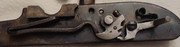
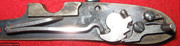
There is something I do not understand. If the sear on the OP's rifle has been bent, the sear bar should be quite a bit higher and I am not seeing that. Look at the relationship between the sear bar and the sear spring. The two locks have different plates.
What am I missing?
There is something I do not understand. If the sear on the OP's rifle has been bent, the sear bar should be quite a bit higher and I am not seeing that. Look at the relationship between the sear bar and the sear spring. The two locks have different plates.
What am I missing?
Here are side-by-side photos to make comparison easier.
There is something I do not understand. If the sear on the OP's rifle has been bent, the sear bar should be quite a bit higher and I am not seeing that. Look at the relationship between the sear bar and the sear spring. The two locks have different plates.
What am I missing?
Oh, yeeeeaaaa - that is one heck of a bend.
Looking even closer - I'm not convinced the OPs sear is a CVA sear. The sear bar is quite different - not sure how or why anyone would bend it like that either.
I think the springs are the same - the internet example has a screw hiding most of it & it's under compression - so, it would look a little different.
Either way, IMO this is a case of "don't try to fix" - replace the guts or replace the lock.






















