Help - 150 grain .308 cannelure question??

Nate.308

Regular
Rating - 100%
54   0   0
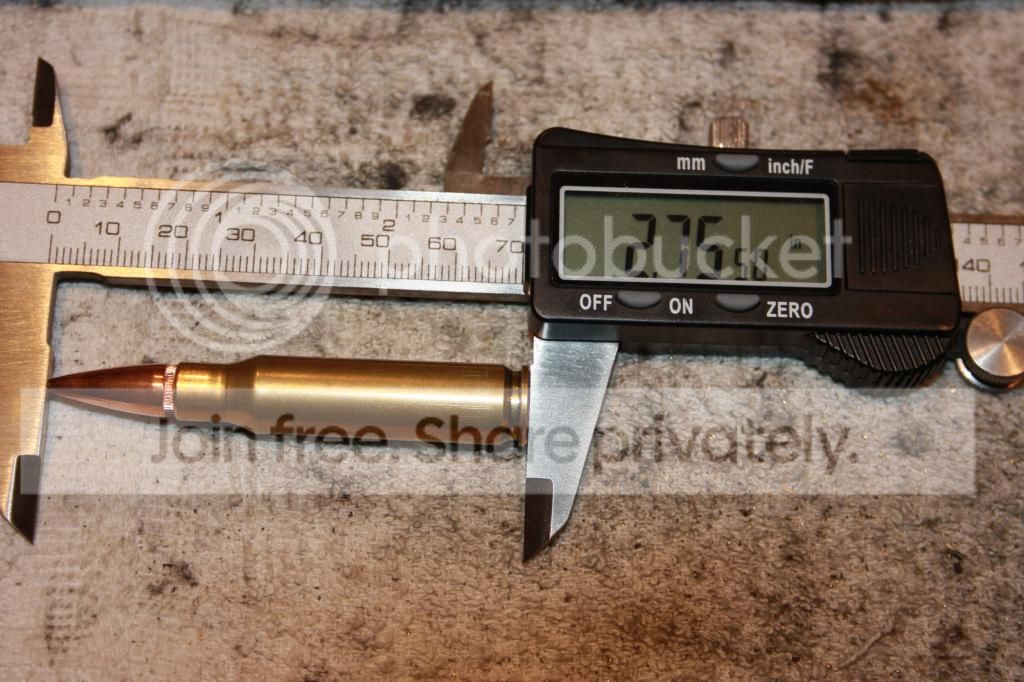
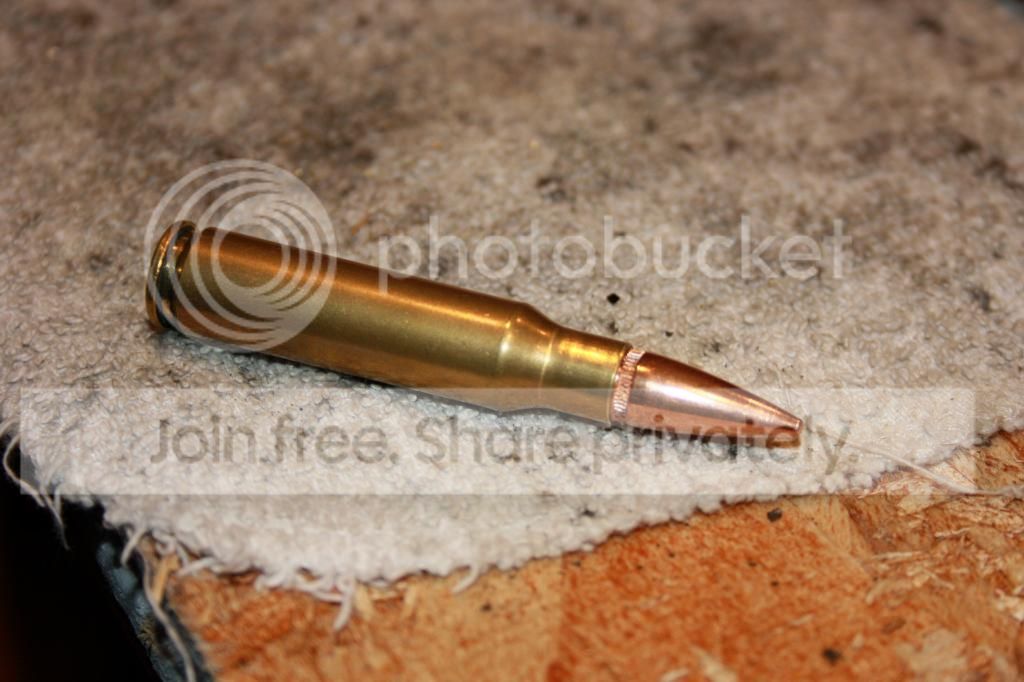
New to this so I thought I would ask the pros! I have been reloading Hornady 180 grain spbt for my 305. After a bit of reading I see that the projectiles were a tade heavy for the 305's gas system. So I picked up a box of Hornady 150 fmj and got started...... one round in, (following the Lee specs from my die set) when seating the 150 grain projectiles I can't get the case lip to engage the cannelure and there for not crimping the round. I didn't have this problem with the 180 grains projectiles, and got a nice crimp and finished product. Will these rounds be safe to shoot? Does the cannelures have to be engaged to the lip of the case? Will it affect accuracy? listed below is what I was using to load;

180 Grain
IMR4895 38.2 grains of powder min OAL 2.725

150Grain
IMR4895 42.1 grains of powder min OAL 2.755


Please teach away!

:cool:
 
Adjust your seating stem to seat the bullet deeper then adjust the the die to crimp into the cannelure if you want to crimp. Sometimes you can't have both desired oal and crimp.
 
Adjust your seating stem to seat the bullet deeper then adjust the the die to crimp into the cannelure if you want to crimp. Sometimes you can't have both desired oal and crimp.

But if I seat the bullet deeper it would be under the min OAL?
 
Sometimes a running start is a good thing.
Do they chamber now?
If they do, just use them the way they are.
Some bullets don't have a cannelure.
 
I shoot 150 gr Hornady FMJ's over 47.0 grs of BLC-(2) seated at 2.800" in my M305, and my loaded rounds look much the same as yours. I don't though because I don't crimp, and I don't know why you do.
 
Pretend the cannelure isn't there. You don't need it, to crimp.
It won't affect accuracy or safety.

The printed c.o.a.l. is how it was tested. You can stray from the numbers, if you understand how it affects pressure.
.010 is straying, .100 is rediculous ;)
 
If you find that you want to try seating a bit deeper so the cannelure meets the case mouth, you should drop your powder charge a bit, and work your way back up..... If your only going 0.010" deeper, I would back off 0.5 grains of powder and proceed from there.

Seating deeper will increase your chamber pressures. Whether or not the increase causes you problems (or grief), you'll have to test.

Stan
 
You can forget the cannelure altogether. You only need to crimp cartridges with heavy recoil and those used in lever actions. Crimping isn't required for a semi-auto. OAL is far more important.
42.1 of IMR4895 is a tick under minimum. Only .5 though, so nothing will happen. OAL should be 2.800" too, but that's not a big deal either.
 
You can forget the cannelure altogether. You only need to crimp cartridges with heavy recoil and those used in lever actions. Crimping isn't required for a semi-auto. OAL is far more important.
42.1 of IMR4895 is a tick under minimum. Only .5 though, so nothing will happen. OAL should be 2.800" too, but that's not a big deal either.

So I'm a little confused, what's the purpose of the min OAL? Other than the obvious lol
 
So I'm a little confused, what's the purpose of the min OAL? Other than the obvious lol

If you find out, maybe you could let me know too, why there is a minimum COAL.
Maybe you could also tell me what the, "Other than the obvious is!"
 
When developing a load, one typically notes the magazine length, and makes a note in the logbook, so that becomes the max OAL for all future loads.

Then one notes the OAL that just barely touches the rifling, and makes a note of that, for that particular bullet. Usually this dimension is longer than the magazine, so you then have to make a choice.

Then you try a few different OALs, ranging from touching to 20 thou off the rifling, to see what shoots best.

Then one cycles a few rounds to make sure the will feed ok. This is critical in tubular magazines.

THEN one looks at the suggested OAL in the book to see how their rifle compares to yours. I find this step optional, and usually skip it.
 
Seating the bullet deeper increases CUP pressures and in some instances can be catastrophic.

Can you prove this theory with rifles?
Can you give me a link to one single case of a catastrophic event happening with a rifle, because the bullet was seated too deep?
 
Can you prove this theory with rifles?
Can you give me a link to one single case of a catastrophic event happening with a rifle, because the bullet was seated too deep?

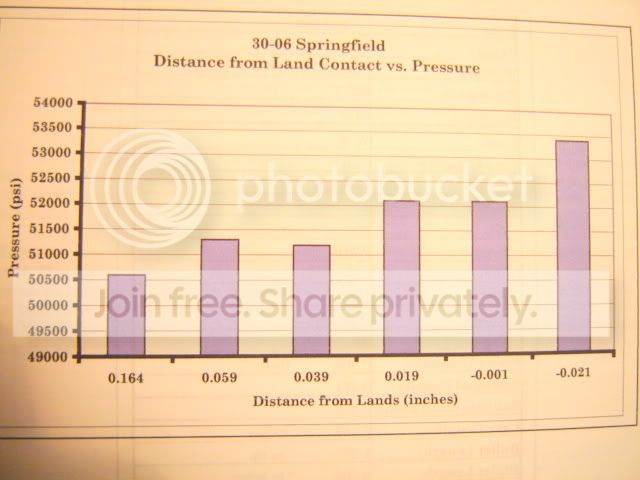
It's good to challenge these kinds of statements, particularly ones that talk about "blow ups" and have entered into reloading folklore. Very small capacity pistol cartridges shot in relatively weak pistol actions are one thing, but for rifles, there really is no Min OAL with respect to "safety". OAL does affect pressure, but in fact reducing OAL typically lowers pressure (except for when you're very close to the rifling) - case capacity might be reduced a couple of percent, but the bullet is given a longer "runup" to the rifling. I found this chart (and carefully chosen Interweb charts always prove someone's point! ;)) that shows the effect of varying OAL in one 30-06:

pressuregraph.jpg


I do have to respect mag lengths, and for lever guns the correct length that allows for reliable cycling, but with all of my guns, I load to the OAL that provides the best accuracy and that's usually about 0.020" from the rifling.
 
Back
Top Bottom