Help with .308 OAL Case Lenght

kouma

CGN Regular
Rating - 100%
111   0   0
Location
Ancaster, ON
Hello,

I am not sure if I should blame my bullet seater or trimmer or caliper. Can someone help me identify my problem. I am using LEE Deluxe 4-piece die set and Quick Trim for .308. I trim all my cases to 2.0050, however I end up with cases that are 2.0035-55. That is a difference of 0.002" which I think is acceptable (correct me if I am wrong). I am using Mitutoyo digital caliper.

After I press my bullets I remeasure them and I end up with ranges that vary between 2.7930-2.840. That is a different of 0.047". Please note that it is harder to measure a complete bullet as opposed to just the case.

Do you think the difference above affects accuracy? What is the "acceptable" variation of the overall length of bullets before it starts affecting accuracy?

The bullets I am using are 175 SMK and the cases are IVI.
 
When you measure the OAL of the assembled cartridge, is that base to the tip of the bullet? If so it will always be different as each bullet tip is different. Try measuring just the bullets and you will see. For proper OAL it should be measured to the ogive of the bullet. Measuring to the bullet tip will get you in the ball park but for exact measurements you need a bullet comparator that clamps onto your calipers.

For case length unless your doing some serious match ammo (get a better trimmer) that small of a variance is plenty fine.
 
Thanks Spawn-Inc,

Can you help me understand something. The bullet seater, does it take into account the neck size or the whole case length when seating the bullet to the correct length. In order words, assuming all bullets are 100% the same length and are easy to measure, i.e. squares, if my cases vary by 0.002, will the resulting assembled cartridge also have that variance or will it all be the same length. If it also has this variance, then the bullet seater takes the neck into account when seating. If all resulting cartridges are the same length, then bullet seater takes the whole case length into account when seating. Which is it?
 
The bullet seater doesn't care about the case length.... The stop for the seater plug is in the top of the die, which is fixed in relation to the press frame, and in a hopefully fixed position relative to the top surface of the shell holder when the ram is at the top of its travel.

FWIW, I measured a bunch of 30-06 rounds both overall length and length to the ogive (using a Hornady comparator)... The extreme spread of the OAL measurements was something like 0.007 inches, but teh extreme spread of the comparator lengths was only 0.001 inch....

When you measure the OAL of a cartridge, you are also measuring varying bullet lengths. Using a comparator-type gauge takes one variable out of the measurement.

Stan
 
Thanks Spawn-Inc,

Can you help me understand something. The bullet seater, does it take into account the neck size or the whole case length when seating the bullet to the correct length. In order words, assuming all bullets are 100% the same length and are easy to measure, i.e. squares, if my cases vary by 0.002, will the resulting assembled cartridge also have that variance or will it all be the same length. If it also has this variance, then the bullet seater takes the neck into account when seating. If all resulting cartridges are the same length, then bullet seater takes the whole case length into account when seating. Which is it?

if you used the same length bullets, say 1.000" long and you trimmed half your brass to 2.500" long and the other half 2.250" long, the OAL would stay the same. if you set your OAL to 2.700" long and the dies worked perfectly, all your rounds would be that length. what would change is if you wanted to crimp your rounds, then you would have to set your dies for the two different cases lengths.

EDIT: so to answer your question, the seating die only effects the bullet, not the case.
 
Looks like I will need to buy a Comparator Set now. I never knew about this until now :)

@OldDude: Is it okay to assume that if I have two cases that are, say .002" different, and I use two 100% identical bullets, would the resulting cartridge be the same length or with a difference of 0.002"?
 
if you used the same length bullets, say 1.000" long and you trimmed half your brass to 2.500" long and the other half 2.250" long, the OAL would stay the same. if you set your OAL to 2.700" long and the dies worked perfectly, all your rounds would be that length. what would change is if you wanted to crimp your rounds, then you would have to set your dies for the two different cases lengths.

EDIT: so to answer your question, the seating die only effects the bullet, not the case.


Thanks, I was looking for this answer.
 
Looks like I will need to buy a Comparator Set now. I never knew about this until now :)

@OldDude: Is it okay to assume that if I have two cases that are, say .002" different, and I use two 100% identical bullets, would the resulting cartridge be the same length or with a difference of 0.002"?

Cartridges would be the same length. As has been said, the seating die only uses the cartridge base and the bullet nose as seating surfaces.

One other factor that may affect your measurements is the consistency of the bullet tip. In theory one should be measuring from the bullet ogive (the reference point on the bullet tip that makes contact with the lands). Some bullets will be a little longer and others shorter but if length to the ogive is consisten, it should not matter.
 
if you are good with making things, working with your hands, etc i suspect you could make your own comparator. some brass tubing cut very flat on each end with a slot in one end for your calipers to fit into and your bullet in the other end. 1/4" ID tube should work for 308 bullets. if you can make sure things are cut nicely and flat, etc it should work the same as a commercial comparator.
 
Looks like I will need to buy a Comparator Set now.

All the replies to your op re bullet comparators are correct, but . . . it's likely that millions of rounds of ammunition are reloaded every year by people who have never even heard of a comparator. Any reloading manual I've ever seen gives overall length of the cartridge measured to the tip of the bullet, not to a location on the bullet ogive. A comparator is nice to have, but it is not absolutely needed.
 
All the replies to your op re bullet comparators are correct, but . . . it's likely that millions of rounds of ammunition are reloaded every year by people who have never even heard of a comparator. Any reloading manual I've ever seen gives overall length of the cartridge measured to the tip of the bullet, not to a location on the bullet ogive. A comparator is nice to have, but it is not absolutely needed.

I agree about the ammo being reloaded without a comparator... The only reason I got one was to satisfy my own curiosity. The ammo I made before I got the comparator is probably more accurate than I am..... ;-})>

With regards to the overall length, if it fits in the mag (if it needs to), and a couple of dummy rounds chamber and extract with no issues, the overall length is okay. If your reloading the same caliber for more than one gun, it would be worth doing the length checks in all of them. The precision / consistency of most (hunting, plinking...) ammo loaded without the use of a comparator will be sufficient for a lot of shooters.

BTW, some reloading manuals also quote a *minimum* OAL for their loads, since seating a bullet deeper will decrease the effective case volume and increase pressure.

Stan
 
The most useless figure and measurement in reloading is COAL. It is only in recent years that the over all length of a cartridge appeared in loading books. It is really stupid to have that figure in a reloading manual, and here is why.
The people who write the manuals have no idea what rifle you are going to use to shoot your loaded ammo. Thus, they have no idea where the bullet should be seated to fit your rifle, whatever your rifle happens to be.
The OAL they give is simply calculated to fit any chamber of SAAMI design for that cartridge.
The simple way to find the cartridge length to fit your rifle, is to take an empty case that has been fired in your rifle. Slightly squeeze the neck, so a bullet can be pushed in with finger, or hand pressure.
With a bullet pushed a little way into the case, slowly load the dummy round into your chamber and close the bolt. The rifling will have pushed the bullet into the case.
Carefully open the bolt and remove the round.
The length of that round will be just touching the lands in your rifle.
To set your seating die, turn it into the press, but stop about a sixteenth of an inch, or so, before the die hits the shell holder, with the handle full down. Set the locking ring.
Loosen the top lock nut and turn the screw that adjusts the seating depth well out, so it will not touch your dummy round when you put it in the die.
With the dummy round in the die and the handle full down, very carefully turn the adjusting screw down. Keep going until it touches the bullet. Go slow and you will feel it touch.
You likely want some clearance on the lands, so turn the little screw about another quarter, or half turn and lock the locking nut.
This will have the bullet seated perfectly in your rifle, with a bit of clearance on the lands. Who gives a damn how long the cartridge is?
You will still have to check it to see if it will work through the magazine. If it doesn't and you want to use the magazine, you will have to seat if deeper until it works.
You will have perfect length cartridges for your rifle and no fancy equipment is needed, not even a caliper!
 
"After I press my bullets I remeasure them and I end up with ranges that vary between 2.7930-2.840"

That is such a gross variation it hardly seems possible.

There is a significant variation in the distance from the shoulder of the ogive to the tip of the bullet. In the case of Sierra 175's, it is in the order of 15 thou. Your bullet seater has a shoulder on it, so it pushes the bullet down on the ogive closer to the shoulder - not on the tip.

It is very handy to know the distance from the ogive to the case head. You can adjust the die for this distance with any bullet.

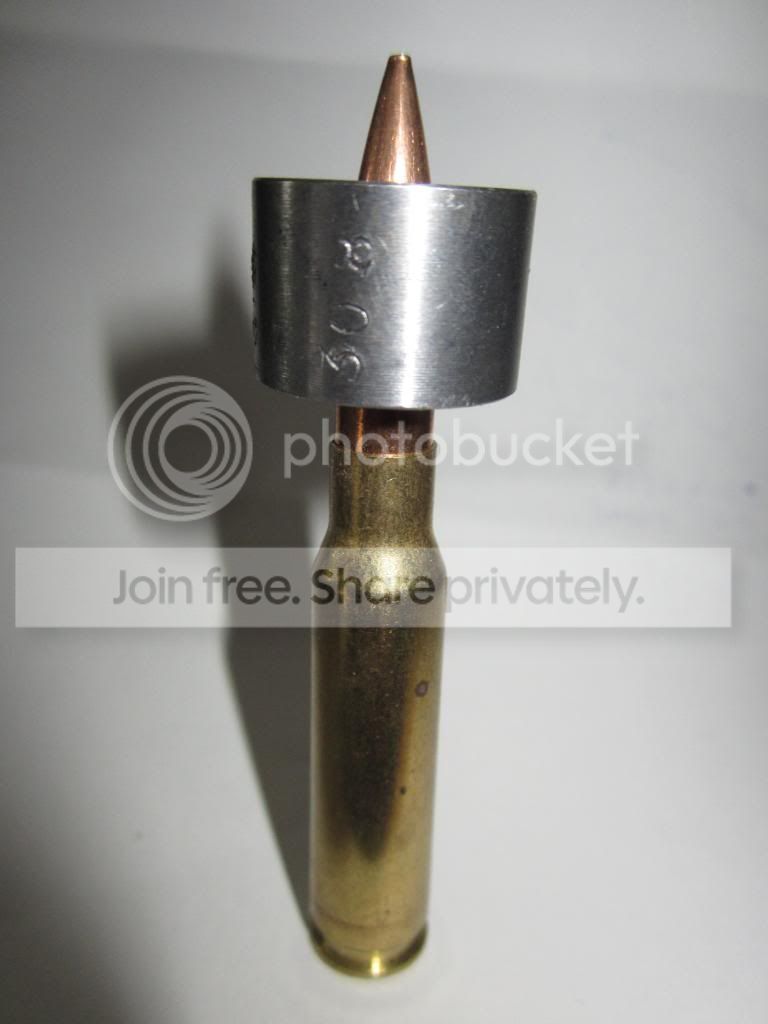
I make a gauge from a piece of 308 barrel. It sits on the bullet ogive, and a measure to the top of the gauge.

COALTOOL.jpg
 
The most useless figure and measurement in reloading is COAL. It is only in recent years that the over all length of a cartridge appeared in loading books. It is really stupid to have that figure in a reloading manual, and here is why.
The people who write the manuals have no idea what rifle you are going to use to shoot your loaded ammo. Thus, they have no idea where the bullet should be seated to fit your rifle, whatever your rifle happens to be.
The OAL they give is simply calculated to fit any chamber of SAAMI design for that cartridge.
The simple way to find the cartridge length to fit your rifle, is to take an empty case that has been fired in your rifle. Slightly squeeze the neck, so a bullet can be pushed in with finger, or hand pressure.
With a bullet pushed a little way into the case, slowly load the dummy round into your chamber and close the bolt. The rifling will have pushed the bullet into the case.
Carefully open the bolt and remove the round.
The length of that round will be just touching the lands in your rifle.
To set your seating die, turn it into the press, but stop about a sixteenth of an inch, or so, before the die hits the shell holder, with the handle full down. Set the locking ring.
Loosen the top lock nut and turn the screw that adjusts the seating depth well out, so it will not touch your dummy round when you put it in the die.
With the dummy round in the die and the handle full down, very carefully turn the adjusting screw down. Keep going until it touches the bullet. Go slow and you will feel it touch.
You likely want some clearance on the lands, so turn the little screw about another quarter, or half turn and lock the locking nut.
This will have the bullet seated perfectly in your rifle, with a bit of clearance on the lands. Who gives a damn how long the cartridge is?
You will still have to check it to see if it will work through the magazine. If it doesn't and you want to use the magazine, you will have to seat if deeper until it works.
You will have perfect length cartridges for your rifle and no fancy equipment is needed, not even a caliper!

Interesting technique! sounds hard, but I will attempt it. I went to Le Baron and they didnt have the comparator :( So, if I follow your technique do I still need to trim my cases?
 
"After I press my bullets I remeasure them and I end up with ranges that vary between 2.7930-2.840"

That is such a gross variation it hardly seems possible.

There is a significant variation in the distance from the shoulder of the ogive to the tip of the bullet. In the case of Sierra 175's, it is in the order of 15 thou. Your bullet seater has a shoulder on it, so it pushes the bullet down on the ogive closer to the shoulder - not on the tip.

It is very handy to know the distance from the ogive to the case head. You can adjust the die for this distance with any bullet.

I make a gauge from a piece of 308 barrel. It sits on the bullet ogive, and a measure to the top of the gauge.

COALTOOL.jpg


Maybe I messed up, but I meant the variation is 2.7930-2.8040, not 2.840. I like your barrel idea, too bad I dont have one lying around.
 
Interesting technique! sounds hard, but I will attempt it. I went to Le Baron and they didnt have the comparator :( So, if I follow your technique do I still need to trim my cases?

Depends if your bullets have a cannelure and how hard you are case crimping.
More chit to think about.
 
Hello,

I am not sure if I should blame my bullet seater or trimmer or caliper. Can someone help me identify my problem. I am using LEE Deluxe 4-piece die set and Quick Trim for .308. I trim all my cases to 2.0050, however I end up with cases that are 2.0035-55. That is a difference of 0.002" which I think is acceptable (correct me if I am wrong). I am using Mitutoyo digital caliper.

After I press my bullets I remeasure them and I end up with ranges that vary between 2.7930-2.840. That is a different of 0.047". Please note that it is harder to measure a complete bullet as opposed to just the case.

Do you think the difference above affects accuracy? What is the "acceptable" variation of the overall length of bullets before it starts affecting accuracy?

The bullets I am using are 175 SMK and the cases are IVI.

Are the cases primed before you trim?? If so, the primers might not be down past the head and your calipers are riding on them. I've had a similar problem with 223, 1F factory Hornday brass. I wasn't uniforming the primer pocket and would get primers to not seat properly.
 
Interesting technique! sounds hard, but I will attempt it. I went to Le Baron and they didnt have the comparator :( So, if I follow your technique do I still need to trim my cases?

It is actually easier than it sounds.
And as has been pointed out, case length does not affect bullet seating. To answer your question about trimming, the short answer is no.
Also, if you followed my post closely, you will see that crimping is not part of the procedure. That was why I stated to set the seating/crimping die a distance from meeting the shell holder, thus nullifying its ability to crimp. Most calibres of rifle cartridges, in particular cases of the 308 Winchester class, do not have to be crimped, when fired in a bolt action rifle.
Just bear in mind that shooters have been reloading their metallic rifle cartridges for about 115 years, and for about the first 90 of those years, there was no measurement of OAL in any reloading data.
For all those years shooters used the method I described, or a similar version, to get their bullets seated the distance from the lands that they wanted.
In the reloading information given in all those years, you probably couldn't find the word, "ogive," let alone how it related to individual bullets!
 
Back
Top Bottom