Help with "new" Enfield - she lives!! Range Report!

OEM

CGN Ultra frequent flyer
EE Expired
Rating - 100%
42   0   0
Hello folks!

I came into this fine (hehe, well, to my untrained eyes) specimen of a Lee Enfield that was given to me by a friend of a friend whose brother passed away. Short story is, he gave me a Cooey 22 and this Enfield and said: Now you've got a real project!

Here she is:
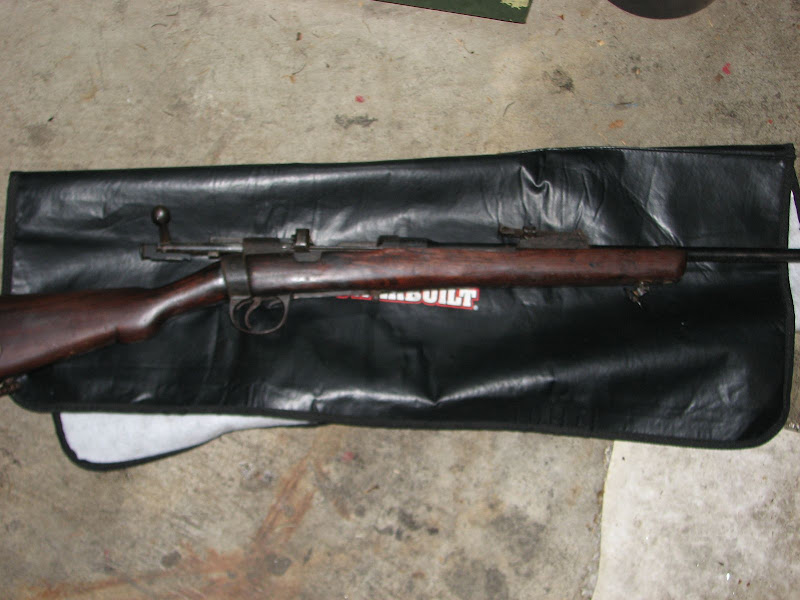
IMG_3347.jpg


So first off, i took out the bolt and cleaned the dickens out of it, and then ran endless patches through it, until I ran out of patches. They're still coming out brown :mad:

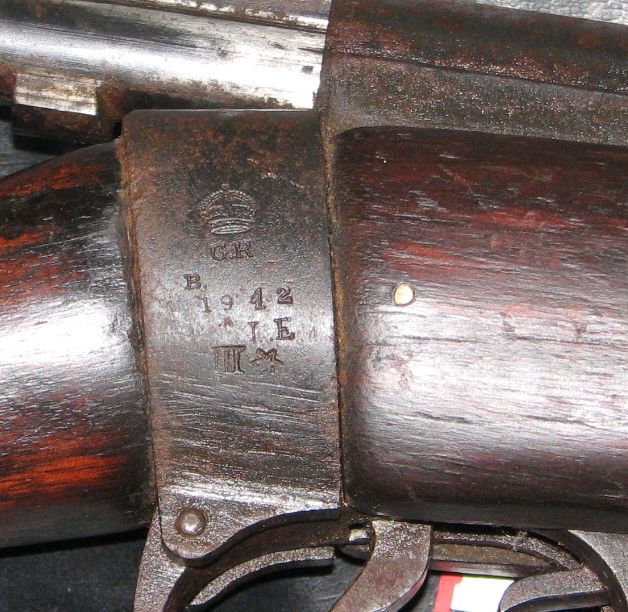
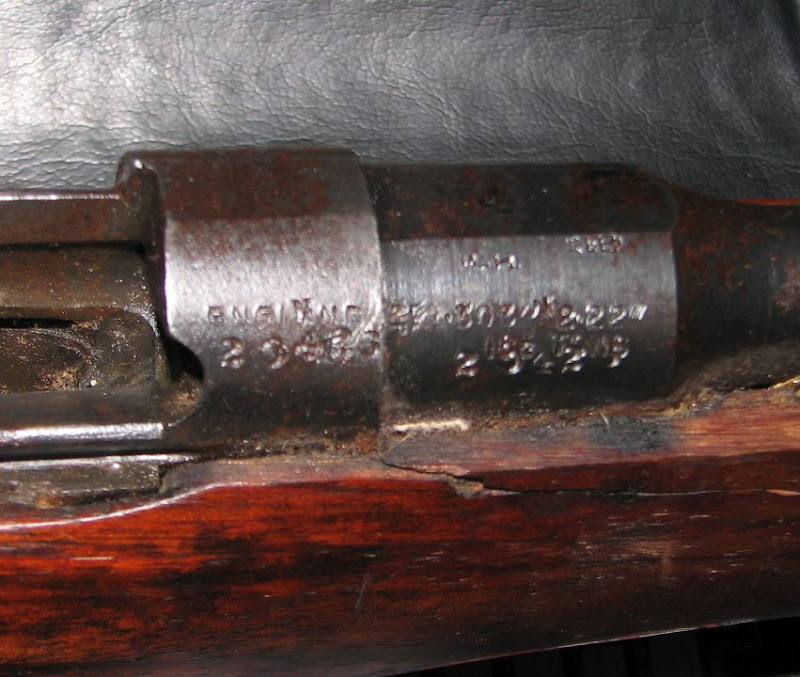
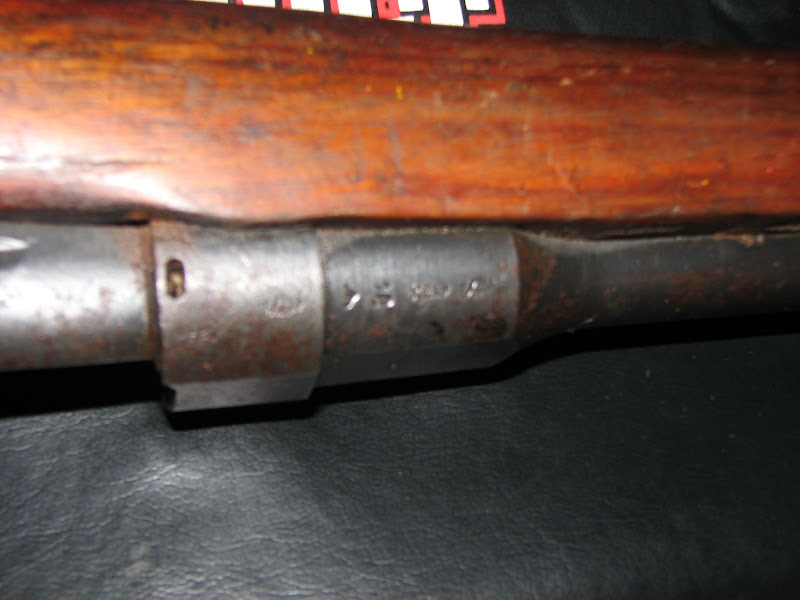
So what do I have here?
IMG_3352.jpg

IMG_3343.jpg

IMG_3344.jpg

Would it be possible to use this as a hunting rifle?
Any tips on getting this rifle back to servicable condition? The bolt cycles nice and smooth, now that I've cleaned it out, and I'm thinking of soaking the barrel in some rust removed to get the inside rust out. The rifling is still pretty clear to me, but I'm not sure if there are any pits inside.

So what do you-all think? Worth it?
 
Last edited:
Cost nothing to try. Remove all rust on it, tighten everything, check headspace, and try to shoot. If it goes everywhere at 25 meters (my first did that) then call this a part gun.

It is a No 1 Mk III*
 
I know it looks hopeless BUTTTT.... I had a Lee Enfield with a really rough bore, could barely keep 10 shots on paper at 50yds. I lapped the bore, glass bedded the action and an inch or two of the barrel and now she and put 5 rounds into just over 1" @ 50yds. Not a bench gun but a lot of fun to shoot. I plan on using it for hunting this year as most shots are not over about 75yds.
 
Give the bore a good scrubbing. A brush is going to loosen more crud than patches. Get some copper cutting bore cleaner, the bore is likely metal fouled.
Oil, OOOO steel wool and elbow grease will do wonders on the exterior.
The rifle is one of the ones set up using a combination of new, old stock and recycled parts, by BSA.
 
Get some of that foaming bore cleaner, let it soak overnight, 20-30 strokes with a nylon brush, a single dry patch, repeat. The last Enfield I tried that on went from "hopeless" to "quite nice" in about a week.
 
Thanks for the tips!!

You guys are awesome! My first thing would be to remove the barrel and all that hardware from the stock right? How many screws do I need to get out. Lou, I hear you on what's underneath, and would like to see. I thought of taking the barrel out and soaking it in Evaporust (which I read so many success stories in the gunsmithing forum). Then soaking the barrel in the foaming bore cleaner (which one do you guys recommend?) Get a rubber stopper, stop up the muzzle, pour and let sit right?

I don't really know how bad the rust is inside the bore, but yeah, I ran out of patches and they all came out brown. I can still see rifling though...;)

"check headspace" how does one do that?

Anything else I need to check...for safety's sake?
 
Dispersal Lee-Enfield Number 1 Mark III* built under BSA supervision in 1942: a real chunk of history from a time in which the British were absolutely desperate for ANYTHING that would go bang.

Never remove a barrel from a Lee unless you HAVE to. They are in very tight and it can be so easy to twist the body (receiver) if you don't know just how to do it and have the right tools. Just take off the wood, clean her up, scrub out the bore, fix The Damned Crack more than likely and you have the makings of the best general-purpose rifle ever made. It can take anything in North America if you feed it right. Do a glass-bedding job around the Body (receiver) and the chamber of the barrel, let the rest float. Adjust your vertical zero with the Inner Band Screw, which has a special lockwasher to keep it from creeping. Likely it will want a pressurepoint at the tip of what fore-end you have.

Also should make a great restoration project.

Have fun! That's what it's all about!
 
All great replies and tips, thanks! I need a magazine as well. The guy who gave me the rifle was shocked that magazines cost as much as they do. "Back in the day" according to him, they were just giving them away! :eek:

smellie said:
Dispersal Lee-Enfield Number 1 Mark III* built under BSA supervision in 1942: a real chunk of history from a time in which the British were absolutely desperate for ANYTHING that would go bang.

Smellie...that's really interesting to know! Could you point me to someplace where I could get more complete info? I tried poring through the sticky, but the 1942 I could find was a "sniper model", which surely can't be the one I have :D

smellie said:
Never remove a barrel from a Lee unless you HAVE to. They are in very tight and it can be so easy to twist the body (receiver) if you don't know just how to do it and have the right tools. Just take off the wood, clean her up, scrub out the bore, fix The Damned Crack more than likely and you have the makings of the best general-purpose rifle ever made. It can take anything in North America if you feed it right. Do a glass-bedding job around the Body (receiver) and the chamber of the barrel, let the rest float. Adjust your vertical zero with the Inner Band Screw, which has a special lockwasher to keep it from creeping. Likely it will want a pressurepoint at the tip of what fore-end you have.

I did not mean to remove the barrel. I meant (as you rightly said) to remove the wood really. How do I do that? Just the screws that I see? Anything hidden? The reason I want to do that is to soal all the metal in Evaporust, and then scrub out the bore (not necessarily in that order) with some kind of solvent (suggestions/brand names welcome!) I like the idea of the best damned general-purpose rifle in North America. Carrying the rifle, I just got the feeling that this was one substantial rifle...something not to be trifled with. And it wasn't just the heft of it. I mean, just working the bolt in and out gave me a sense of solidness. Dry firing it and hearing that bolt slam does quicken the pulse somewhat too! And now, with the almost unanimous opinion from all who've responded, this apparently, is a rifle worth saving! :)

I will need to read up about "glass-bedding" and what it entails as well as the barrel-float thing you refer to. Goes without saying that "Inner Band Screw" and "pressurepoint at the tip of the fore-end" are flying way above me. :p Perhaps you can point me some I may be educated in these terms.

It does indeed seem like I have quite the project in hand. Another friend of a friend who heard that I was into this now has promised me a box of what he called "original 303 ammo meant for the Lee Enfield. This is WW2 stuff that he's kept since then! Sadly, he gave up all his rifles over 30 years ago. So it does seem like I might be heading down the milsurp path in more ways than one!
 
Well - Be careful with Mr Evaporust, its likely Mr Evapoblue as well. There are better ways to remove the rust and not harm the bluing. Also, that WW2 ammo is likely corrosive, and will toast your bore (rust) if you dont know how to clean it.
FWIW - I'm not sure I would spend a lot of time restoring it until I assessed the shootability of the bore. You mentioned rust coming out on patches... Have you pulled out the bolt and looked through the bore at a light? Some of those old rifles have bores that look like sewer pipes, and dont have enough rifling to spin a bullet!
Bear in mind that you could pick up an equivalent rifle in very good shape for 125$, complete with mag.
 
Well - Be careful with Mr Evaporust, its likely Mr Evapoblue as well. There are better ways to remove the rust and not harm the bluing. Also, that WW2 ammo is likely corrosive, and will toast your bore (rust) if you dont know how to clean it.
FWIW - I'm not sure I would spend a lot of time restoring it until I assessed the shootability of the bore. You mentioned rust coming out on patches... Have you pulled out the bolt and looked through the bore at a light? Some of those old rifles have bores that look like sewer pipes, and dont have enough rifling to spin a bullet!
Bear in mind that you could pick up an equivalent rifle in very good shape for 125$, complete with mag.

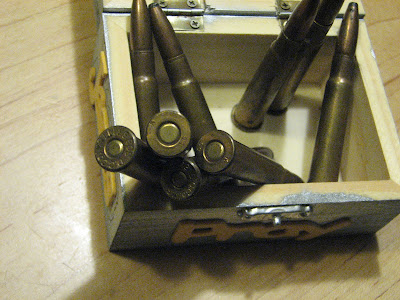
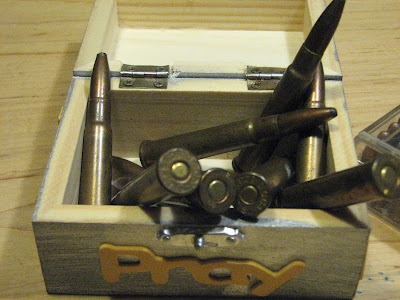
OK, I picked up the ammo from my buddy, its not WW2 ammo as he said. In fact, it looks like commercial ammo that has been reloaded with hollow points
IMG_3354.jpg
IMG_3357.jpg

I also borrowed his bore cleaning set, and used something called Nitro Powder Solvent (came with his Stag kit) and ran alternate patches and brushes until it was mostly clean. No more brown, but now black stuff coming out. I must've brushed that bore over a hundred times and yes, I can see nice rifling when I shine a light through it! Nice to see some fruits of labour here;)

So it appears that I may have licked the rust that's inside. Now about the outside. I can do the steel wool thing or evaporust thing. Either way, I would need to remove the wood. Tips anyone?
 
Remove trigger guard, (two screws) The only other possible screw would be on the inner barrel band (ahead of the rear sight.) Push forend straight down, DO Not pull on the front of it.
Buttstock, You are gonna need a BIG LONG screwdriver. Keep in mind that there is usualy a felt washer at the bottom of the hole and you won't be able to get the screwdriver in the slot until you fish it out, (try a coat hanger with a small hook on the end)
 
John Sukey (as usual) is correct and succinct. You will never get it apart if you pull down on the fore-end tip! It jams itself solid.

For the wood, clean that with mild steelwool and any kind of solvent: even kerosene works well. Once you have the crud and the rust off the wood, then you clean it right down to actual WOOD with a product such as Brake-Kleen. It will float out and flush away all the old motor-oil that the woodwork was soaked with during the last 68 years. Now you have actual wood, which you can bring back to iriginal appearance with a bit of walnut stain, some REAL boiled linseed oil and Japan drier. You will have to get the boiled oil and Japan dryer at an artist's supply: the boiled oil that most hardwares stock has been chemically treated to MIMIC boiled oil..... for PAINT purposes..... more or less. It takes five-eighths of forever to dry if you use it to refinish a stock.

You have the rust outta the bore now and now you are cleaning out the decades of crud and fouling. Great! The old girl will just LOVE it! Nitro Powder Solvent in any of several brands WILL do the job UNLESS you have nickel fouling. The Army treatment for this was somewhat drastic and would engender much more than heart murmurs were I to detail it. You can get much the same result chemically with something like Sweet's 7-62 or the old 3-0-3 bore cleaner, if you can still find it. I am using Sweet's (Australian) in my own .303s, including a couple of really rare variants, and it hasn't hurt them. Just be sure you clean the Sweet's out in 20 minutes. It has a small amount of ammonia in it, just enough to loosen nickel fouling. Stay AWAY from the old Frankford Arsenal "Ammonia Dope" that you had to mix fresh for every use: just 'way too many barrels destroyed by it. But the Sweet's is just fine.

The term "glass-bedding" refers to setting the steel parts of the rifle in a bed of semi-liquid fibreglass epoxy which has been installed into the woodwork, with a coating of some kind of 'release agent' so that everything doesn't glue itself together. I get a good bedding job using ESSO UNITOL grease as my release agent: goes on extremely thin and it shows easily, as it is a bright blue. Once the epoxy has set up and you have removed the grease, your stock and metalwork are just as tightly together as the day the rifle was made. I generally get 4 to 6 rifles from a single Brownell's bedding kit. Get the stuff called "acra-Glas Gel': the liquid stuff is pure hell to work with and it's REALLY rough on carpets!

For more information, try finding a copy of 'The Lee-Enfield Rifle' by Maj. E.G.B. Reynolds. There is also information in Ian Skennerton's book, but it is huge (and a ton of money). All it means is that during War Two, rifles were being built in several plants, but the Germans had a pretty good idea where the plants were. So they came up with an idea about 'dispersing' production. a Garage, for example, might make action screws, a furniture shop might make stocks, a machine-shop might make bolts.... that kind of thing. The parts then all were brought together at a central point and assembled. That's what your rifle is. You can find out exactly what part was made by what company from the markings on each part! There are lists in several books with this information.

Anyway, happy fixing.... and welcome to the wonderful world of Lee-Enfield rifles!
 
Perfect!! This is exactly the kind of info I was hoping for, Smellie! I'm printing off these instructions and starting on it tonight! I was afraid to touch the wood with solvent (I actually have stuff in a big black bottle called solvent, must be the real thing), but I guess I can even use Brake-Kleen on it!

As for the bore...how does one know if there's nickel fouling? Is it a specific colour I'm looking for? For now, I'm just happy to clean out all the rust inside and outside the barrel, but for future, I'd like to know the symptoms of nickel fouling.

Its interesting to know that the rifle was built in so many places and which is why its called a "dispersal Lee Enfield". My children are very interested as well, and there's one in particular who was very impressed that this gun could very well have been used in the 2nd World War. She'd be really interested that it was made in many places and brought together. Anyway, this is the one that follows me to the range regularly.

John Sukey. thanks for succinct and concise dissertation on disassembly. Much appreciated!
 
Back
Top Bottom