Hodgdon vs IMR

RangerPark

CGN frequent flyer
Rating - 100%
160   0   0
So I'm in the process of testing both IMR4064 and Varget in .308 and was debating the benefits of Hodgdon vs IMR powders. At some point I had both powders on the bench at the same time, I know I know, and I noticed the following:

Hodgdon.jpg IMR.jpg

It reminded me of this:

Duff.jpg

So if I'm not mistaken Hodgdon is made in Australia and IMR is made in Canada. We both get screwed by exporting our powders to the USA where they're packaged and then resold to us for a huge premium.

Other than that, is there really a difference worth talking about? I'm not talking about different burn rates and whatnot, but rather about quality and differences in the manufacturing process.

Please chime in with your knowledge.

Cheers! RP

 

Attachments

  • IMR.jpg
    IMR.jpg
    45.6 KB · Views: 393
  • Hodgdon.jpg
    Hodgdon.jpg
    45.5 KB · Views: 392
  • Duff.jpg
    Duff.jpg
    62.8 KB · Views: 392
Remington-Dupont set up the factory in Australia to produce the IMR line of powders at the start of WWII. The powders were improved to be less temp sensitive at the request of the Australian military. The Hodgdon Extreme powders (improved powders) are made in Australia. See the chart below.

http://www.adi-powders.com.au/handloaders/equivalents.asp

33XPgx3.jpg


Rumor has it the Australian powders have Vegemite mixed with their improved powders.
 
Last edited:
They are both decent brands on the more budget friendly side. Still waiting to see what CanAmmo can get out of IMR Canada for rifle powder other then 4198....$25/lb is right up my alley.
 
Over the course of load development for a Remmy 700, (.308, 20", 1/10,) I spent more than $2000 and two years testing sierra and hrndy 168 gr hpbt and imr 4064, imr 4895 and varget.

Spring, summer, fall, winter, through all the temps and going down to .1 grains in my ladder tests... varget hands down between powders tested shot most consistantly and tightest groups with both bullets tested.

As for the op's question about the different companies manufacturing process; who cares. Get varget. I'd sprinkle it on my cornflakes in the morning If it did the same for me as my remmy.
 
Remington-Dupont set up the factory in Australia to produce the IMR line of powders at the start of WWII. The powders were improved to be less temp sensitive at the request of the Australian military. The Hodgdon Extreme powders (improved powders) are made in Australia. See the chart below.

Rumor has it the Australian powders have Vegemite mixed with their improved powders.

I thought IMR was now made in Canada. Did they move along the way?
 
They are both decent brands on the more budget friendly side. Still waiting to see what CanAmmo can get out of IMR Canada for rifle powder other then 4198....$25/lb is right up my alley.

So that's where their mystery powders come from! I though they got them off the back of a truck... Which can still be true actually. I wonder if they will bet their hands on a 4064 type powder.
 
The difference between 4064 and Varget is that Varget meters better and is more temperature stable. 4064 is bulkier, handy in 308 & 3006 cases.

Over the course of load development for a Remmy 700, (.308, 20", 1/10,) I spent more than $2000 and two years testing sierra and hrndy 168 gr hpbt and imr 4064, imr 4895 and varget.

Spring, summer, fall, winter, through all the temps and going down to .1 grains in my ladder tests... varget hands down between powders tested shot most consistantly and tightest groups with both bullets tested.

Thanks for your feedback but I wasn't looking for this thread to become an IMR 4064 vs Varget thread, the internet has enough of those already. I'm still curious abot why both brands, which are supposed to be different, are acatually packaged in the same place in the US.
 
Thanks for your feedback but I wasn't looking for this thread to become an IMR 4064 vs Varget thread, the internet has enough of those already. I'm still curious abot why both brands, which are supposed to be different, are acatually packaged in the same place in the US.

Because Hodgdon Powder has a rather large exclusive contract to market IMR powders.
 
Thanks for your feedback but I wasn't looking for this thread to become an IMR 4064 vs Varget thread, the internet has enough of those already. I'm still curious abot why both brands, which are supposed to be different, are acatually packaged in the same place in the US.

Hodgdon's is the distributor for both IMR and Hodgdon. And winchester too.
 
I thought IMR was now made in Canada. Did they move along the way?

The Australians hired DuPont to setup the factory which belongs to ADI, that is now owned by a French company. And your Canadian IMR plant is owned by General Dynamics Weapons Devision.

The world I grew up in of Remington-DuPont and Winchester-Olin is long gone and Olin chemical now only makes chemicals for fertilizers.
 
Remington-Dupont set up the factory in Australia to produce the IMR line of powders at the start of WWII. The powders were improved to be less temp sensitive at the request of the Australian military. The Hodgdon Extreme powders (improved powders) are made in Australia. See the chart below.

http://www.adi-powders.com.au/handloaders/equivalents.asp

33XPgx3.jpg


Rumor has it the Australian powders have Vegemite mixed with their improved powders.

That chart is more about similar use than equivilent powders. They have ball and stick powders listed together.
 
Here's a chart I found at:
From https://thefiringline.com/forums/showthread.php?t=470152 post #3

...................|.St..Marks..|........................|..........|
.....Hodgdon.......|..Military..|......Winchester........|.Thales...|..IMR
...................|..&.OEM.....|........................|.(ADI)....|
___________________|____________|________________________|__________|_______________________
...................|............|........................|..........|
HP-38..............|...OBP231...|..231...................|..........|
H110.--------------|---.WC296.--|-.296.------------------|----------|-----------------------
H414...............|....WC760...|..760...................|..........|
H380...............|....WC852...|........................|..........|
Lil'.Gun.----------|--.OBP516.--|------------------------|----------|-----------------------
Hybrid.100V........|...SHP771...|........................|..........|
HS-6...............|....WC540...|........................|..........|
H335.--------------|---.WC844.--|------------------------|----------|-----------------------
BL-C(2)............|....WC846...|........................|..........|
Titewad............|...OBP132...|........................|..........|
Tightgroup.--------|--.OBP242.--|------------------------|----------|-----------------------
Longshot...........|...OBP473...|........................|..........|
US869..............|....WC869...|........................|..........|
-------------------|---.WAA90.--|-.WST.------------------|----------|-----------------------
...................|...WXC170...|..WSF...................|..........|
...................|...OBP124...|..AALite.(WFL)..........|..........|
-------------------|--.OBP465.--|-.Super-Handicap.(WSH).-|----------|-----------------------
...................|....WC748...|..748...................|..........|
...................|...WMR780...|-.Supreme.780...........|..........|
-------------------|--.SMP224.--|..AutoComp.-------------|----------|-----------------------
...................|............|........................|..........|
Clays..............|............|........................|..AS30N...|
International.Clays|------------|------------------------|-.AS50N.--|-----------------------
Universal.Clays....|............|........................|..AP70N...|
H4227..............|............|........................|..AR2205..|..IMR.4227.second.source
H4198.-------------|------------|------------------------|-.AR2207.-|-----------------------
Benchmark..........|............|........................|...BM2....|
H322...............|............|........................|..AR2219..|
-------------------|------------|------------------------|-.AR2210.-|-.IMR.8208.XBR.--------
H4895..............|............|........................|..AR2206H.|
Varget.............|............|........................|..AR2208..|
H4350.-------------|------------|------------------------|-.AR2209.-|-----------------------
H4831..............|............|........................|..AR2213..|
H4831SC............|............|........................|.AR2213SC.|
H1000.-------------|------------|------------------------|-.AR2217.-|-----------------------
Retumbo............|............|........................|..AR2225..|
H50BMG.............|............|........................|..AR2218..|
-------------------|------------|------------------------|-.AR2215.-|-.IMR.4198.second.source
...................|............|........................|..AS25BP..|-.IMR.Trail.Boss
 
That chart is more about similar use than equivilent powders. They have ball and stick powders listed together.

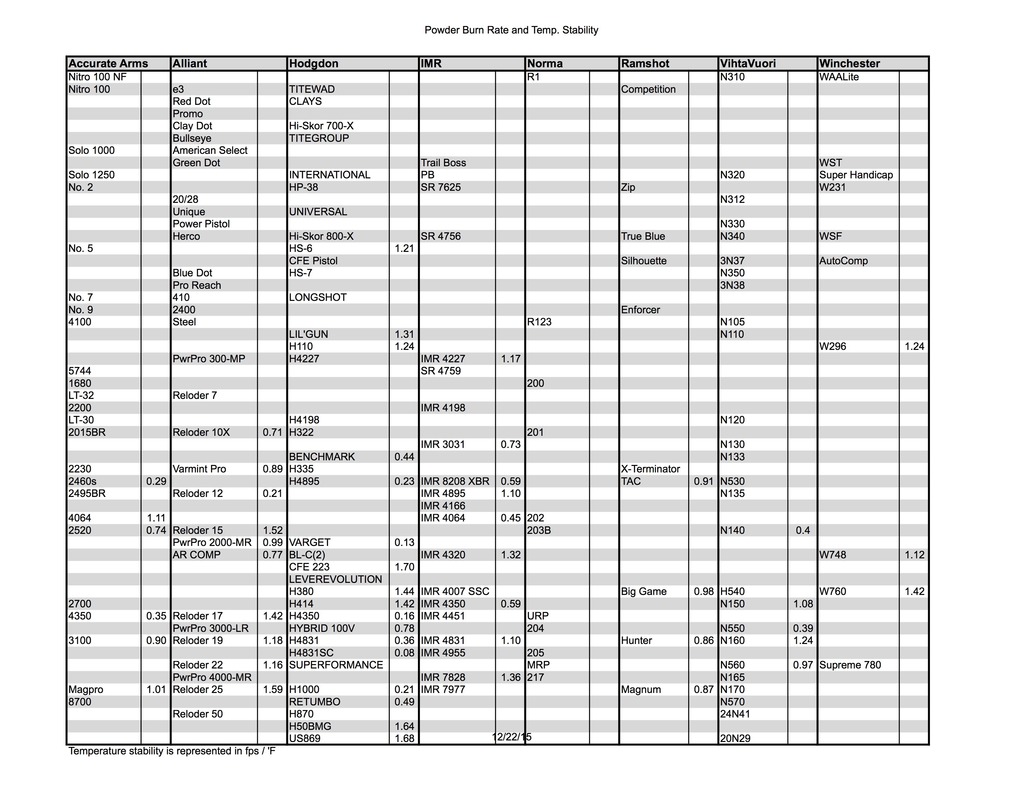
The chart I posted lists and gives the burn rate "and" the powders temp stability in numerical values. Meaning the chart gives temp stability in order of their burn rate no matter if the powder is single base or double base.

Below the the top cartridge listed 7.62mm, NATO, Ball, Special, M118LR was loaded with the double base RL15 and was replaced by the 7.62mm Special Ball, Long Range, MK 316 MOD 0 that is loaded with IMR-4064. If you look at the chart the single base powder IMR-4064 is over half as temp sensitive as the double base RL15.

Cartridge, Caliber 7.62mm, NATO, Ball, Special, M118LR (United States): 175-grain (11.3 g) 7.62×51mm NATO Match-grade round specifically designed for long-range sniping. It uses a 175-grain (11.3 g) Sierra Match King Hollow Point Boat Tail bullet. Produced at Lake City Army Ammunition Plant. The propellant's noticeable muzzle flash and temperature sensitivity led to the development of the MK 316 MOD 0 for Special Operations use.

Cartridge, Caliber 7.62mm Special Ball, Long Range, MK 316 MOD 0 (United States): A 175-grain round specifically designed for long-range sniping consisting of Sierra MatchKing Hollow Point Boat Tail projectiles, Federal Cartridge Company match cartridge cases and Gold Medal Match primers. The Propellant has been verified as IMR 4064 (per NSN 1305-01-567-6944 and Federal Cartridge Company Contract/Order Number N0016408DJN28 and has a charge weight per the specs of 41.7-grain.

NOTE, the least temp sensitive powder in that burn rate would be the Australian powder Varget. "BUT" the U.S. Military didn't want to load the cartridge with a powder made in Australia.

If you look at the bottom of the chart the numerical values to the right of the powder are the increase in velocity/fps with each degree of temp increase.

Example the "Extreme" powder H4895 is 0.23 and the IMR-4895 is 1.10, so looking at the chart the Australian/Hodgdons "Extreme" powders are much less temp sensitive.

33XPgx3.jpg
 
Last edited:
What I'm getting at is that chart gets put up about once a week to prove that certain powders are the same, when it was never meant for that at all.

http://bulletin.accurateshooter.com/2010/12/hodgdon-equivalents-for-adi-product-codes/

The only time I post this chart is to show temp stability, and this chart is arranged by burn rate of the powder to show the temp stability of like powders. Just like the difference I posted about IMR-4895 and H4895 in temp stability. And at 300 yards or less the vertical dispersion due to temp stability is very small with any powder of a like burn rate.

Below Dan Newberry's OCW or Optimal Charge Weight Load Development method .308 loads.

All Winchester brass. Reduce by .4 grains if using Lake City, or Federal brass. Reduce by .3 grains if using Lapua brass.

155 grain Sierra Matchking (or any comparable 155 grain match bullet)
45.6 grains of IMR 4895
or
46.5 grains of Varget, IMR 4064, or W748
there is a high node with Varget at about 47.8 grains (Nosler's max is 48 grains).

168 grain Sierra Matchking (or any comparable 168 grain match bullet)
43.6 grains of IMR 4895 (my all time favorite accuracy load)
or
44.5 grains of Varget or IMR 4064 or W748
there is a high node with Varget at or near 46 grains, Hodgdon's max...
or
39.0 grains of IMR 3031 (slower, but very accurate to 300 yards, a great close range tactical load).

175 Sierra Matchking
43.5 Varget, or 45.0 Varget (high node, be careful).
or
42.4 grains IMR 4895
or
43.4 grains of IMR 4064 (high node)
42.2 grains of IMR 4064 (low node)
or
43.5 grains of RL15

With 178 AMAX (Hornady)
42.0 grains IMR 4895
or
43.1 grains of Varget
or All Winchester brass. Reduce by .4 grains if using Lake City, or Federal brass. Reduce by .3 grains if using Lapua brass.


155 grain Sierra Matchking (or any comparable 155 grain match bullet)
45.6 grains of IMR 4895
or
46.5 grains of Varget, IMR 4064, or W748
there is a high node with Varget at about 47.8 grains (Nosler's max is 48 grains).

168 grain Sierra Matchking (or any comparable 168 grain match bullet)
43.6 grains of IMR 4895 (my all time favorite accuracy load)
or
44.5 grains of Varget or IMR 4064 or W748
there is a high node with Varget at or near 46 grains, Hodgdon's max...
or
39.0 grains of IMR 3031 (slower, but very accurate to 300 yards, a great close range tactical load).

175 Sierra Matchking
43.5 Varget, or 45.0 Varget (high node, be careful).
or
42.4 grains IMR 4895
or
43.4 grains of IMR 4064 (high node)
42.2 grains of IMR 4064 (low node)
or
43.5 grains of RL15

With 178 AMAX (Hornady)
42.0 grains IMR 4895
or
43.1 grains of Varget
or
43.0 grains of IMR 4064 (high node)
41.8 grians of IMR 4064 (low node)
or
43.1 grains of RL15

190 grain Sierra Matchking
40.9 grains of IMR 4064

200 grain Sierra Matchking
40.2 grains of IMR 4064

These load recipes are approximate (but very close) to wAll Winchester brass. Reduce by .4 grains if using Lake City, or Federal brass. Reduce by .3 grains if using Lapua brass.


155 grain Sierra Matchking (or any comparable 155 grain match bullet)
45.6 grains of IMR 4895
or
46.5 grains of Varget, IMR 4064, or W748
there is a high node with Varget at about 47.8 grains (Nosler's max is 48 grains).

168 grain Sierra Matchking (or any comparable 168 grain match bullet)
43.6 grains of IMR 4895 (my all time favorite accuracy load)
or
44.5 grains of Varget or IMR 4064 or W748
there is a high node with Varget at or near 46 grains, Hodgdon's max...
or
39.0 grains of IMR 3031 (slower, but very accurate to 300 yards, a great close range tactical load).

175 Sierra Matchking
43.5 Varget, or 45.0 Varget (high node, be careful).
or
42.4 grains IMR 4895
or
43.4 grains of IMR 4064 (high node)
42.2 grains of IMR 4064 (low node)
or
43.5 grains of RL15

With 178 AMAX (Hornady)
42.0 grains IMR 4895
or
43.1 grains of Varget
or
43.0 grains of IMR 4064 (high node)
41.8 grians of IMR 4064 (low node)
or
43.1 grains of RL15

190 grain Sierra Matchking
40.9 grains of IMR 4064

200 grain Sierra Matchking
40.2 grains of IMR 4064

These load recipes are approximate (but very close) to where the accuracy nodes are. Work up from a grain or two below, to be safe.
here the accuracy nodes are. Work up from a grain or two below, to be safe.

43.0 grains of IMR 4064 (high node)
41.8 grians of IMR 4064 (low node)
or
43.1 grains of RL15

190 grain Sierra Matchking
40.9 grains of IMR 4064

200 grain Sierra Matchking
40.2 grains of IMR 4064

These load recipes are approximate (but very close) to where the accuracy nodes are. Work up from a grain or two below, to be safe.
 
Back
Top Bottom