Home made trigger job on a 1911

soditide

CGN Regular
Rating - 99.4%
160   1   4
I have a Norinco 1911 and i would like to do a trigger job without polishing. I just want to change some parts. What are the parts i have to change. Sear, sear spring. what else?

Other question. How i can put more tension on on grip safety? The mine is too lose.

Thanks
 
First off, make sure you know how a 1911 functions before tinkering with it to make it unsafe.

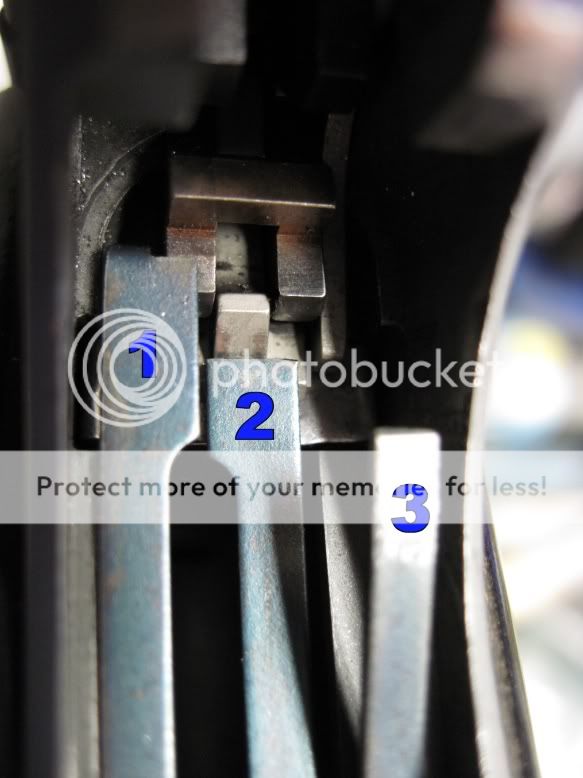
For the grip safety, if you remove the mainspring housing, there is a 3 stem leaf spring. You can bend the stem of the 3rnd spring towards the grip.

searspring4.jpg
 
Just changing the sear and sear spring is not a trigger job. In fact, just throwing a new sear in without any other fitting.. Your going to end up with a paperweight. There is a lot to a trigger job. I invested a lot of time learning and reading then a lot of money into tools, jigs and parts. Took a lot of practice to get a "decent" trigger job.
 
If your not willing to invest time and money into learning and practicing, it would be a hell of a lot cheaper to get a smith to do it for you.
 
I just want to decrease the tension of the trigger pull with custom parts. I don't want to pay $140.00 for a real trigger by a gunsmith. I paid $250 today for a used Norinco. I would be happy if i the tension could be at 5-6 pounds. The trigger pull of the Norinco's is about 9 pounds. It's horrible
 
Custom parts don't drop in. They need to be fitted regardless. Unless you know how to fit them, you will need a gunsmith. To get a 5# pull with just swapped custom parts, the parts alone will run you 120$ plus shipping. Right now you have 2 options. Take it to a gun smith and have it done exactly to the specs you want, and never have to worry about it. Or... Slightly bend back your sear spring to decrease the tension on the sear leg and in turn, decrease trigger pull. Buy if you go this route, there is chance you will bend it too much (Dosent take a lot) and have a gun might double or worse full auto. Not worth losing your licence over a 120$ trigger job.
 
I can tell you that on my Norc 1911 gov't from Canam that the sear and hammer is not the same size as the Wilson Combat 1911 auto value line sear and hammer (from Brownells), and the firing pin spring is definitely not the same size as the Wilson Combat one either. Slide spring is fine. I tried just dropping in the Wilson sear (which is quite close to the Norc sear, except Norc sear has no relief cut)... but then I experience some strange random slide lockups.

I brought those with the Ed Brown sear jig and a 2 stone set all from Brownells. It's actually not hard to polish the trigger (well, the parts of the trigger that touches the frame and the sear), the sear (except making the relief cut, but I wasn't trying very hard... but I think the relief cut does make a difference), and making sure the hammer hook has a 90 degree angle (Norc hammer hook is close to 90 degree, but has a bit more than the minimum hammer hook depth). But that won't get you a 4-5 lb pull unless you also pull back the 3 stem leaf spring seen above. After some aggressive pull back of the left 2 stems, I could get the trigger pull down to the same as my cz shadow in single action... but the hammer follows (from full #### to half ####) when you drop the slide (which means not enough pressure on the sear from the left-most stem). At that point I decided to play it safe and bend forward the 2 stems to be like before. In the end, even if you just do the polishing, you'll get still get a way cleaner trigger break although the pull will not be reduced by a lot. The trigger creep is mostly gone. You pretty much need a trigger pull gauge as well if you care about safety.

 
I just want to decrease the tension of the trigger pull with custom parts. I don't want to pay $140.00 for a real trigger by a gunsmith. I paid $250 today for a used Norinco. I would be happy if i the tension could be at 5-6 pounds. The trigger pull of the Norinco's is about 9 pounds. It's horrible

Cool story....

To perform a proper trigger job, you are looking at spending $100-$150 just for the tools (stones, trigger bow form, sear jig, 0.018" gauge, trigger pull gauge or weight).

If you don't know what you are doing, you could get into real trouble with your 1911. "Saving money" and "home gunsmithing" are mutually exclusive concepts.
 
You get what you pay for, especially with norinco. Same goes with gunsmithing.... A $100 trigger job is worth $100 because its done right.
 
I just want to decrease the tension of the trigger pull with custom parts. I don't want to pay $140.00 for a real trigger by a gunsmith. I paid $250 today for a used Norinco. I would be happy if i the tension could be at 5-6 pounds. The trigger pull of the Norinco's is about 9 pounds. It's horrible

You could easily pay $140 for the high end trigger parts you want/need, then still need to have them fitted by a gunsmith in order to get them to work properly. So instead of paying the gunsmith $150 to improve the trigger you have, removing creep and over travel as well as the unwanted weight; you'll end up paying $300+ for the trigger you think you want. An entire industry has been built around after market improvements for the 1911 and AR, that might be worth considering when you want improvements made to a gun you would prefer to keep basically stock. If you want your gun tricked out like a high end Kimber or Wilson, the cost will be comparable regardless of whether you buy it ready to go off the shelf, or have it built from a stock 1911. If you would like the contact information for an excellent Canadian pistol smith, Google Bumblebee Custom Machine in Prince George. Asking him questions pertinent to your specific gun and what it would take to make it shootable, might be eye opening.

I don't recall what the Norinco 1911 sights look like, but if they are the stock military 1911 style, you aught to consider installing a set of high visibility sights, should you re-evaluate and choose the gunsmith route. A manageable trigger and sights you can see are the two elements of the pistol that have the greatest effect on marksmanship. A beveled magazine well, a ported slide, after market recoil springs and buffers, custom grip panels, after market checkering, and a Cerakote finish will do nothing for your marksmanship.
 
Last edited:
It is fairly easy to reduce the trigger pull weight on a 1911 to a reasonable level (most of the time), just by adjusting the individual leaves on the sear spring. But you should take the time to understand what you are doing because it is also fairly easy to make your pistol unsafe by doing so.

As has been said, there are no drop-in parts in the 1911 fire control system. You might get lucky and buy a matching hammer, disconnector, and sear that work fine when dropped in, but you might not.
 
OK, here is what a klutz can do to a 1911 to improve the trigger weight.

At the bottom rear of the grip frame is a pin that is easy to knock out. This will allow you to slide the back strap off.

This contains the hammer spring. At the top of this unit you can see the cup on top of the sprong peeking out. It is retained by a small pin with a head on it. Put the unit in a vice, push the hammer spring in a bit and the pin is easy to push out with a paper clip. Catch the little pin. Then let the hammer spring push the cup out.

Pull the spring out and pull out the pin on the bottom. Clip 3 coils off the bottom, put the bottom pin back in. Put the spring back in, depress it and reinstall the little pin. You can do this by hand. no tool needed.

This will reduce the trigger weight noticeably.

If you want the trigger as light as possible, without a real trigger job, remove the flat spring and bend each of the tines towards you so that each is now about 1/10" closer to the rear than before. This will reduce trigger weight and increase compression on the grip safety.

Put it back together. This will teach you about some of the basic parts of your gun and if you screw up real bad the damaged parts only cost about $10 to replace.

 
I did a trigger job on my Norc 1911...rerplaced the trigger, sear,hammer spring hammer and sear spring...poished surfaces. trigger is crisp at abot 5 lb now....STI parts
 
At the Brownell's web sight there's a section on technical articles. One of them is tuning the three finger spring. You can get a lot from some time spent tweaking that spring even before you try anything else.

Also be aware that nothing is a "drop in" with 1911's. You can buy a matched sear and hammer but then your safety might not work. It's all related and things have to happen starting from the right end to get a fully useable action out the other end.
 
There's no such thing as a trigger job without polishing. Nor can you just change the parts. Those parts require fitting. However, if you just change the springs you will see some improvement
Anyway, a trigger job on a .45 is easy and requires no special tools. Polishing(no files or rotary tools. Just a fine or medium stone and only enough to remove tool marks) the mating trigger/sear parts and cut 1/4 turn of the mainspring is all you need do.
 
it's really easy for a ham fist, or someone who's not done much stoning before to change the angle, or perpendicularity of the sear or hammer notches with a medium stone...even a fine one..
Your better off with a jig, it takes the feel out of it.

Polishing will help smooth it out and make it feel lighter, but you can bugger the parts pretty quick that way too.
 
Back
Top Bottom