Hornady Brass Weight Sorted

The larger a cases and its capacity variations the less effect it has on chamber pressure.


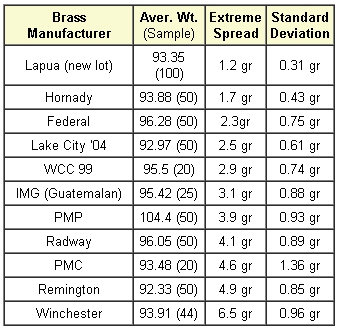
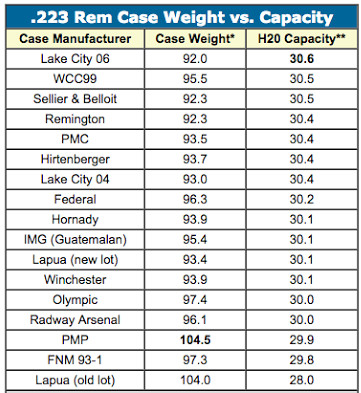
Below .223/5.56 case weight variations and case capacity.

PExmCCk.jpg


Below the top Lake City case at 30.6 case capacity and the bottom case at 28.0 capacity will vary the chamber presure 6,000 psi with the same charge of 25.0 grains of H335. (Quickload data)
Meaning a larger case like a 30-06 would have smaller pressure variations due to its larger case volume. And your pictured "artillery" cases would even have less effect.;)

LjAQ7L9.jpg
 
Thanks for the info, they're 45/70. I was going to toss out the "freaks" for load development but they're all a little freaky.

In other forums, they say you have to be shooting past 300 yards to see the difference in vertical impact due to weight/case capacity. And your 45-70 is a close range mortar round and less effected by capacity.

I had a Ruger No.3 carbine in 45-70 that only weighed 5 1/2 pounds and was not fun to shoot at the range from a bench. I shot two 500 grain bullets out of it that were for a .458 Winchester magnum once and both gave me a nose bleed. I learned a great deal that day about a light rifle and "heavy" bullets and keeping your nose away from the base of your thumb.
 
Prep, load and shoot. My Hornady brass in 6.5 Creed is not weight sorted or by batch either. Still shoots 1/2 MOA out to 800. Certainly not the best brass but far from junk.
 
Since you have the brass, why not do a simple experiment. Prep the cases so they are the same externally with FH deburred.

Load and shoot them IN THEIR WEIGHT GROUPS... I would group all those singles in the lower half weight range.... see what happens on your target

I suspect, you will not be able to tell a significant difference given the cartridge, bullet types and likely rifle. And if you do, it will be at the extremes of your weight range

Let us know how it works out.

Jerry

PS after the brass has been fired, compare the volumes. I would use a very fine ball powder (or salt) and just fill the case to the top... pour into the next case and compare the fill level. I suspect, the volumes will be very similar.... and that is what matters.
 
Have you weighed the same cases multiple times to find out what the spread of your scale is?
Before assuming the spread is truly in the case weight you need to know what the spread of your sampling method (scale and operator variation) is.
 
I have some 308 Brass low to high 7g difference :(

I also have some 30-06 brass the vary less than 3 grains over 300 pcs. :)..... if I could get my powder measure to very less than 2 g I would be very Happy :( but when its Iron Sights ;):):)
 
The variation you are seeing is only abut 2% total (1% +/- average) which is insignificant. As mentioned trim them all to the same length and load them up.
 
You guys are right, it's like balancing the wheels on a hay wagon. More of an observation than anything. Theoretically would it be more useful to weigh them after once fired and trimmed?

No. Just find your starting load and work up until you see the accuracy you are looking for.

BTW, With the 45-70 you will not get many warning signs that you're are getting over-pressure loads so stick with published loads.
 
Last edited:

I made up a lot of 308 using Hornady brass for my M1a, the velocity SD was about 7FPS. I would buy more, but I've got a bunch of Lake City rounds made up as it is. The velocity SD for it was 15 FPS.
 
You guys are right, it's like balancing the wheels on a hay wagon. More of an observation than anything. Theoretically would it be more useful to weigh them after once fired and trimmed?

weighing cases was a lazy way to guess what you are really after... confirming case volume. There is no way to accurately deduce case volume from case weight ... don't believe me? Compare case volume in the heaviest and lightest case. It will likely be the same or vary very little. There is a lot of areas on a case that isn't machined identically. Brass is very heavy vs its volume so a little bit here and there, and you have a heavy case

If you want to compare case volume, measure case volume... after the case has been fireformed.

but in a 45-70 which is unlikely to be consistently sub MOA, it is like applying ceramic paint finish to that hay wagon.

If you have a rifle capable and goal to make ammo sub 1/2 MOA, then by all means confirm the case volume... but weighing cases is not the answer.

Jerry
 
weighing cases was a lazy way to guess what you are really after... confirming case volume. There is no way to accurately deduce case volume from case weight ... don't believe me? Compare case volume in the heaviest and lightest case. It will likely be the same or vary very little. There is a lot of areas on a case that isn't machined identically. Brass is very heavy vs its volume so a little bit here and there, and you have a heavy case

If you want to compare case volume, measure case volume... after the case has been fireformed.

but in a 45-70 which is unlikely to be consistently sub MOA, it is like applying ceramic paint finish to that hay wagon.

If you have a rifle capable and goal to make ammo sub 1/2 MOA, then by all means confirm the case volume... but weighing cases is not the answer.

Jerry

This. Sorting brass by weight is not good indicator of the internal volume. I did repeated tests to confirm this but do not take my word and do it yourself. If you want to sort your brass, use h20 volume. It will be long and painful and you will probably find it not worth the hassle unless you are trying to have loads that goes the precision of the rifle and shooter.
 
Weighing cases is a complete waste of time.
The only thing it tells you is that 1 case is a different weight to another. This in no way indicates that the internal volume is different.
The manufacturing tolerances are so wide that all your cases could be of identical internal volume but completely different weights.
 
Buy 200pcs and weight sort, then you'll have a few tight batches of 50pcs+

Sound advice ^^^... years back I bought a 21st Century Primer Plug. Handy little trinket that didn't cost much. Good thing it was a very long winter, as I used it to H2O capacity test 300 Lake City 5.56 cases. Well, it was a TEDIOUS process.

I found that any given case could hold say 30 grain of fluid. I could empty (dry it right out) that same case and repeat and get a reading 30.3 grains... do that same case again and maybe get 29.8 grains.

The Meniscus line (whether it is convex or concave) on the top of the case mouth could change the H2O weight by 0.4 grains or so. I'm certain that I didn't have air bubbles, it was just meniscus.

Now a days, I will uniform the Primer Pockets, Flashhole deburr, turn the necks, clean in stainless steel media, resize and trim to length.
Now I have 300 pieces of brass that are free of carbon and have all been machined in a consistent manner....as a final step I sort them by case weight and break them out into 4 batches of 75. Within each 75 batch I might see 0.2 to 0.3 grain extreme spread.

The way I look at it, at this point the heavier brass should have a smaller capacity (i.e. thicker base maybe thicker bodies too) as all the excess brass in other places in the case (primer pockets, flash holes and necks) have been removed and they are now unformed everywhere else

 
Sound advice ^^^... years back I bought a 21st Century Primer Plug. Handy little trinket that didn't cost much. Good thing it was a very long winter, as I used it to H2O capacity test 300 Lake City 5.56 cases. Well, it was a TEDIOUS process.

I found that any given case could hold say 30 grain of fluid. I could empty (dry it right out) that same case and repeat and get a reading 30.3 grains... do that same case again and maybe get 29.8 grains.

The Meniscus line (whether it is convex or concave) on the top of the case mouth could change the H2O weight by 0.4 grains or so. I'm certain that I didn't have air bubbles, it was just meniscus.

Now a days, I will uniform the Primer Pockets, Flashhole deburr, turn the necks, clean in stainless steel media, resize and trim to length.
Now I have 300 pieces of brass that are free of carbon and have all been machined in a consistent manner....as a final step I sort them by case weight and break them out into 4 batches of 75. Within each 75 batch I might see 0.2 to 0.3 grain extreme spread.

The way I look at it, at this point the heavier brass should have a smaller capacity (i.e. thicker base maybe thicker bodies too) as all the excess brass in other places in the case (primer pockets, flash holes and necks) have been removed and they are now unformed everywhere else


My experience mirrors yours.

If the outside dimensions of all the cases are the same, then any discrepancies in case weight will have to have some affect on case volume.
 
Back
Top Bottom