Finger Toes
Regular
- Location
- Yellowhead County
Not overly impressed with the weight sorting results of this brass. Extreme spread nearly 4 grains, almost $2/piece. It's not for a bench gun but still.
Last edited:













































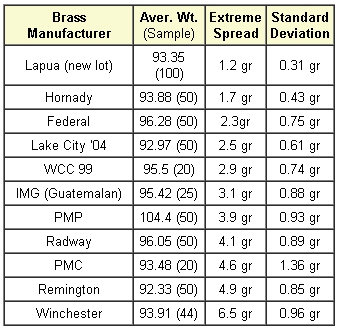

Thanks for the info, they're 45/70. I was going to toss out the "freaks" for load development but they're all a little freaky.
You guys are right, it's like balancing the wheels on a hay wagon. More of an observation than anything. Theoretically would it be more useful to weigh them after once fired and trimmed?
You guys are right, it's like balancing the wheels on a hay wagon. More of an observation than anything. Theoretically would it be more useful to weigh them after once fired and trimmed?

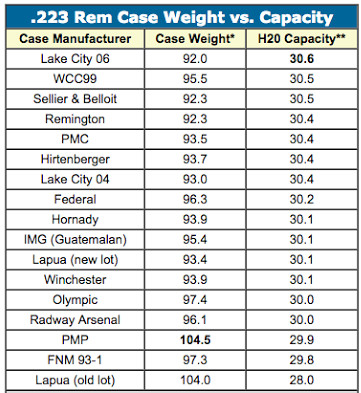
weighing cases was a lazy way to guess what you are really after... confirming case volume. There is no way to accurately deduce case volume from case weight ... don't believe me? Compare case volume in the heaviest and lightest case. It will likely be the same or vary very little. There is a lot of areas on a case that isn't machined identically. Brass is very heavy vs its volume so a little bit here and there, and you have a heavy case
If you want to compare case volume, measure case volume... after the case has been fireformed.
but in a 45-70 which is unlikely to be consistently sub MOA, it is like applying ceramic paint finish to that hay wagon.
If you have a rifle capable and goal to make ammo sub 1/2 MOA, then by all means confirm the case volume... but weighing cases is not the answer.
Jerry

Buy 200pcs and weight sort, then you'll have a few tight batches of 50pcs+
Sound advice ^^^... years back I bought a 21st Century Primer Plug. Handy little trinket that didn't cost much. Good thing it was a very long winter, as I used it to H2O capacity test 300 Lake City 5.56 cases. Well, it was a TEDIOUS process.
I found that any given case could hold say 30 grain of fluid. I could empty (dry it right out) that same case and repeat and get a reading 30.3 grains... do that same case again and maybe get 29.8 grains.
The Meniscus line (whether it is convex or concave) on the top of the case mouth could change the H2O weight by 0.4 grains or so. I'm certain that I didn't have air bubbles, it was just meniscus.
Now a days, I will uniform the Primer Pockets, Flashhole deburr, turn the necks, clean in stainless steel media, resize and trim to length.
Now I have 300 pieces of brass that are free of carbon and have all been machined in a consistent manner....as a final step I sort them by case weight and break them out into 4 batches of 75. Within each 75 batch I might see 0.2 to 0.3 grain extreme spread.
The way I look at it, at this point the heavier brass should have a smaller capacity (i.e. thicker base maybe thicker bodies too) as all the excess brass in other places in the case (primer pockets, flash holes and necks) have been removed and they are now unformed everywhere else