HOW DO RIMFIRE TUNERS DO WHAT THEY DO?

WHY TUNER EFFECT IS HARDER TO SEE AT LONG RANGE

At short range, the setup works in your favor. Groups are smaller, wind has less influence, and differences between tuner settings are easier to recognize. You can often see the classic “tighten–open–tighten” pattern as you adjust.

At longer range, that advantage fades. Groups are larger. Wind becomes a major variable. Velocity spread produces more visible vertical. Those effects stack on top of each other.

So even if the tuner is still influencing the result, it becomes harder to separate that influence from everything else. This creates an unavoidable limitation: at distance, it is hard to prove a tuner change caused what you’re seeing -- and just as hard to prove it didn’t.

That doesn’t mean tuners stop working at distance. It means distance makes interpretation harder.
 
SHORT RANGE AND LONG RANGE TESTING DO DIFFERENT JOBS

At short range, the other influences on the shot are small enough that they don’t hide the effect of the tuner.

Wind is minimal, velocity effects are small, and groups stay tight, so changes in tuner setting tend to show up as clear patterns. You can see groups tighten, open, and tighten again, which makes it easier to identify a tune window and judge how stable it is.

At longer range, you are no longer seeing one effect. Small differences in muzzle angle grow, velocity variation produces more vertical, and wind becomes a major factor. All of these effects overlap, so the pattern you saw at short range is harder to recognize.

This makes each distance useful in a different way. Short range lets you see what the tuner is doing because other influences are small. Long range shows how muzzle behavior, velocity, and wind all combine on target—but it’s much harder to separate their individual effects.

So short range shows differences clearly. Long range shows consequences. Neither is more true -- they just answer different questions.
 
TEMPERATURE AND CONSISTENCY FIT THE SAME PATTERN

Temperature fits into the same framework.

Temperature can influence velocity. Warmer conditions often produce slightly higher speeds.
Cooler conditions often produce lower speeds. That changes how long the bullet takes to reach the muzzle, which changes the exit moment relative to barrel motion.

There’s another part to this: not every round responds in exactly the same way. More consistent ammo tends to respond more uniformly. Less consistent ammo may show not only a change in average velocity, but a change in spread.

So temperature can do two things at once:
  • move the average exit timing (and therefore where you sit in the tune window)
  • change how tight the groups are within that window
The key point remains the same: the tuner doesn’t remove variation. It works inside whatever variation already exists.
 
A CONCLUSION: WHAT ACTUALLY MATTERS

By now, this should all be starting to come together.

A tuner does one thing: it changes when the bullet exits relative to the barrel’s motion. That’s the mechanism. Everything else -- good results, poor results, different opinions -- comes from how that interacts with the rifle and the ammunition.


What actually drives performance isn’t the tuner itself -- it’s what you start with:
  • how consistently the ammo performs
  • how repeatable the barrel behaves
  • how much variation exists shot to shot
  • whether that variation stays inside a usable tune window
The tuner operates on top of all of that. It can shape the result, but it cannot create consistency where it doesn’t already exist.

That explains why good rifles with good ammo respond to tuning, why inconsistent setups don’t, and why some shooters leave tuners alone while others adjust frequently.

The tuner isn’t the source of accuracy. It’s a way of managing timing within whatever accuracy already exists.
 
FINAL TAKEAWAY

Tuners don’t fix your rifle or your ammo -- they show you what you really have.


A tuner doesn’t create accuracy. It changes when the bullet exits within the barrel’s motion. If the rifle and ammo are already consistent, that change can place the exit in a favorable part of the motion and make the setup more forgiving. If they aren’t, the tuner has nothing stable to work with.

Get the rifle and ammo shooting consistently first -- then use the tuner to get the best out of that combination.
 
FINAL TAKEAWAY

Tuners don’t fix your rifle or your ammo -- they show you what you really have.


A tuner doesn’t create accuracy. It changes when the bullet exits within the barrel’s motion. If the rifle and ammo are already consistent, that change can place the exit in a favorable part of the motion and make the setup more forgiving. If they aren’t, the tuner has nothing stable to work with.

Get the rifle and ammo shooting consistently first -- then use the tuner to get the best out of that combination.
Thank you for taking the time to write this and the previous post. It explains a lot of what the variables are, and problems we run into chasing tight groups.
 
Barrel tunes are just like bar weights for motorcycles:

A little bit of science, a whole lot of snake oil and 95 percent of the time the problem is actually solved by correcting the riders posture....

YMMV
 
Last edited:
IMG-8003.jpg
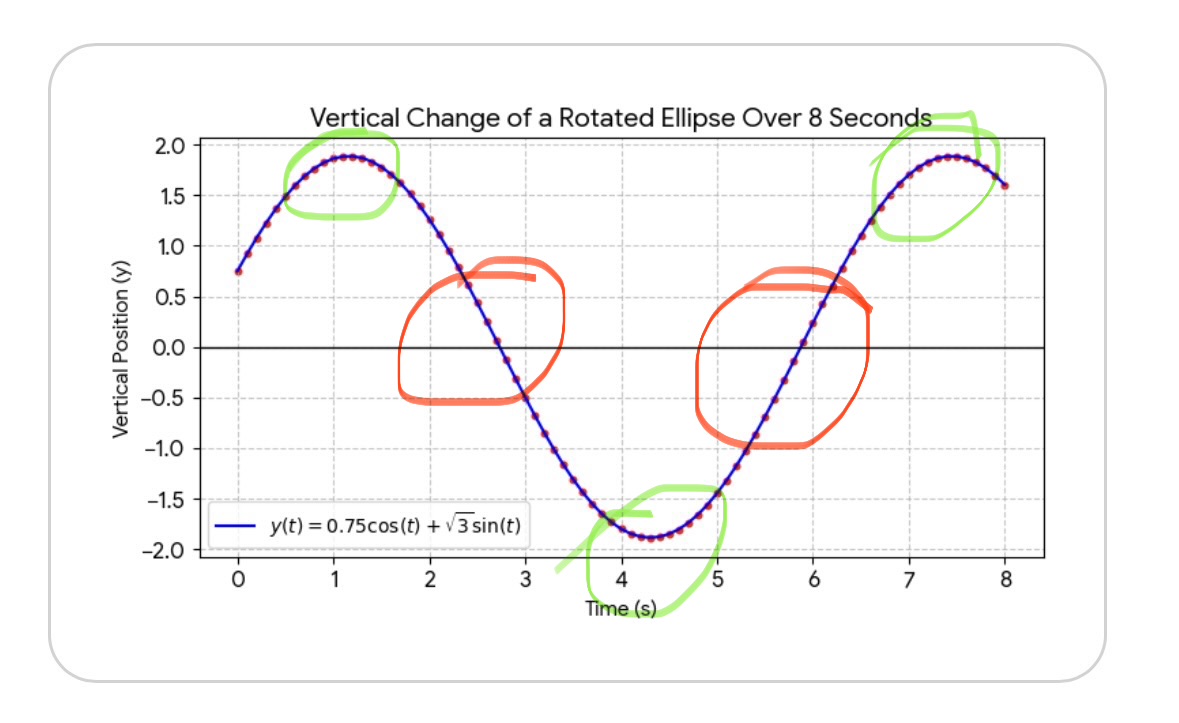
Nice post. I thought I’d add a visual to help show how your vertical can be affected by barrel timing.

I got AI to make a simple graph and this is illustrating the vertical distance between consistent points in time of an ellipse.

I don’t know what shape the muzzle will make, so I picked an ellipse and rotated it a bit. Ignore the time scale since I didn’t care enough to like it up with ‘real’ barrel time.

This is just to show how your groups can tighten up if the bullet leaves the muzzle around the top or bottom of the oscillation (circled in green). It’s really easy to see if you think of your group as being any sequence of three consecutive dots.

If the bullets leave between those high/low points, (circled in red), your group will grow.
This is incorrect. Geoffrey Kolbe of Border Barrels and Varmint Al of Varmint Al both have very good and complimentary explanations of what is going on. All three green sections and the left red section of that cycle are bad. The only good portion is the right red section. The only way for the green sections to be beneficial would be if you could eliminate muzzle velocity variations, which we cannot do with rimfire ammo. Even the tightest velocity spread of the most consistent reloaded centrefire ammo will still be better off with the upswing of the right red circled area. Muzzle velocity variation is never eliminated, and thus a completely still barrel is not beneficial. You always want to give faster shots a lower launch angle and slower shots a higher launch angle. And that's what the right red circle accomplishes.

http://www.geoffrey-kolbe.com/articles/rimfire_accuracy/tuning_a_barrel.htm
https://www.varmintal.com/a22lr.htm


grahuanen, how many different tuners have you used and which do you prefer?

I can't help but wonder how easy or hard it is to change the harmonics on short stiff barrels shooting .22lr vs longer barrels with more flex?
 
Can-down

Lilja has a calculator that let us enter barrel specs and outputs a stiffness factor.
Super slow camera's really show the flex of guns, scopes and mounts for heavier recoiling guns.... when it comes to .22lr and say a 12 inch bull barrel it's hard to imagine just how small the amount of harmonic impulse there is....

I would guess that a 12 inch barrel would not be that reactive to most tuners out there that are meant for longer barrels.

I just did a quick search for the Lilja calculator and only saw something to help a person balance out the weight distribution of a build.

There are so many variables when it comes to shooting small groups with rimfire guns that it makes it a tweekers dream and nightmare!
 
Last edited:
I've got some joy on a medium weight 22 inch barrel with a Harrell with added weight. I wouldn't bother with anything shorter.
 
There is likely not much barrel whip with lower powered cartridges like .22lr when compared with heavier center fire cartridges but there would still be some harmonic vibrations and oscillation even with shorter stiffer barrels.... I can see where it could be a rabbit hole but given the amount of competition shooters out there much of the trial and error is likely already done.


A big part of competing at a high level is mental confidence and a relaxed flow state as you surrender to the moment confident that you are prepared physically and mentally for success.... how people get to that state is not a fixed path but simply part of the journey.
 
You do not want the stiffest barrel possible. An infinitely stiff barrel leaves you at the mercy of muzzle velocity. There are reasons competitive benchrest barrels all have similar specs. You need movement. And you need to control it for a particular speed of movement and direction of movement. That means a given length and profile for it to work well with a given tuner. If you’re going to use a popular off the shelf tuner it needs to be paired with a barrel that it is designed for. A random tuner with a random barrel design isn’t likely to give you want you want. It might help. It might not. It certainly won’t be ideal. And since 22 LR benchrest tends to be at 50 yards, people have pretty much found the ideals for 50-yard competition.
 
You do not want the stiffest barrel possible. An infinitely stiff barrel leaves you at the mercy of muzzle velocity. There are reasons competitive benchrest barrels all have similar specs. You need movement. And you need to control it for a particular speed of movement and direction of movement. That means a given length and profile for it to work well with a given tuner. If you’re going to use a popular off the shelf tuner it needs to be paired with a barrel that it is designed for. A random tuner with a random barrel design isn’t likely to give you want you want. It might help. It might not. It certainly won’t be ideal. And since 22 LR benchrest tends to be at 50 yards, people have pretty much found the ideals for 50-yard competition.
I like the idea of seeking to control the movement rather then eliminate it.
I can also see where tuning a longer more flexible barrel would be easier and likely offer more sensitivity.

I can also see where a person could get consumed chasing after that last little bit of accuracy shooting rimfire..... :)
 
Back
Top Bottom