How do they make those cutaway cartridges?

schick

Regular
EE Expired
Rating - 100%
5   0   0
Location
Saskatchewan
I sure most of us have seen those great cut-away cartridges. You know, the ones with part of the case removed and teh posder exposed, or half the bullet removed.

Anyone know how they do it? I can see a case being not too hard to cut, but I can't see how they mock up the powder.
 
I like to use 5 minute epoxy for most propellants. You have to work fast, but the results are great - you just need to use the right amount of glue. Too much and the powder grains become blobby. Too little and it is too fragile.

Black powder:
577Snider.jpg


Cut Cordite:
Section3.jpg


Large grain multi-perforated:
section1.jpg


Standard IMR:
XM645Honeywell.jpg


Section4.jpg

In this instance, I find it useful to put just a tiny bit of oil of the cut surface of the projectiles so that if any epoxy touches it can be wiped off.

For regular cordite, I like to use 'Collodion Flexible' - a flexible skin adhesive (used by sport teams):
section2.jpg


Paul
 
Large grain multi-perforated:
section1.jpg


Standard IMR:
XM645Honeywell.jpg


Section4.jpg

In this instance, I find it useful to put just a tiny bit of oil of the cut surface of the projectiles so that if any epoxy touches it can be wiped off.

Paul

I hate to hi-jack (actually I don't, but it makes me feel better if I say that), but what in God's name are those rounds? This board is lucky you've recently found us, looks like you've got some pretty awesome stuff.
 
Sorry, I knew I should have posted descriptions...

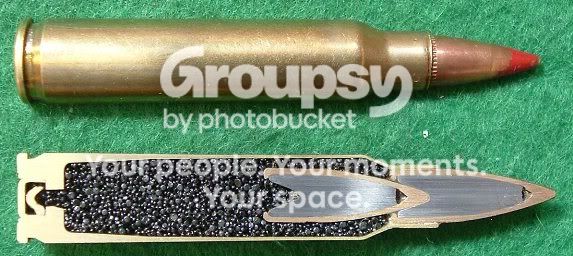
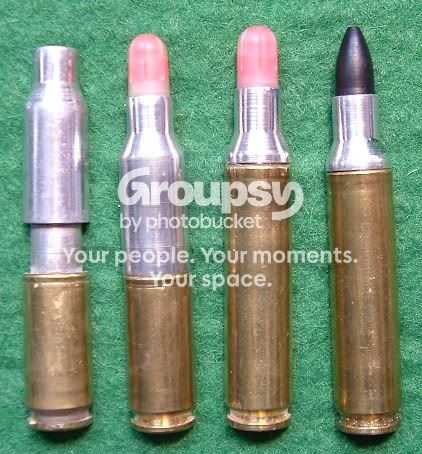
Top to bottom:

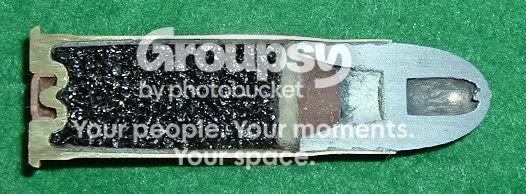
.577 Snider. Note the paper liner withint he case.

6.5mm Carcano 'Magistri' blank for machine gun. The projectile is brass foil filled with compressed granulated lead.

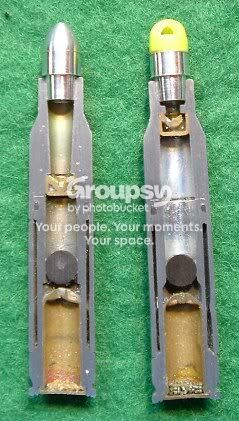
25x137 TPDS-T (Training Practice Discarding Sabot Tracer)

XM645 Flechette. This is an earlier loading with the Honeywell 'crushed' fiberglass sabot and early style of flechette. Note also the piston primer. Upon firing, the piston primer is forced back, strickes the bolt face and started to unlock the action (aka primer actuation; This idea of primer actuation was conceived by John Garand (a Canadian by birth!). Garand experimented with several prototype semi automatic rifles using primer actuation in the early 1920s while at Springfield Armory).

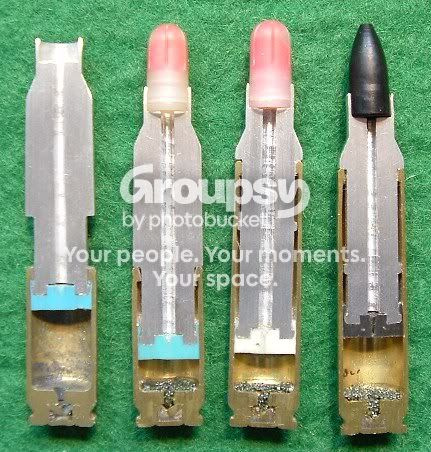
5.56 x 45 ACR (Advanced Combat Rifle) Duplex loading. Dates from the late 1980's.

For more sections, please visit: http://cartridgecollectors.org/cmo/cmoindex.htm

Thanks,
Paul

 
Don't be cutting live ammo in half with the powder still in the case. The metal gets hot enough to light it. The sparks actually.
 
aw shucks, I have to throw two in.
DCP_2308_edited.jpg

27kolibria.jpg


5 minute epoxy or not, they look amazing, I have pondered many a time how Son Of Tiriaq manages these beautiful little gems. (thats a 303brit head for size comparison).
 
Wow, thanks gents.

Those pics are great and teh advice is appreciated. I think I'll start experimenting.
I'm guessing that straight, clean cuts on cases only look easy. I wonder how hard it is to section bullets.

This seems like a cool hobby. I like collecting interesting cartridges. Now I can display their guts.
 
Sorry, I knew I should have posted descriptions...

Top to bottom:

.577 Snider. Note the paper liner withint he case.

6.5mm Carcano 'Magistri' blank for machine gun. The projectile is brass foil filled with compressed granulated lead.

25x137 TPDS-T (Training Practice Discarding Sabot Tracer)

XM645 Flechette. This is an earlier loading with the Honeywell 'crushed' fiberglass sabot and early style of flechette. Note also the piston primer. Upon firing, the piston primer is forced back, strickes the bolt face and started to unlock the action (aka primer actuation; This idea of primer actuation was conceived by John Garand (a Canadian by birth!). Garand experimented with several prototype semi automatic rifles using primer actuation in the early 1920s while at Springfield Armory).

5.56 x 45 ACR (Advanced Combat Rifle) Duplex loading. Dates from the late 1980's.

For more sections, please visit: http://cartridgecollectors.org/cmo/cmoindex.htm

Thanks,
Paul

I recognized a few of them, missed a few others. (the 6.5 blank, and I didnt notice the piston in the flecchette)
My question is why are you cutting neat rare cartridges? Doesnt that devalue them?
 
My question is why are you cutting neat rare cartridges? Doesnt that devalue them?
I'll take a stab at that if I may, my few are done by Son Of Tiriaq, and they were done because no one had done them. The internal design of the 2,7mm Kolibri AFAIK had not been illustrated anywhere until he cut that one, so it can show you things about construction that otherwise would be missed. Additionally most folks, including me, dont do it to thier best specimens, ones with flaws, dent or corrosion etc on one side are great subjects.
As for the depreciation, I would argue that no, it doesnt deminish them, depending on who does them. S.O.T is renowned for his skill and precision, I have seen really awful ones, hamhanded and sloppy, downright halfarsed. Those will deminish the value, but if done correctly and neatly I would argue the value in most cases would be the same, and in some elevated.
 
tootall - actually, these rounds are not all that rare - not even all that scarce. Interesting, yes, but even more interesting when sectioned! Most of the pieces I cut are for commission, and I've done some very rare rounds (1 of 6 known; but the round had been repaired and it was not kow if it was a fake. It was genuine and is now the only known sectioned .30-06 frangible tracer round). Most of everything I section ends up being published ('The Better Half' in the International Ammunition Journal) or in private publications. By sharing what can be learned more than compensates for the 'destruction' of one one round.

If anyone has any particular requests, I'll gladly post the pictures I have.

In the interim, for tootall, some 5.56 x 45 training ammunition:

UTM (Ultimate Training Ammunition)
556UTM.jpg


FX/IVI (developed by SNC (formerly Canadian, now owned by ATK (USA)))
556FXtraining.jpg
556FXtrainingreverse.jpg
 
Ok, daveg01...

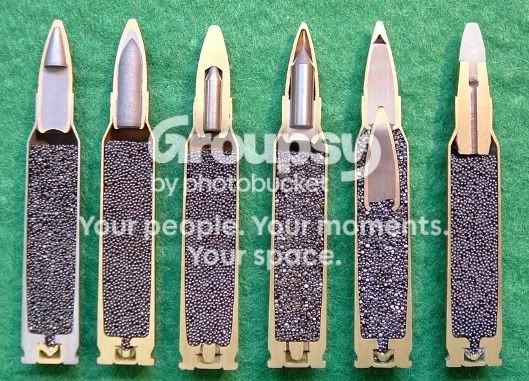
Some different 5.56 x 45 rounds

left to right:

French, experiemental AP, tungsten penetrator
Dutch, experimental AP, tungsten penetrator
Belgian, experimental AP, hardened steel rod penetrator
Swedish AP, tungsten penetrator in aluminum boot
USA, ACR Duplex (different than the one illustrated previously)
German, short range (training)


556x45.jpg


Paul

 
Those duplex loads, is that just a press fit between the bullets? One would almost think the second bullet would just get left in the case. Interesting.
 
Back
Top Bottom