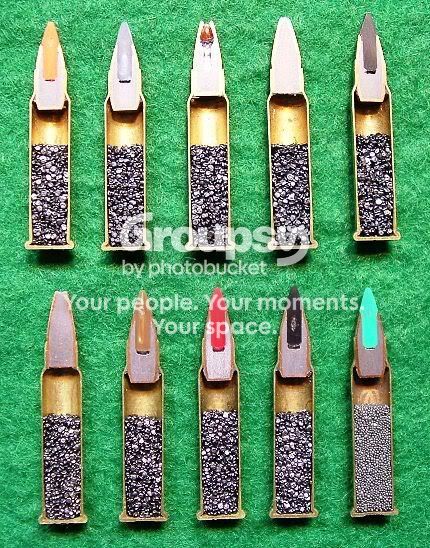
How do they make those cutaway cartridges?

Thanks for the answer Paul, and also for the cutaways of the UTM ammo. I got to play with some 9x19mm examples of the civvy version (called N-Range) when I was in Vegas for the SHOT show.
I scooped up some of the fired sprung cases, and sectioned one myself.

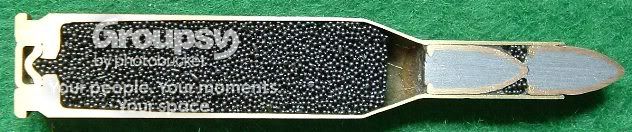
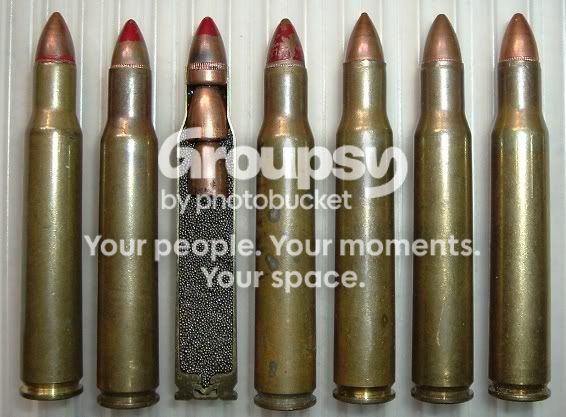
While I am aware of the system, i did not know until seeing yours above that the aluminum bullet and the paint man-marker are different internally. Yours clearly shows the primer in different locations. Very cool.

I see the IVI FX things also stretch upon firing, I was not aware of that.

Dean
 
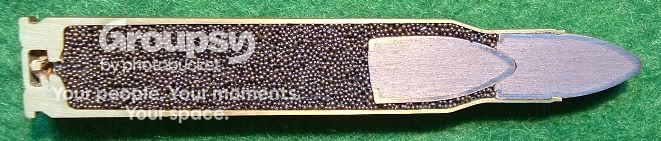
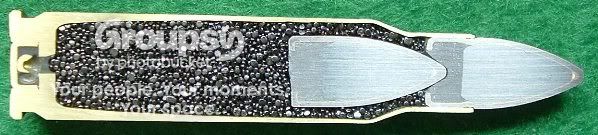
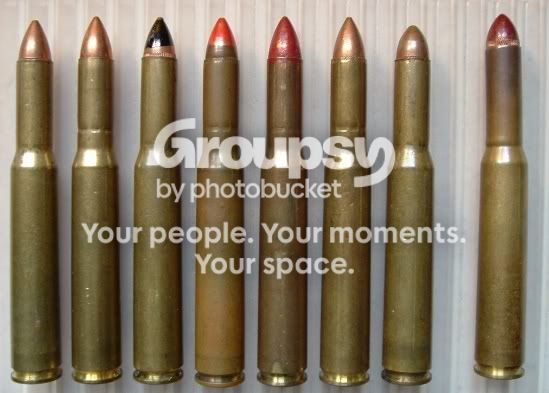
Multi-ball loadings are not new...actually the idea is very old. If one is good, two (or more) must be better, or so the reasoning goes. From a modern military perspective the only duplex load ever adopted was the 7.62 Nato M198 Duplex, used primarily in miniguns during the Viet Nam war. Leading up to this was the SALVO program. There are many variations to be found - some common, some super rare (like the .25 and .27 cal duplex and triplex loadings). But others in .22 and .30 caliber are quite common. So, to answer tonyg's question, the projectile are intended to separate. In fact, some of the loads were designed with the rear bullet having a canted base. This feature would ensure a random dispersion of the second projectile. Some of these rounds below show this feature.

.30-06 Duplex
30-06Duplex.jpg


.30 Triplex (74 mm case length; note the propellant between the projectiles to aid in separation).
30-06Triplex.jpg


7.62 Nato (this is not the M198, just an early version)

762natoDuplex.jpg


.22 Duplex
22duplex.jpg


.30-06 Duplex and Triplex loads
30salvo001.jpg


".30-06" duplex and Triplex loads
30salvo004.jpg


Paul
 
22duplex.jpg


Is there really powder between the bullets? One would think that powder would not burn unless hot gas escaped around the rear bullet..........
 
I'm loathe to give any detailed instructions. All I'll say is that primers never really die...they just become desensitized. Apply enough energy and they will react, with unpredictable vigour. Oil is not always enough to 'kill' a primer. Always use a solvent (like acetone) first to dissolve any sealants, followed by oil and then let it sit for a minimum 14 days. But there are so many variables and pitfalls - like making sure there is no airlock in the flash hole that prevents the oil from actually making contact with the primer. This is bad. Patience is your friend and energy management is the law...that and good protective gear.

Paul
All digits present and accounted for.
 
This is a .50 cal BMG 'Plate Test'. Plate test rounds are simply down loaded rounds (this one is loaded to about 1,800 fps) and were used to determine, in this case, the penetration of this AP load at a predetermined velocity. This is done so that you don't have to hit the target from some great distance, but rather at something more convenient. The cotton wadding is simply there to keep the powder column in place.

This round was made at Frankford Arsenal in the 1940's. The silver over black tip colour is the identification.

50calplatetest.jpg


platetest.jpg


Paul

p.s. if anyone has any specific requests, let me know. I have a pretty big photolibrary of sectioned rounds.
 
With what you sid about primers never being fully all the way dead, it must make for an interesting day, doing the rimfire rounds.


I would imagine rimfire would be easier that centerfire. Simply pull bullet, dump powder, fire empty case in chamber to ignite primer. Then just make sure the side of the rimfire with the firing pin strike is the side you remove.
 
These rounds were commission pieces. I'm not sure how he came across it. I've also done a red based proof .17 HMR round. The headstamp is 'PROOF'.

Rimfires are much easier to section as there are fewer pieces to work with. Snapping off the primer once the projectile and powder are removed is certainly one way of taking care of the priming composition. I don't have a .17 HMR, so have to do 'old school'.

Paul
 
Back
Top Bottom