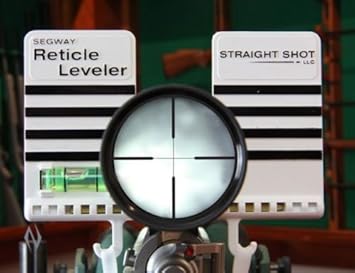
How do you level your scopes?

winchester1852

CGN Regular
Rating - 100%
4   0   0
Location
Rain out west
I see there's lots of ways on google but some of them seem like re inventing the wheel. I figured aligning the vertical line of the scope with a straight line would make the scope level, but has me thinking it won't be completely level.
 
Lots of ways to skin a cat. I personally take a very small level that came with a tv mount and secure the rifle in a vise when the top of the action or any flat part on the top of the rifle is level. I then gently install the scope and tighten it down with the level on the top turret of the scope all the while tightening the scope rings a bit at a time to ensure the scope stays level.


 
Lots of ways to skin a cat. I personally take a very small level that came with a tv mount and secure the rifle in a vise when the top of the action or any flat part on the top of the rifle is level. I then gently install the scope and tighten it down with the level on the top turret of the scope all the while tightening the scope rings a bit at a time to ensure the scope stays level.

That's the same way i do it.
 
I eyeball it.
I want the scope level the way I most comfortably hold the gun which isn't 100% plumb.
My guns hit what they are aimed at.
Most of my rifles in my hands can consistently group 1 moa or less at 100 meters.
Never missed an animal yet because of marksmanship.
Good enough for hunting. Good enough for me.
Having stated the above it's clear I'm not a 1000 yard bench rest shooter.
 
A friend and I set up a 2 foot carpenters level outside his house in the country.
We then ensured the rifle was level.
Last we rotated the scope until the crosshairs lined up with the carpenters level, & tightened the screws.
 
This method works pretty good. A Wheeler magnetic scope leveling kit.

vopRnThh.jpg
 
Lots of ways to skin a cat. I personally take a very small level that came with a tv mount and secure the rifle in a vise when the top of the action or any flat part on the top of the rifle is level. I then gently install the scope and tighten it down with the level on the top turret of the scope all the while tightening the scope rings a bit at a time to ensure the scope stays level.

Use this method as well
 
That's what I did today, lining up the vertical crosshair with the Center of the action. Then I started to second guess myself after seeing all the tools specifically meant for levelling. Thanks for all the great tips guys:)
 
I remove the adj checkpiece (McMillan A5) and use a bubble level on the flat surface. Close enough for government work. Having your scope level to your target is much more important.
 
I eyeball it.
I want the scope level the way I most comfortably hold the gun which isn't 100% plumb.
My guns hit what they are aimed at.
Most of my rifles in my hands can consistently group 1 moa or less at 100 meters.
Never missed an animal yet because of marksmanship.
Good enough for hunting. Good enough for me.
Having stated the above it's clear I'm not a 1000 yard bench rest shooter.

For anything other then bench rested, bipod, big scope with a bubble level ,long distance type shooting..... your technique makes sense.
Wood stocks can be twisted and everyone's shoulder and body mechanics are different.

I use a basic level on the action in a rest and then level off the turret caps, then I shoulder the gun naturally towards a known plumb target (usually door or window trim and confirm that the vertical reticle is plumb.
 
I bring a 2ft level to the range and level my target. ( or you can also draw a black sharpie line on the target with the level ) Then level the rifle on the bipod. Done at 100 yards. Then pull the bolt to bore sight. Gets to within 12" easily.
 
For Picatinny rails, I use feeler gauges between the Picatinny rail and the flat turret base. Stack the correct combination of gauges for a tight fit and then tighten the scope.
 
I level the rifle and keep it level while aligning the crosshairs to a plumb-line. If the magnification goes low enough, I'll use my laser level set up down the hallway. Picked up an Arisaka scope leveler to try out (for picatinny rails or mounts) which works just the like Spuhr leveling wedge. I don't worry too much about leveling my reticle perfectly to the rifle, but make sure it is bang on with any of the level indicating devices I'm using, which may be a scope bubble level, the level in a spuhr mount, or my MPA chassis, etc.
 
I eyeball it.
I want the scope level the way I most comfortably hold the gun which isn't 100% plumb.
My guns hit what they are aimed at.
Most of my rifles in my hands can consistently group 1 moa or less at 100 meters.
Never missed an animal yet because of marksmanship.
Good enough for hunting. Good enough for me.
Having stated the above it's clear I'm not a 1000 yard bench rest shooter.

Same here. If you look at a beam or post most people can see if it needs to go right / left / up or down.
 
For Picatinny rails, I use feeler gauges between the Picatinny rail and the flat turret base. Stack the correct combination of gauges for a tight fit and then tighten the scope.

We are discussing reticle or crosshair level and plumb ...... sounds like you are talking about adjusting the angle of the scope it self.
 
I hold the rifle and look through the scope holding left handed, then do it again right handed. If it looks good both ways, its good enough for me.
 
Lots of ways to skin a cat. I personally take a very small level that came with a tv mount and secure the rifle in a vise when the top of the action or any flat part on the top of the rifle is level. I then gently install the scope and tighten it down with the level on the top turret of the scope all the while tightening the scope rings a bit at a time to ensure the scope stays level.

^Same!

Cheers
Jay
 
We are discussing reticle or crosshair level and plumb ...... sounds like you are talking about adjusting the angle of the scope it self.

It does seem like that at first, but he's actually referring to reticle leveling using this technique (replacing the wedge with feeler gauges):


I haven't tried this method, yet, but it's intriguing. I usually do an initial leveling with a bubble level on the turret cap and action, and then should and look at the corner of a distant house to double-check --- a plumb line at 100yds would be even better. I suppose there's a possibility that the reticle may not be at right angles to the turret cap, hence the double-check.
 
Back
Top Bottom