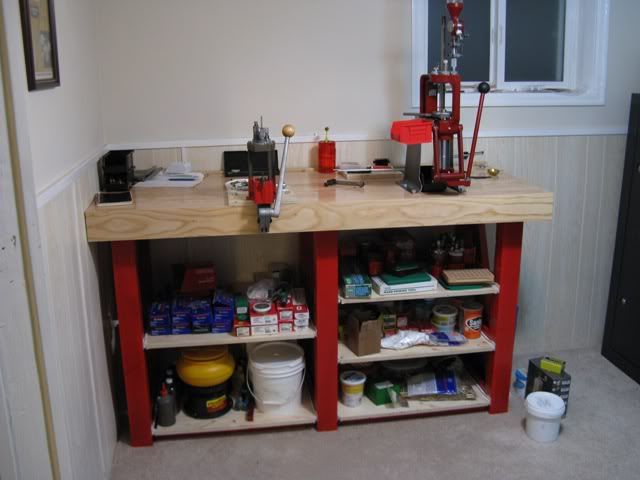
How High is your Reloading Bench? Update on pg 3

Bart212

CGN Ultra frequent flyer
Rating - 100%
88   0   0
Location
Ottawa
Hey all,

I'm building a reloading bench this weekend and need the know what heights others have theirs.

I don't have my reloading kit as of yet. Henry said that it's in the mail. I ordered a Hornady LnL AP.

Any suggestions in addition to the height would be appreciated.

Thanks.
 
Last edited:
Whatever is comfortable for you, honestly. Mine, after some trial and error, is 33".

Suggestion - deliberately make your bench high. Use it for a while (not just one small run of ammo). If it's OK, fine; if not, take an inch off. The point is not to be too hasty in trimming. You've got the rest of your life.

Welcome to the dark side.

Edit: Other suggestions

Lighting is critical. If there's some way to build in lighting, it's worth it.

A fire extinguisher nearby (but not right on it) is a good idea. You only need it when you really need it.

Think in advance about how you are going to level it. I'm not saying that the tabletop needs to be perfectly level. Rather, if one leg is a bit too short and the bench wobbles a bit, how are you going to fix that annoying problem? (In my case, I put 2x4s horizontally between the front and rear legs. I have an unfinished concrete floor, so a lag bolt screwed in from the top of the 2x4 allows semi-precision adjustment - good enough, anyway).

A raised platform for beam-balance scales is a very good idea as you don't have to scrunch down to read it. The plans chalkriver linked to put the scales on a shelf - same-same.

Painting the top white or covering it with white Melamine makes cleanup much easier.

A strip magnet fastened to the wall is an excellent place to hang fiddly tools like Allen keys, tiny screwdrivers, etc.

Nearby storage space for the dozens of little bits and pieces - dies, stuck case extractors, lube sets, bullet pullers, etc - will save you a lot of time. I have a cheap set of drawers under my bench and a discounted cupboard on the wall above it.

 
Last edited:
As others have said an old sturdy wooden desk or something similar can work but If you want to build one here are the plans to a nice one
100_1580_small.jpg


Reloading bench plans
http://www.shotgunsportsmagazine.com/downloads/bench_plans.pdf
 
Thanks for the advice everyone.

How far back are the Bolt holes on a LnL press? I'll need to know this so that I don't have a cross beam going right through where it'll need to be bolted.
 
Height, mine is 39". At times I'll do some of my reloading standing and this is a convenient height to be able to do that. Or, it's also a convenient height for use of ths chair/stool in the picture.

Reloadingrm1.jpg
 
Another hint, for when you get your gear.

Think of reloading as a multi-step process. Brass goes in here, is resized, then goes there to be belled and primed, then back to over there for propellant - think about how convenient it's going to be for you to pass things back and forth. Even with a progressive, you still have to feed things in and take things out.

My point is put the various bits of equipment where they will fit in smoothly with that flow.
 
Another hint, for when you get your gear.

Think of reloading as a multi-step process. Brass goes in here, is resized, then goes there to be belled and primed, then back to over there for propellant - think about how convenient it's going to be for you to pass things back and forth. Even with a progressive, you still have to feed things in and take things out.

My point is put the various bits of equipment where they will fit in smoothly with that flow.

Hey thanks, for the tip.

Just as a heads up I also bought the Dillon 1200B and a case feeder.

I'm aiming at this model ... It seemed the most simple. If there's any critique to how this guy operates I would greatly appreciate it.
[youtube]wBQ_vJHiGek&feature=related[/youtube]
 
Mine is about standard Kitchen Counter height.

I also have two different height stools though - one for reloading, and one for working on the guns. The tall one is for repairs and maintenance - I prefer to "look down" on something when I am workign on it. For reloading, I like sitting a little lower so I can pull the press arm towards me, rather than having to push it down.
 
Painting the top white or covering it with white Melamine makes cleanup much easier.

Nearly storage space for the dozens of little bits and pieces - dies, stuck case extractors, lube sets, bullet pullers, etc - will save you a lot of time. I have a cheap set of drawers under my bench and a discounted cupboard on the wall above it.


The finish that I have is that of the Plywood, it's onside finished and sanded. I was just going to put boiled linseed oil on it.

I'm planning on building shelves below for powders on one side and primers on the other. Then latter I'll be building storage on top with extra lighting.
 
I found that having the top of the LNL press frame at 150cm was perfect for reloading standing or sitting on a barstool type chair. I achieved this by making my benchtop 105cm off the floor, then mounting the LNL on a steel bracket.

front2.jpg


The 105cm height also proved to be ideal for reloading using my single stage and turret presses while sitting on the same stool.

 
Thanks for the advice everyone.

How far back are the Bolt holes on a LnL press? I'll need to know this so that I don't have a cross beam going right through where it'll need to be bolted.

Having a cross beam of sorts wouldn't necessarily be a bad thing. Just drill through for the bolts if it happens .. Extra support never hurts

My bench top is 41" high, which seems to be a good height for my LNL ... Almost finished building my new bench right now ...
 
Back
Top Bottom