How high to shoot geese?

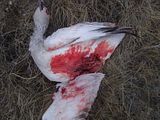
My experience with the far out shots is that I have seen snow geese with their soft skin split right open when hitting the hard or frozen ground. Could this help explain all the damage to the breast meat?
 
My experience with the far out shots is that I have seen snow geese with their soft skin split right open when hitting the hard or frozen ground. Could this help explain all the damage to the breast meat?

I was dropping ducks a couple of weeks ago and they were "breaking" on impact with the ground. Backs cracked and keel bones snapped.

I've shot birds flying with a 40+ km/hr tail wind before that gutted themselves when they hit the water or peeled the skin off the breast.

60 yards with steel can be done -- but it results in more injured birds generally. If I'm on a dedicated goose shoot, I usually pony up the dough and pick up some Hevishot or Tungsten.
 
200ft is pretty damn far. Off the top of my head, I get 65y out of that. I wouldn't consider 65y to be super awful skybusting, but it's gettin out there. Anything outside 50y is pretty much a hail mary.

Something went wrong with the shell. Maybe it got wet and the steel shot rusted together?
 
One problem is the size of the pattern at 75 yds, but the bigger problem is that there's a huge difference in shot energy between when it's fired 75 yds horizontally or 75 yds vertically. The shot will be going a whole lot slower when it hits the 75 yd target in the vertical shot. Heck with turkey, a 75 yd horizontal shot is a Hail Mary, but guys regularly go 100+ yds with geese?

Skybusters - the guys who shoot at the geese directly over your position just as you're thinking they're close enough..... All they need is one kill in 20 tries to keep at it. Sort of like the guys who make "regular" 600 yd deer kills.
 
Anything over 40 yards is getting into hail Mary territory.

From Ducks Unlimited:

http://www.ducks.org/Hunting/shooti...31/whatdoesittaketobringdownaduck.html?poe=od


"Four or five number 4 or 2 pellets driven deeply into a duck-sized target at 40 yards (with the heavy nontoxic pellets, number 5 and even number 6 can do this) should do the job. Forty yards is close to the practical ballistic limit of steel shot and, frankly, also close to the practical shooting-ability limit of most waterfowlers, regardless of shot material. "
 
One problem is the size of the pattern at 75 yds, but the bigger problem is that there's a huge difference in shot energy between when it's fired 75 yds horizontally or 75 yds vertically. The shot will be going a whole lot slower when it hits the 75 yd target in the vertical shot. Heck with turkey, a 75 yd horizontal shot is a Hail Mary, but guys regularly go 100+ yds with geese?

Skybusters - the guys who shoot at the geese directly over your position just as you're thinking they're close enough..... All they need is one kill in 20 tries to keep at it. Sort of like the guys who make "regular" 600 yd deer kills.


Anybody shooting at geese at 100y is a retard.
 
th_Antelopecreekranchnov62009003.jpg


There it is.
 
Looks like you just heart shot it and it is bleeding out. Happens all the time, did you examine the bird when cleaning it? I would say you should hold your fire until they are close and shoot them in the head, this will preserve meat and shells. You mentioned using 4's, most likely the bird was hit with a few that clumped together and these struck an artery, probably the main wing artery or heart and it just looks shot up. If you switched to larger shot the pellets would pass through leaving you with no worry of dental injury when you eat the bird.
 
Back
Top Bottom