How hot do you load 223?

Kryogen

CGN Ultra frequent flyer
Rating - 100%
11   0   0
Location
Quebec
I loaded a few of a new load to test
27.0 CFE223 with a Hdy 55 FMJ-BT 2.200 (Hdy listed OAL)

They chronoed at 2918 out of my 18.5 kektec

They felt quite hot to me. (recoil, noise). (edit: relative to a factory 223 round, just to explain because somehow there is a member here that feels the need to macho up telling me that a 223 does not recoil hard... whatever)

Quickload predicted 3012 FPS at +- 50 000PSI / 55 000PSI max.

So um, how should I actually deal with that? According to quickload, they should go faster and have more room, but Hdy lists a max of 27.4, so imo they are already quite close to max and felt quite hot.

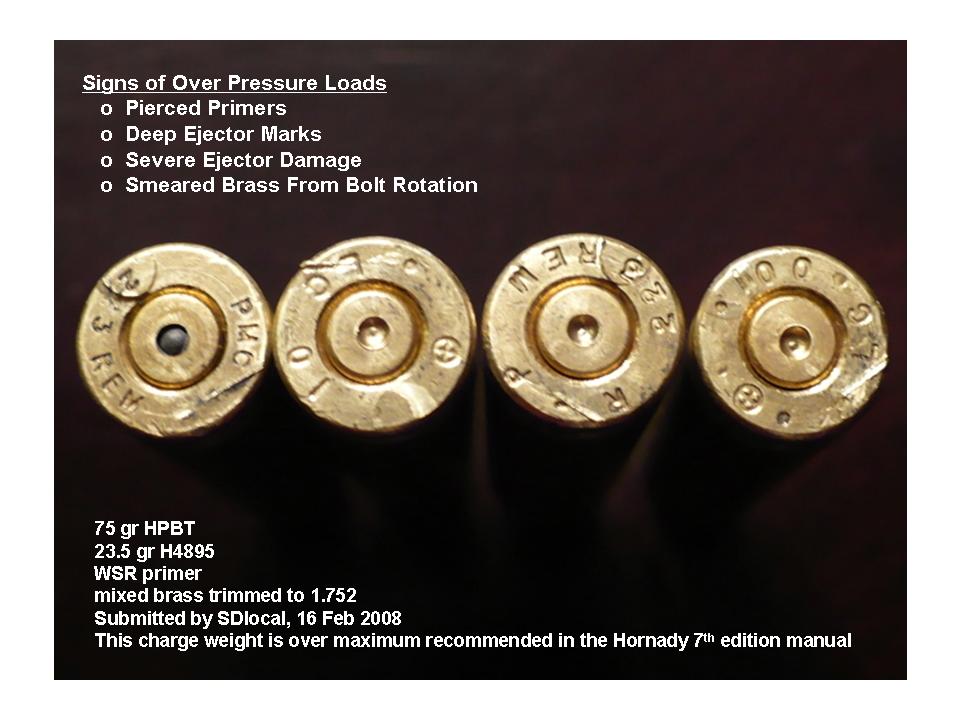
No pressure signs.
I am probably just keeping it there (because of the Hdy book max) and using that load, but I am a bit curious about the large FPS difference with quickload.
 
Last edited:
I find a 100-200 fps difference between book and chrono velocity with 18.5" .223 semis. Working up to max in XCR's with H335 gives just under 3100 fps with 25.0 being my best shooting load at 3080 avg. I do run into flattened primers as I approach max of 25.3. As far as a computer progrom not lining up with real life, I'd say thats to be expected from time to time but I would keep working up. A lot can happen in those last few tenths and sometimes not much happens either. Book max loads are to be taken with a grain of salt unless you're shooting the exact same components from the same lot #'s in the same rifle. Start loads are more important and working up safely and cautiously will tell you where your max load is for your setup. Personally I like atleast a few tenths under pressure signs for a good shooting .223 load. Unless you're paying for premium brass then brass life is not much of a factor. Primer pockets seem to outlast necks for me with 556 brass and its cheap to replace.
 
They felt quite hot to me. (recoil, noise).

66697237.jpg
 
Kryogen

Quickload is nothing more than computer generated guesses, to make it more accurate you need a chronograph and change the burn rate in Quickload until the two velocities match.
Quickload has three load sections for the .223/5.56, .223 SAAMI, .223 CIP, and 5.56x45 NATO. So you have two different methods of pressure taking and throat lengths giving different chamber pressure readings. ual

I'm loading for three AR15 rifles and a Savage .223 bolt action that has a longer throat than the AR15 rifles do and it can be loaded warmer. The AR15 rifles have a chrome chamber and bore, a melonite coated chamber and bore and a plain bare steel chamber and bore. The two 16 inch carbines vary in velocity with the same factory and reloads. And all these factors with each firearm must be adjusted for in Quickload to make the output even close to actual results.

I'm writing this on my laptop that "had" Windows 8 on it and now has Linux on it and no more Quickload. I'll let you know if I even miss Quickload and its computer generated guesses.

Because there are so many variables in firearms, Quickload is not the greatest thing since sliced bread. If you just change primers the chamber pressure and velocity will be different and Quickload will need to be tweaked and readjusted to your chronograph reading.

Below variations in case capacity with the .223/5.56 can cause 6,000 psi difference in chamber pressure and this is just one of the many Quickloads inputs.


308_zpsf81bb4cc.jpg


288_zps26698a67.jpg


Call me old fashioned, but overall I was disappointed with Quickload because of the amount it takes to tweak and calibrate it with your chronograph. It does give interesting information "BUT" all this information is ball park and each firearm and reloading component changes what you actually have and what Quickload guesses at.
 
Last edited:

because a semi auto hides "hard bolt lift" how do you approach a safe load safely on a semi auto? Load according to book?
 
Why are you pre-occupied with finding a max load? This is your second post in recent days on the same topic. Give yourself some margin. For example, you don't mention what brass you are using - this can affect performance. As an extreme example, mil spec brass has a substantially smaller case volume than commercial brass and will give a much hotter load than commercial brass, which must be accounted for when reloading.
Give yourself a safety factor - say 3% below book max grains, or 3% below max published velocity, whichever comes first.
 
Why are you pre-occupied with finding a max load? This is your second post in recent days on the same topic. Give yourself some margin. For example, you don't mention what brass you are using - this can affect performance. As an extreme example, mil spec brass has a substantially smaller case volume than commercial brass and will give a much hotter load than commercial brass, which must be accounted for when reloading.
Give yourself a safety factor - say 3% below book max grains, or 3% below max published velocity, whichever comes first.

Actually military 5.56 cases are not thicker like the 7.62x51, 5.56 cases are made of harder brass and our American Lake City cases have the most internal volume. If the 5.56 was made thicker like the 7.62 it would not have enough internal volume to generate the required velocity at 50,000 cup or 55,000 psi.

casecap_zps3f8bb2c9.jpg


223-556weight_zps3566d29a.jpg


556hard-a_zps7570e6b0.jpg


hardness-a_zps8d54ad66.jpg


How Hard is Your Brass? 5.56 and .223 Rem Base Hardness Tests
http://bulletin.accurateshooter.com/2014/05/how-hard-is-your-brass-5-56-and-223-rem-base-hardness-tests/

TEST RESULTS
Using Rockwell hardness standards (.062″x100kg, Rockwell “B”), the brass measured as follows:

LC 2008 = 96
Lapua 223 Match = 86
Winchester 223 = 69
Remington “R-P” = 49

Summary of Test Results
Catshooter writes: “For all you guys that have believed that Winchester cases were tougher than Remington — you are vindicated, they are a lot tougher! However, Lake City and Lapua are ‘the pick of the litter'”. Catshooter notes that both Lake City and Lapua are significantly harder than either Winchester and Remington .223 brass. That’s something that we’ve observed empirically (Lapua and LC stand up better to stout loads), but now we have some hard numbers to back that up. Hats off to Catshooter for settling the hardness debate with his Ames Hardness Gauge.
 
The book max load is irrelevant in a different rifle than tested. Primers certainly aren't a golden rule but I do watch them flatten as I work up towards max in .223 loads. Sometimes they'll be flattened before I get there, sometimes I can go a little over. Never have I found an accurate load right at max, my best shooting loads show no primer flattening. I just know I can't get book velocity in an 18.5" semi.

because a semi auto hides "hard bolt lift" how do you approach a safe load safely on a semi auto? Load according to book?
 
I load 55gr fmjs with 25.5gr of h335 in my kel-tec. They get about 3100 fps if I remember correctly. They flatten primers out and are closer to 5.56 pressure than .223. I like this load as it's approximating a military m193 load.
.223 brass is easy to pickup at the range so I don't mind running it a little hot. The kel-tec are rated for 5.56 (wylde chamber) so they're fine with it.

This load is also more accurate than the lighter h335 loads I tried. In my rifle
 
Playing with the same 185 pieces of supposedly once fired .223Rem PMC range brass and 43 pieces of mixed miscellaneous head stamps and using 26.5gr of Ramshot Tac, Campro 55gr BT-FMJ's and Winchester SR primers at 2.250" COAL. Brass not trimmed but probably should have been. Shoulders all wrinkled from too much lube during FL resizing. Slightly longer COAL because the brass fit into the cannelure better. All fired and ejected fine.

Reloaded again to the same specs but all brass trimmed to 1.75" and way less lube so no more shoulder damage. Again, all fired and ejected fine with no pressure signs. Comparing the Campro bullets to Hornady V-max 55gr BT-FMJ's, the Campro have a slightly wider cannelure but otherwise look identical. Campro 12 cents each, Hornady 35. Mixed brass left behind after firing it this time.

Brass trimmed again to 1.75" most grew .015" to .025" and FL resizing added another .005" to .012" Not enough Tac left to do them all, so I'm going try Benchmark, H322 and H335 starting at the maximum load for .223 from Hodgdon's site and with Seiler and Bellot SR primers as no more WSR left. Powder load decision based on extrapolating from Western Powder's published loads for .223Rem vs. 5.56 Nato. Their Nato loads are about 5% over those for .223Rem. The amount of brass growth has me concerned but I can see no signs of impending case head failure inside or out and the primer pockets are still tight so why not.

This will be my last batch with this brass and will try some Norinco next. After that then a bunch of Federal and LC. Even at only 3 or 4 uses of brass life, that still works out to over 5000 rounds of firing. :ar15:
 
Ok so basically no one knows.

I'll buy a box of commercial 55 grains FMJ ammo and chrono it with my rifle, and just load reloads to approx the same velocity if the load is safe in the book...

Thanks

(I don't want a "max" load, I just want a "commercial OEM load".)

If no rifle is the same, how do factories actually decide what the charge is, because factory ammo is technically good in all firearms, right?
And factory ammo is usually quite hot also, isnt it?
 
Last edited:

Is this a troll thread or did you really just skip all the good info that answers your question because someone hurt your feelings? The answers, and then some, are right there.
 
Ok so basically no one knows.

I'll buy a box of commercial 55 grains FMJ ammo and chrono it with my rifle, and just load reloads to approx the same velocity if the load is safe in the book...

Thanks

(I don't want a "max" load, I just want a "commercial OEM load".)

If no rifle is the same, how do factories actually decide what the charge is, because factory ammo is technically good in all firearms, right?
And factory ammo is usually quite hot also, isnt it?

triple-facepalm.jpg
 
Ok so basically no one knows.

I'll buy a box of commercial 55 grains FMJ ammo and chrono it with my rifle, and just load reloads to approx the same velocity if the load is safe in the book...

Thanks

(I don't want a "max" load, I just want a "commercial OEM load".)

If no rifle is the same, how do factories actually decide what the charge is, because factory ammo is technically good in all firearms, right?
And factory ammo is usually quite hot also, isnt it?


No, thank you for saving me time by not wasting it to post the results of the rounds I just loaded.
 
Ok so basically no one knows.

I'll buy a box of commercial 55 grains FMJ ammo and chrono it with my rifle, and just load reloads to approx the same velocity if the load is safe in the book...

Thanks

(I don't want a "max" load, I just want a "commercial OEM load".)

If no rifle is the same, how do factories actually decide what the charge is, because factory ammo is technically good in all firearms, right?
And factory ammo is usually quite hot also, isnt it?

A "run of the mill" load may not give you the accuracy your Rifle is capable of.
Do a ladder test and find the load your rifle likes and load that.
Handloading is more about accuracy then "hot loads", they are for the bedroom.
 
Is this a troll thread or did you really just skip all the good info that answers your question because someone hurt your feelings? The answers, and then some, are right there.

No hurt feelings, I have 3 books of load data, It just wont help to tell me that you loaded x y or z load and that it was accurate, its not the question.

On a bolt action rifle, you approach max loads and bolt lift becomes harder.
On a semi auto you wont notice that.
So you just just go with published loads and thats all?
 
Exactly as I said, you skipped the info posted.

No hurt feelings, I have 3 books of load data, It just wont help to tell me that you loaded x y or z load and that it was accurate, its not the question.

On a bolt action rifle, you approach max loads and bolt lift becomes harder.
On a semi auto you wont notice that.
So you just just go with published loads and thats all?
 
No hurt feelings, I have 3 books of load data, It just wont help to tell me that you loaded x y or z load and that it was accurate, its not the question.

On a bolt action rifle, you approach max loads and bolt lift becomes harder.
On a semi auto you wont notice that.
So you just just go with published loads and thats all?

When you notice hard bolt lift, you have already exceeded the maximum load for your rifle, and your components. By the way, increased bolt lift isn't the only pressure sign that occurs, so just because you shoot a semi auto, doesn't mean that there aren't pressure signs to watch out for.
 
Back
Top Bottom