












































You are using an out of date browser. It may not display this or other websites correctly.
You should upgrade or use an alternative browser.
You should upgrade or use an alternative browser.
How important is it to not mix brass?
- Thread starter hifiwasabi
- Start date


I've been slowly acquiring components and equipment to start reloading for my #1 in .303 British. My question is, how important is it to not mix brands of cases when trying to develop a load? I've got a fair number of Federal, S&B and Winchester cases and a few random Kynoch and Imperial cases. Just for context, I'm thinking of using BL-2(C) to lob Hornady 174 RN's at .308 velocities.
As Mystic Precision stated in his post Prvi Partizan (PPU) is the strongest modern .303 British cases made today. And if you load any type .303 case to .308 velocities they will not last long and case head separations will result.
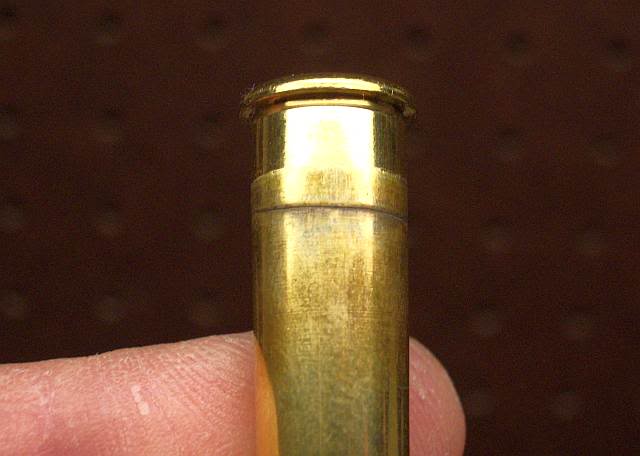
The Winchester .303 British case below was loaded at maximum levels and split the third time it was fired.
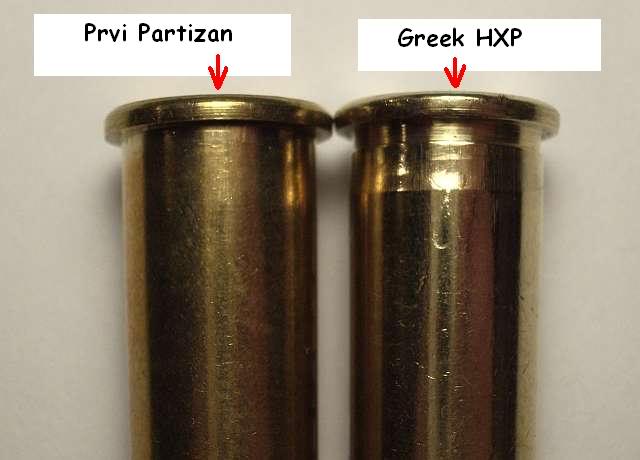
Below on the left is a Priv Partizan case and fired in the same No.4 Enfield as the HXP case. The Prvi case has thicker rims and is .010 thicker in the base of the case and larger in base diameter than other cases. (Meaning they are built Ford Truck Tough)

NOTE, at the max military headspace of .074 and with a rim thickness of .058 you will have .016 head clearance or air space between the rear of the case and the bolt face. And the first firing the cases will stretch the most and why neck sizing is so important.
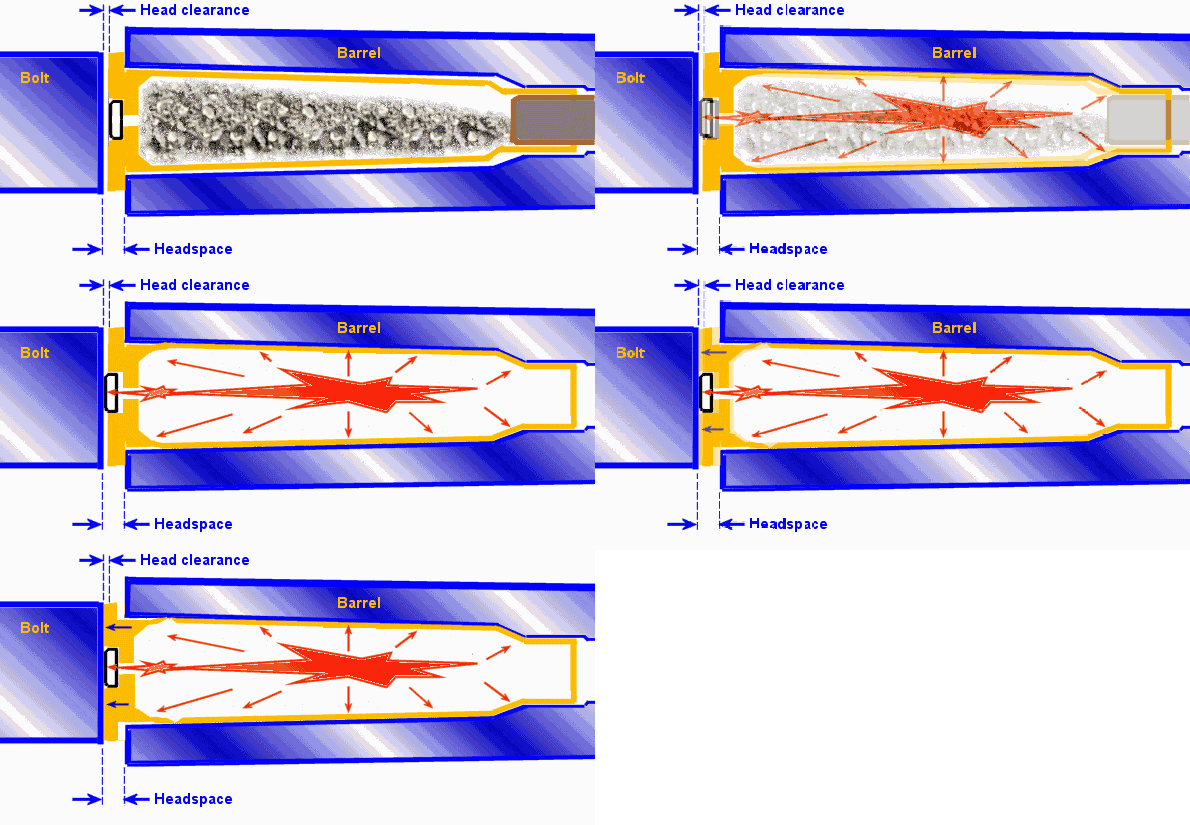
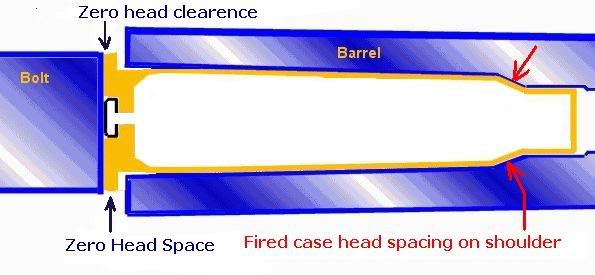
Bigedp51's explanation of what happens when .303 ammunition is fired in a Lee Enfield is outstanding.
I would assume that the OP's Ruger No. 1 single shot is headspaced according to SAAMI commercial standards, and case stretching will be much less than in a Lee Enfield.
The case will fireform to the chamber of course, but because the headspace is controlled by the rim, there should be minimal stretching. Probably no need to resize the cases to the maximum, shellholder touching the die. Just enough sizing to insure free chambering should be sufficient; maybe necksizing only would be satisfactory.
I reload for my Ross Mk. II** target rifle. The minimum chamber and minimum headspace is very different than in a Lee Enfield.
I would assume that the OP's Ruger No. 1 single shot is headspaced according to SAAMI commercial standards, and case stretching will be much less than in a Lee Enfield.
The case will fireform to the chamber of course, but because the headspace is controlled by the rim, there should be minimal stretching. Probably no need to resize the cases to the maximum, shellholder touching the die. Just enough sizing to insure free chambering should be sufficient; maybe necksizing only would be satisfactory.
I reload for my Ross Mk. II** target rifle. The minimum chamber and minimum headspace is very different than in a Lee Enfield.
I would sort the cases regardless of whether it is going to be used for target or hunting.
How can you load safely looking for pressure signs (loading to 308 velocities) when every brand of brass is going to give you different pressures?
Just buy a 308 if you want 308 velocities, load the 303 to 303 velocities and enjoy it for what it was designed, why push it? You'll just burn through brass anyway and have to start buying it to keep up with how much you're destroying.
I would load for the most accurate load you can and forget about maximizing velocity. Being accurate is way more noticeable than an extra 200fps.
https://www.chuckhawks.com/303British.htm
How can you load safely looking for pressure signs (loading to 308 velocities) when every brand of brass is going to give you different pressures?
Just buy a 308 if you want 308 velocities, load the 303 to 303 velocities and enjoy it for what it was designed, why push it? You'll just burn through brass anyway and have to start buying it to keep up with how much you're destroying.
I would load for the most accurate load you can and forget about maximizing velocity. Being accurate is way more noticeable than an extra 200fps.
https://www.chuckhawks.com/303British.htm

I would sort the cases regardless of whether it is going to be used for target or hunting.
How can you load safely looking for pressure signs (loading to 308 velocities) when every brand of brass is going to give you different pressures?
Just buy a 308 if you want 308 velocities, load the 303 to 303 velocities and enjoy it for what it was designed, why push it? You'll just burn through brass anyway and have to start buying it to keep up with how much you're destroying.
I would load for the most accurate load you can and forget about maximizing velocity. Being accurate is way more noticeable than an extra 200fps.
https://www.chuckhawks.com/303British.htm
With a Ruger No1 you can load them to 308 velocities with absolutely no issues as long as you check your case dimensions when working up the loads.
However good brass that has been fireformed in the same rifle is a mandatory requirement for a project like that .
I haven't lost any brass due to high pressures in my Ruger.
Cat

hifiwasabi
Regular
- Location
- I live in a giant bucket.
I don't intend to start at 80000 psi, I intend to start at regular loads and work up. I'll probably go with PPU brass as recommended and try out RL-15 and BL(C)-2 as the pressures tend to stay very reasonable in the manuals.
As to the .308 comment, I've had .308's before but I LIKE .303.
As to the .308 comment, I've had .308's before but I LIKE .303.
I don't intend to start at 80000 psi, I intend to start at regular loads and work up. I'll probably go with PPU brass as recommended and try out RL-15 and BL(C)-2 as the pressures tend to stay very reasonable in the manuals.
As to the .308 comment, I've had .308's before but I LIKE .303.
My Ruger in .303 is within 75 FPS of my 308's with a 180 grain bullet and still 3,000 PSI under the SAAMI max so it is not really pushing anything as far far as pressures go
Cat
With a Ruger No1 you can load them to 308 velocities with absolutely no issues as long as you check your case dimensions when working up the loads.
However good brass that has been fireformed in the same rifle is a mandatory requirement for a project like that .
I haven't lost any brass due to high pressures in my Ruger.
Cat
Ya, but this guy wants to use random mixed brass and push it up to 308 velocities. I don't get the feeling he's overly experienced at reloading which is why I encourage not pushing velocities or pressures.
I don't intend to start at 80000 psi, I intend to start at regular loads and work up. I'll probably go with PPU brass as recommended and try out RL-15 and BL(C)-2 as the pressures tend to stay very reasonable in the manuals.
As to the .308 comment, I've had .308's before but I LIKE .303.
I'm really not sure what you like about 303 over 308 but that's your choice. I don't have to understand it.
I would use matching brass with the same number of firings at least.
Good luck and be safe

I have a 1910 Ross in 303 British. It has been rebarrelled, since the old tube was pretty well shot.
It has a minimum chamber and headspace. 308 Velocities are easy to achieve with 3 or 4 different powders.
Some of my brass has been fired 7 times with no sign of any issues.
OP, your #1 should be capable of similar results. Personally, I like IMR 4320 and Norma 202 for powders. Dave.
It has a minimum chamber and headspace. 308 Velocities are easy to achieve with 3 or 4 different powders.
Some of my brass has been fired 7 times with no sign of any issues.
OP, your #1 should be capable of similar results. Personally, I like IMR 4320 and Norma 202 for powders. Dave.





















