I spent a solid 2 hours today trying to get a scope mounted with a level reticle. I used the plumb method with a level on the receiver. Challenge is the receiver is completely round so it’s hard to level the receiver. I know have it close to level, like really close but the reticle still seems canted. Is it okay to have a bit of cant in the reticle or do I need it absolutely perfect? It will be mainly for hunting around 200 yards













































You are using an out of date browser. It may not display this or other websites correctly.
You should upgrade or use an alternative browser.
You should upgrade or use an alternative browser.
How much cant?
- Thread starter MattE93
- Start date

- Location
- Western Manitoba
For "eyeballing" in your shop - get rifle mounted in a holder, in a padded jaw vice. From behind, try to verify that the vertical line in the scope passes right through the dead centre of your bolt (assuming bolt action). You will lose some of the field of view - just keep the reticle as clearly centered in the scope as you can, then check against the centre of receiver, centre of bolt. If you can not see an angular error, then you have it as good as you can get. If you see "cant" when you shoulder the rifle, that is you, not your gear. Alternatively - your scope base mounting holes are Top Dead Centre on the receiver (or should be). Install base(s), remove barrelled action from stock, grab barrel in padded vise jaws, set a dependable level across the flats on the scope base(s), and rotate barrelled action left or right as needed, snug up vise - you want the tops of scope bases as perfectly level (left to right) as you can get. Then install scope rings - can use a string on a plumb bob some distance away to rotate scope as needed to get vertical cross hair plumb. Will be as close as you can get, I think.

Looking from the front of the mounted scope is also useful. Easier to see the reticle as it aligns with the barrel from there. If you wear glasses, probably take them off - at least that's how it works for me with my +3 reading glasses blurring the lines right out from in front of the scope. Naked eye works fine.
You will soon realize you hold your rifle canted much more than the crosshairs are canted. Hold your rifle as you normally do and put your plumb bob at a distance. You will be surprised how far off level you hold it. I wonder if you are better off leveling to your cant (natural way you hold the rifle) or trying to fix your cant.
THe problem is that if you shoot with a canted scope your zero will be correct at only 1 distance. Anything closer than that and your POI will be to one side, further than your zero the bullet will gradually wander off to the other side. So it's fine if you only ever shoot at one exact distance or close to that, but for most, who shoot at variable ranges, cant becomes a real problem.I wonder if you are better off leveling to your cant (natural way you hold the rifle) or trying to fix your cant.
THe problem is that if you shoot with a canted scope your zero will be correct at only 1 distance. Anything closer than that and your POI will be to one side, further than your zero the bullet will gradually wander off to the other side. So it's fine if you only ever shoot at one exact distance or close to that, but for most, who shoot at variable ranges, cant becomes a real problem.
If you cant your rifle and level the crosshairs to a plumb bob, shouldn't it be the same at all distances? As long as your scope reticle is parallel to gravity.
- Location
- Western Manitoba
I think for most of us, most all effects are more theoretical than for real. Years ago I bought a Winchester 94 - the top ejector style. Missed several deer with iron sights so decided a scope would solve my problems (it didn't, but that is another story...). Those Weaver side mounts place the tube of the 1" scope completely off side of that vertically ejecting cartridge. So, let's be generous and say the centre of the scope was 1/2" to the left of the bore line. Sight in on a calm day to "zero" at 150 yards. So the theory says that your group will be 1/2" to the right at 300 yards. I have no way to tell - never had a calm enough day that the wind was not affecting the groups at 300 yards; that rifle was plunking 6, 8 and 10 inch groups out there, and quite a bit low - no clue how much that offset was to blame for that, but did not really know how to find exact centre of a 5 shot group back then. Wind and range with a 3 MOA rifle and shooter pretty well explain that the 1/2" to left offset at the receiver amounted to nothing, really.
- Location
- Western Manitoba
If you cant your rifle and level the crosshairs to a plumb bob, shouldn't it be the same at all distances? As long as your scope reticle is parallel to gravity.
The only way canted rifle shooting works (as is done by some high end shooters) is to have offset mounts - the issue is to get the vertical line in the scope passing through the bore line - the rifle could be held at a 45 degree angle, so long as the scope mounts placed the vertical cross hair directly plumb above the bore.
And, to prove that, need a shooter with world class wind / mirage reading ability, unless there is an indoor many hundred yard range somewhere - Houston Warehouse, for example...
Thinking some more on that - if scope is mounted to be 1" to left of bore line, and "zero'd" on a target with group centered 1" to right of point of aim, it would continue to be 1" right until affected by atmosphere. Line of Sight though scope would be 1" to left of the Line of Bore.
I believe I have seen target rifles equipped with "swivelling" butt plates. It was my understanding this allowed the butt to mount to the shooter in a "canted" position, but the rifle and sights were being held square and plumb to the world.
Last edited:
The only way canted rifle shooting works (as is done by some high end shooters) is to have offset mounts - the issue is to get the vertical line in the scope passing through the bore line - the rifle could be held at a 45 degree angle, so long as the scope mounts placed the vertical cross hair directly plumb above the bore.
And, to prove that, need a shooter with world class wind / mirage reading ability, unless there is an indoor many hundred yard range somewhere - Houston Warehouse, for example...
Thinking some more on that - if scope is mounted to be 1" to left of bore line, and "zero'd" on a target with group centered 1" to right of point of aim, it would continue to be 1" right until affected by atmosphere. Line of Sight though scope would be 1" to left of the Line of Bore.
I believe I have seen target rifles equipped with "swivelling" butt plates. It was my understanding this allowed the butt to mount to the shooter in a "canted" position, but the rifle and sights were being held square and plumb to the world.
A 2.5 degree cant works out to .05mils for every 100m. Take it to 200 yards and zero there and you wouldn't see any real world difference from 0-200.
If you mount your scope level to a canted rifle, within reason shouldn't the bore line go parallel as soon as you zero your scope? Of course you would lose your full range of adjustment though.
- Location
- Northeastern Ontario
Under all circumstances a canted scope is accurate at only one distance. The shorter the distance being shot the less the impact on accuracy. The greater the distance the more POI and POA will differ. The problem is made worse when both the rifle and the scope are canted and the canting is not consistent. This is because gravity is the most important factory in accuracy (if the wind can be disregarded for the purpose of simplicity here) and gravity works in one direction -- straight down. The corollary is that the less the scope is canted the less the inaccuracy. Holding a rifle level is not as easy as ensuring it's level on the bench.
Below is an image of the effects of scope and rifle cant. It's made for airgunners but the principles are the same.
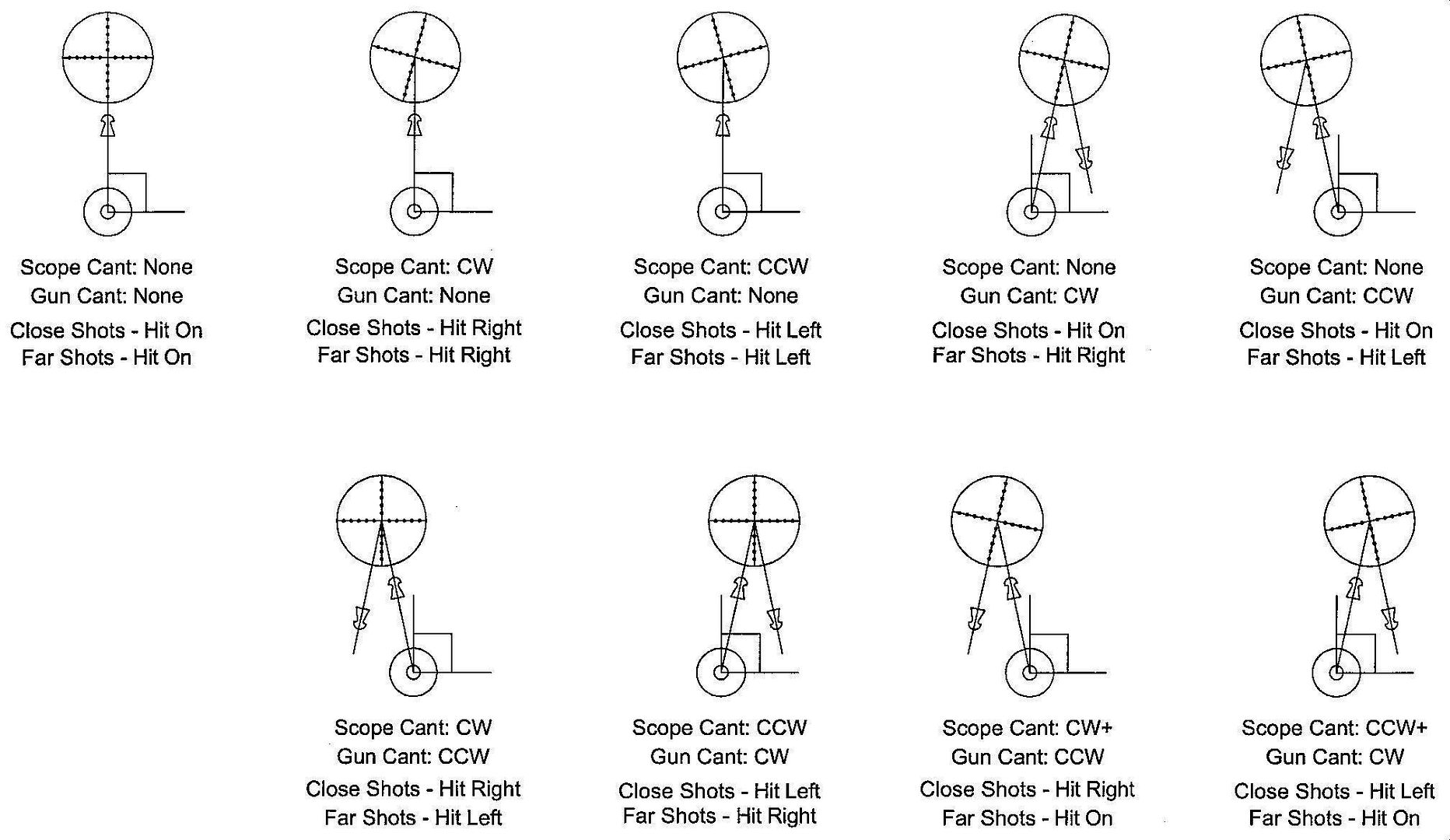
It can be difficult to perfectly line up the crosshairs to be level with the rifle. The design of some rifles can make it hard to determine when they themselves are level. The rifle must be leveled first, then by various means, some of them described above, the scope can be leveled. A level line of sufficient length on a target can help. The results may not always be perfect, but the less a scope is canted the more accurate they will be.
Below is an image of the effects of scope and rifle cant. It's made for airgunners but the principles are the same.

It can be difficult to perfectly line up the crosshairs to be level with the rifle. The design of some rifles can make it hard to determine when they themselves are level. The rifle must be leveled first, then by various means, some of them described above, the scope can be leveled. A level line of sufficient length on a target can help. The results may not always be perfect, but the less a scope is canted the more accurate they will be.
- Location
- Western Manitoba
Should be able to verify - Start with known good load. Fire one shot. Turn vertical adjustment up, say 10 clicks - fire again. Repeat several times - if bullet holes are more or less vertical (within accuracy capability of load, rifle and shooter), then have pretty much eliminated "cant" as an issue. If holes are trending left or right (outside accuracy capability), then likely have a canted installation.
Makes sense. Thanks for the diagrams. At 200 yards max with a zero at 200. Wouldn’t your max error be 1” or reticle centre to bore centre and that’s exiting the barrel and scope mounted on the side? So basically nothing to worry about if you aren’t shooting long distances and you just have a minor cant?
Off by an inch is a miss on a squirrel's noggin. Off by half an inch at 50 is still a miss, or at least a nasty wounding shot on that same critter. Trying not to miss is kind of one of the central points of shooting, even if it's just on paper...
Doubt he is shooting gophers with his 200 yard rifle. Regardless it’s at most an inch. I would guess it’s at most a quarter inch if we talk about canted crosshairs rather than a side mount scope. More important things to focus on such as trigger control, wind and estimating distance. 0-200= minute of dead gopher for a slight cant.Off by an inch is a miss on a squirrel's noggin. Off by half an inch at 50 is still a miss, or at least a nasty wounding shot on that same critter. Trying not to miss is kind of one of the central points of shooting, even if it's just on paper...
Last edited:





















