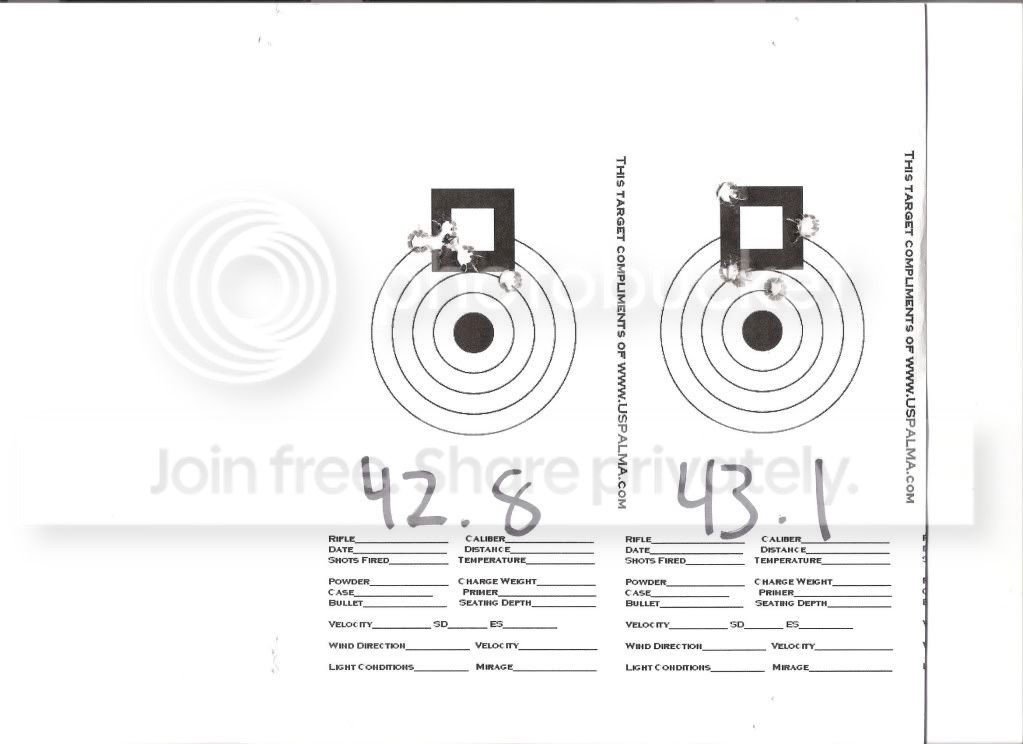
How much does a half grain really matter?

Have a look at the groups below, and at the powder charges listed on the targets. Even with a small case like the 223 rem, the group size only varies by .040" with a change of two grains in the powder charge. The target with 23gr was no different, but some idiot ruined it by shooting my target, before I could remove it from the backboard.I search out loads where the accuracy is reasonably constant over a two or three grain spread, and I usually find them. I find that this type of load stability also does very well with changing temperatures.
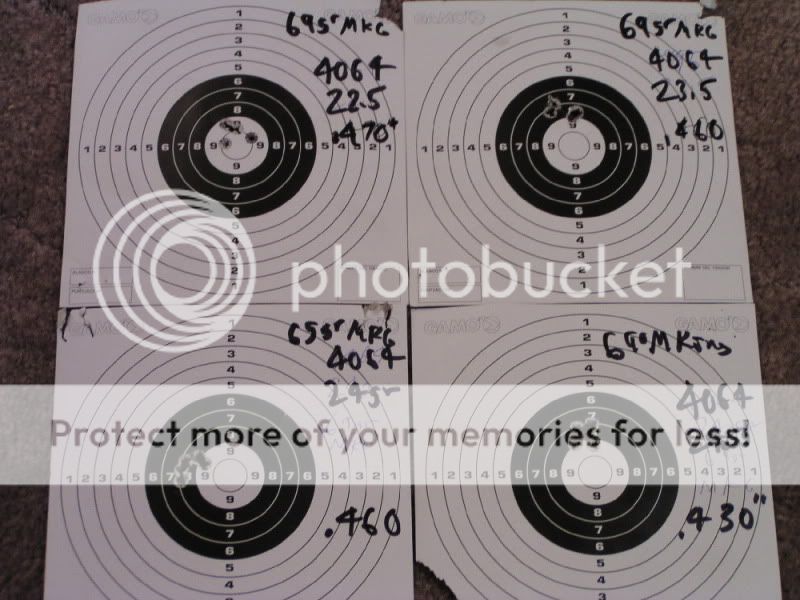
223tikkagroups.jpg
 
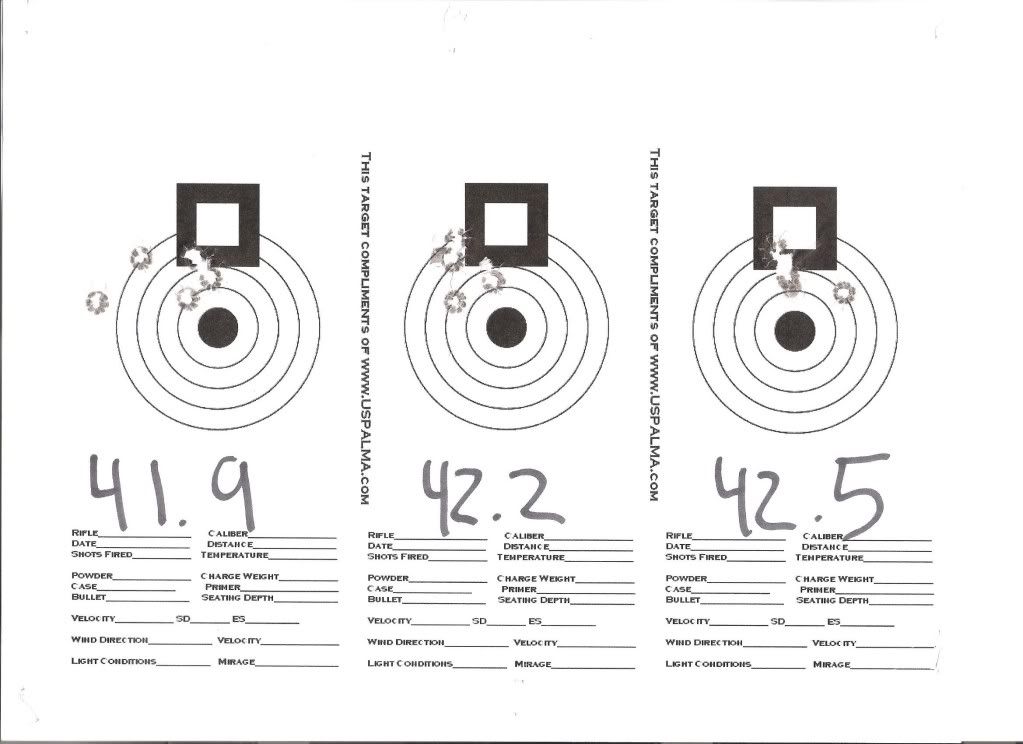
Here is what .3 grain increments look like for some of my initial load development.

A fine example of what these nodes look like.You can definitely tell when you find the barrel harmonics vs velocity/charge.

If you test in 1 grain increments there is a possibility of missing that sweet spot the lies right in between some charge weights.

0016.jpg


0017.jpg
 
If you test in 1 grain increments there is a possibility of missing that sweet spot the lies right in between some charge weights.

And if the load has a very narrow sweet spot, I will not be using that load for a hunting load, as it will likely be just as sensitive to changes in temperature.
 
We forget that there are many variables.

How much of the grouping is human induced? How much is from the puff of wind that might have occured? Was the case capacity of each case identical? Were the bullets identical? How did the barrel temperature or level of fouling change the group? etc.

As for loads, when we say 46.8 grs, was it exactly 46.8, or was it 46.76, or 46.84? There's no way to know. That's why I stick to 0.5 gr increments.

However, if you can find a load that produces the best five shot group over dozens of groups, then you're onto something. Until you run out of powder from that lot......
 
Hodgdon powders seem to keep my target groups together fairly well at most temperatures.However you won't find me doing load development and target practice when we get January temperatures either, something about not feeling the trigger is tough on accuracy. :p

For hunting loads, yes, you don't have to be as fussy but I still like to get all the potential out of a load for whatever it's intended purpose is.

Yes there are many variables but by testing and playing with fine details and seeing what results you get does allow you to see what even small changes can make.Keeping things as consistent as possible is key, sure there are variables but good enough just isn't good enough in the game of accuracy.

If it didn't matter why would we be using digital scales , or trim our brass all the same or use powder from the same lots now would we?;)

Also, guys loading for .223 vs .338 LM, may need to be a bit more consistent when it comes to powder charges.
 
And if the load has a very narrow sweet spot, I will not be using that load for a hunting load, as it will likely be just as sensitive to changes in temperature.

These are my feelings exactly!!
Like Stubble, I seek out loads that have a wider "window" as to an accuracy "sweet" spot.
Then I do not need to worry if I am slighly off one way or other, or the temperature varies a bit.
The only time I get picky about loads is for the stuff I put together for a 1000 yard match.
Eagleye.
 
We forget that there are many variables.

How much of the grouping is human induced? How much is from the puff of wind that might have occured? Was the case capacity of each case identical? Were the bullets identical? How did the barrel temperature or level of fouling change the group? etc.

As for loads, when we say 46.8 grs, was it exactly 46.8, or was it 46.76, or 46.84? There's no way to know. That's why I stick to 0.5 gr increments.

However, if you can find a load that produces the best five shot group over dozens of groups, then you're onto something. Until you run out of powder from that lot......


As anal as some of us undoubtedly are ... few handloaders put much concern to 00.04 gr variations. I get what you're trying to say, however, a 1/2 grain jump is too wide to "sweet spot" some of my best rifles.

Hodgdon powders seem to keep my target groups together fairly well at most temperatures.However you won't find me doing load development and target practice when we get January temperatures either, something about not feeling the trigger is tough on accuracy. :p

For hunting loads, yes, you don't have to be as fussy but I still like to get all the potential out of a load for whatever it's intended purpose is.

Yes there are many variables but by testing and playing with fine details and seeing what results you get does allow you to see what even small changes can make.Keeping things as consistent as possible is key, sure there are variables but good enough just isn't good enough in the game of accuracy.

If it didn't matter why would we be using digital scales , or trim our brass all the same or use powder from the same lots now would we?;)

Also, guys loading for .223 vs .338 LM, may need to be a bit more consistent when it comes to powder charges.

Funny you should mention that, the colder the better for this 'ol coot .... every numb-shot breaks as a suprise. No chance of that niggling mini-blink-'n-flinch:eek: Best way to see what a better shooter could've done with my gun/load.
Them dang digital scales are the devil's instrument, caused more grief than ya can shake a stick at. After retreating back to the 10/10, and good results, it turns out the Dillon don't appreciate flourescent lights nearby:(
 
What measures are you guys using to produce your carts? I'm just using a lee auto disk at the moment, which I know will make most of you cringe.

Anything consistent, cheap and quick out there?
 
Have a look at the groups below, and at the powder charges listed on the targets. I search out loads where the accuracy is reasonably constant over a few grain spread, and I usually find them.

I agree. To me a good load will shoot a wide range in charge weight well, and to the same point of impact at closer ranges. If a load is so picky that 1/2 grain is the difference between good and bad, then good luck if the temperature drops, the sun goes behind a cloud or you open a new can of powder.
 
Here is what .3 grain increments look like for some of my initial load development.

A fine example of what these nodes look like.You can definitely tell when you find the barrel harmonics vs velocity/charge.

If you test in 1 grain increments there is a possibility of missing that sweet spot the lies right in between some charge weights.

0016.jpg


0017.jpg

Personally I think if you shot those 5 groups again your results just might look like you rotated all those targets two places either way!

Unless your targets above are 200yds, it looks like the gun is not accurate enough to see .5 gn diff :cool:
 
My most accurate rifles have "nodes", where they are most accurate and consistent.
Those nodes are typically 1/2 grain wide, so 1/4 grain either side of nominal will often start to open groups.
Some guns will double the dispersion at that amount of charge variation IMO.

For hunting or plinking, no big deal.
At 600 yards though, the variables start to stack against you.

What he said.

The other thing half a grain can do, is pop primers etc.

I remember working up loads for my 300 win mag 5-6 years ago and all was going great with H1000 until I bumped the load up by 1/2 a grain to 1/2 under max and all of a sudden all hell broke loose.

Blown primers, pockets so loose new primers fell out, huge pressure issues.

Interestingly, no effect on accuracy.
 
The other thing half a grain can do, is pop primers etc.

I remember working up loads for my 300 win mag 5-6 years ago and all was going great with H1000 until I bumped the load up by 1/2 a grain to 1/2 under max and all of a sudden all hell broke loose.

Blown primers, pockets so loose new primers fell out, huge pressure issues.

If a 1/2gr more powder caused blown primers, I would be very suspicious of the load using only 1/2gr less. I would be backing off at least 1-1/2 to 2 grains from the load that caused blown primers.
 
It only matters if 3/4inch at 500 yards matters to you...
I punched some numbers so here goes,

155gr A-Max over Varget

44.0 gr = 2759 fps
47.0 gr = 2909 fps
4 gr difference = 150 fps, 150/4 = 37.5 fps, 1/2 gr brings it to 18.75 fps

so, 155gr A-Max at 2909fps drops 53.33inch at 500 yards,
2909fps-18.75=2890fps (rounded down)
2890fps drops 54.1inch at 500 yards

54.1-53.33=.77inch

disclaimer, It's Friday night and I'm 5 drinks in so if this doesn't add up, too bad...;)

I presume your loads must usually all be more consistant than 19 fps. Were any of your velocities for a group better than that? I have moly coated bullets and barrels, and done in the range of 10 ft before, but that was unusual, probably luck as it did not happen every time. I don't think that the velocity is linear when compared to the powder charge, or that the powder charge is the only variable when you are talking about the small difference in velocity that 19 ft per second is.
 
Have a look at the groups below, and at the powder charges listed on the targets. Even with a small case like the 223 rem, the group size only varies by .040" with a change of two grains in the powder charge. The target with 23gr was no different, but some idiot ruined it by shooting my target, before I could remove it from the backboard.I search out loads where the accuracy is reasonably constant over a two or three grain spread, and I usually find them. I find that this type of load stability also does very well with changing temperatures.
223tikkagroups.jpg

This is very goodshooting, and not to make light of it, you would wear out several barrels using scientific quality testing before you convinced me that half a grain of powder is ever a signifigant difference, firstly, the human error would have to be removed, along with a whole bunch of other variables.

 
This is very goodshooting, and not to make light of it, you would wear out several barrels using scientific quality testing before you convinced me that half a grain of powder is ever a signifigant difference, firstly, the human error would have to be removed, along with a whole bunch of other variables.

Yes. A couple of statistics classes and scientific method would do several on these forums some good. The sample sizes are way too small, and there are way too many uncontrolled variables for conclusions to be so definitively drawn from this thread.
 
What's a good inexpensive and accurate powder measure?

That phrase is an oxymoron.

You can have good and accurate, but you can't have inexpensive. Or you can have inexpensive, but it won't be very good and accurate ;)

If you want a good "bang-for-your-buck" powder measure that is capable of getting within 0.5gr with large stick powders, then the RCBS Uniflow is very popular and solidly built.

I've got a JDS Quick Measure coming for Christmas. :) Precision of 0.1gr with large stick powders, which is nice for LR accuracy, but unnecessary for regular hunting use.
 
Unless you are shooting a case smaller than a 222 Remington, my experience flies in the face of that statement.
Eagleye.

Yes.

A half grain change in the roughly 20 grains of powder in a .222 is about 2.5% of the charge. A half grain change in the roughly 75 grains of a .300 Win is about .7% of a change in the charge. The proportionally larger change may have an effect, sometimes. The other is not very likely to cause any change you can measure in a hunting rifle.
 
Back
Top Bottom