how much FFFG in the pan

david doyle

CGN Ultra frequent flyer
EE Expired
Rating - 97.7%
86   2   0
Just got back from making some smoke and noise. Got my mis-fire rate down to a level where I would feel confident hunting . It sure did not take long to get the Lyman shooting consistently.

What I have noticed is that my ignition is way more reliable when I give the pan 2 doses of FFFG instead of one. One throw from my primer fills the pan almost flush, 2 throws really fills it. When I fire with a heavy charge of primer
I get ALOT of fouling on the lock. What I am wondering is if my heavy charge of FFFG in the pan is making up for some other problem or if what I thought was alot is just the right amount.

Should a flintlock show dramatic response in ignition with different primer amounts? Either dose puts alot of explosive next to the vent hole!

BTW anyone out there who does'nt have a flint lock is missing alot of fun! There were 4 of us shooting today and of all the firearms passed around the lyman with a 50 grain charge brought the biggest smiles/grins. A 22lr swavy 10 year old lit it off twice and is now I suspect he is hooked for life.


BTW when I say misfire I mean the primer charge did not ignite. I have yet to have a primer charge ignite with out the main charge igniting immediately.
 
In my opinion its not a exact science with flintlocks, its impossible to give you the indisputable perfect advice here,
its all about your frizzen face and your flint face and the force propelling them to meet.

Basically this is how I keep my musket going bang every time I pull the trigger.


1./ sharp flint of the black english variety

2./properly heat treated battery/frizzen

3./wipe frizzen and flint face after each shot

4./ clear touchole

5./ ------as much prime as will fit in the pan-----, I dump in generous prime and crush down the frizzen/pan-cover.

There are those who delight in a single grain in the pan and some-such,

I have found its best to err on the side of caution and use generous and perhaps to some excessive amounts of powder in the pan.

My opinion is that you should use as much prime as is possible, wipe the flint and frizzen face and maybe give the touch hole a stab with a bit of wire.

No point nit pickin over the merits of 8 grains over 5 grains in the pan, dump the prime in, crush the frizzen/pan-cover closed and take aim!!!
 
Tradition says that you should only have about 1/2 of a panfull of 4F but I find a panfull of 3F is not noticeably slower and gives a greater surface for the spark to fall on and hence more reliable ignition. As the flint gets shorter, the sparks fall farther forward and in extreme situations I will put a bit of prime right behind the actual pivot as well as the prime in the pan.
I used to use 4F priming but it was a nuisance carrying 2 horns and minimal benefit. Even with a smoothbore and 2F, I prime with 2F

cheers mooncoon
 
For years I used a very simple technique that worked amazingly fast. This was demonstrated to me by the builder of my Flintlock rifle., who was a incredible flintlock shooter and builder.
While loading put a vent pick in the vent and angle it to the back of the gun, then close the frizzen and load...the pick should be a just slightly smaller then the vent hole...use a welder's cutting torch tip cleaner. Once the gun is loaded pull the tip cleaner and with the frizzen open trail a small amount of FFFG from the flash/vent hole to the outside of the pan. The priming powder should roughly appear like a teardrop in the pan. Close the frizzen and try not to tip the gun to the side or shake it about. The priming procedure works best in of the cross-sticks or bench rest. I used this method while shooting offhand it worked very well with a personal best score at 50 yards 48 2X out of a possible 50 5X...this was standing offhand. The gun has beena consistant award winner with numerous 50 out of 50 with as high as 4X's.
Cheers
 
Tradition says that you should only have about 1/2 of a panfull of 4F but I find a panfull of 3F is not noticeably slower and gives a greater surface for the spark to fall on and hence more reliable ignition. As the flint gets shorter, the sparks fall farther forward and in extreme situations I will put a bit of prime right behind the actual pivot as well as the prime in the pan.
I used to use 4F priming but it was a nuisance carrying 2 horns and minimal benefit. Even with a smoothbore and 2F, I prime with 2F

cheers mooncoon

I remember when I shot your pistol, and you primed from your loading horn, I could barely close the frizzen, and remember thinkin' this aint right :confused:
That pistol lit up like it was a percussion :D, goes to show you ;)
What works for me,is I prime on the frizzen and let the FFFFg scatter around , inside and outside the pan, usually at least 3 hits on the priming nozzle.
Her's some flintlock #### , you might enjoy, from Larry Pletcher.

http://www.blackpowdermag.com/featured-articles/new-high-speed-video-from-friendship-09.php

Cheers nessy
 
Hi David. You really should only need a small amount (perhaps half a pan) of powder for priming. If your pan charge is not igniting I think you should be looking at your flint or frizzen. I would think you are not getting enough spark. A misfire should be every bit as rare in a flintier as it is in an inline.
 
I have found that 1/3 to 1/2 pan full will give consistent ignition of both the pan and main charge and grain size is less important than we once thought. What is essential is that the sparks land on/in the pan consistently. Check this with the gun unloaded and no powder in the pan: drop the #### a few times and watch where the majority of the sparks land - they should scatter all over the pan. If not, then try inverting the flint so the bevel is down, try a bigger flint if the #### can hold it, and anything else that could help focus the sparks onto the pan. I like to scatter the powder all over the pan surface to increase the odds of a spark contacting the pan charge. Even a decent lock should fire reliably when inverted. If you aren't getting lots of sparks then degrease the frizzen and wipe it clean after each shot, and ask someone knowledgeable about flinters whether your frizzen might be too hard or not hard enough.
 
Thanks for all the constructive advice. Spent some time in a dim area playing with flint set and I think I have more of a downward shower now then the forward sparks I was shooting with.
One thing I know for sure is that when the primer ignites the rifle fires as simultaneously as anyone could measure.

Accuracy wise this lyman deerstalker is like a laser and very easy to shoot well with wieght in the right places and a very decent trigger.

Ben's conicals should arrive some day very soon so I'll let you know about the 20 shots in a row with no FTFs. LOL

I am especially excited by Mooncoon's nod to using 2F in the pan. Simple is good, one bottle of powder sure beats two clinking containers!

One other question. I am able to easily find my patches as I am shooting over snow and I have been noticing that they all have rifling cuts. Very consistent and clean. Like they were cut with a razor. I am shooting a light load and the bore has only seen 50 shots tops. Are these cuts ok or do I need a smaller ball and thicker patch?
 
I charge my Siler locks with about 1/2 a pn, maybe, close the frizzen, turn the gun slight on its side and give it a slap - I'm not sure if it does anything, but the idea os to get some FFFG inot the flash hole - it;s quicker that way while hunting, than messing around with vent picks, etc.
A clean frizzen and sharp flint make a big difference as well.
Many of my flinters would fire without powder in the pan, most were Silers ...
Cat
 
cut patches on a new gun are common. With the new sharp rifling it is like a razor. The more you shoot the better it will get. Accuracy will also continue to improve. You will eventually (for me it was about 100shoot to finally be happy)find your patchs whole, uncut, and with no burning.

Have fun.
 
I thought we wanted a nice clear vent hole for the hot gases to get through?

That's been my understanding. Powder in the vent slows ignition. A bigger vent is better, up to a point. The big advantage of the liners is to be able to counterbore the inside, to bring the distance the flash has to travel, down.

Going of the reading and high speed video that has been posted around the web, the flash from the pan's prime, is what is supposed to travel through the vent to ignite the main charge.

After watching one fella shoot his Lyman at the local range, with a consistent click-whoosh---bang, usually on the second or third attempt, I figured that loading the pan right up was a bad thing.

I need a flintlock, I think. :)

Cheers
Trev
 
How the vent is designed is going to make a difference. I've yet to fire it - have just sparked the lock - but my Wilkinson 16ga shotgun is set up with a platinum plug with small vent, and a rather small pan. You wouldn't be able to get powder much into the vent itself, even if you tried. I am assuming that the patent breech has the flash channel enlarged inside the breech, with the vent channel itself being rather short. Sparks are directed right into the pan. The gun was made in 1822, and I think that by that time, high quality British flintlocks were about at their peak of evolution. I would be careful with welders' cleaning tools in touch holes. They are little files.
 
I remember when I shot your pistol, and you primed from your loading horn, I could barely close the frizzen, and remember thinkin' this aint right :confused:
That pistol lit up like it was a percussion :D, goes to show you ;)

The lock on that gun does not spark well and I like to have powder spread around over the whole pan surface to that wherever a spark lands, it will ignite the priming. The rifle I shoot most of the time had a small (1/4") liner which meant that the recess in the back of it was also small. I found after about 10 shots, the recess seemed to foul up and I had to get a few grains of powder in the actual touch hole to have certain (and usually fairly fast) ignition. That liner also had a screw driver slot in it and that slot seemed to pick up rain drops and wick the water into the hole in the liner and drown the gun. I changed to a 5/16" liner with no slot and have shot in the rain with no problems plus I don't have to get any powder against the actual hole any more.

I definitely notice that were the sparks fall depends on how long the flint is and obviously the flint gets shorter as you knap it from time to time. If the frizzen sparks really well, it does not particularly matter where the prime is but if the flint is dull and you only get a few sparks, I need to put prime where the sparks are most likely to fall.

I have also noticed that if a frizzen develops a deep hollow from wear and I think also applies to the ripples that develop in the frizzen again from wear, that hollow slows the flint down and can stop a frizzen from sparking or at least reduce how well it sparks. I think the ripples develop because with knapping, effectively you get say 3 lengths of flints and these 3 lengths develop 3 locations of wear and after a couple of thousand shots you get quite noticeable ripples in the frizzen.

cheers mooncoon
 
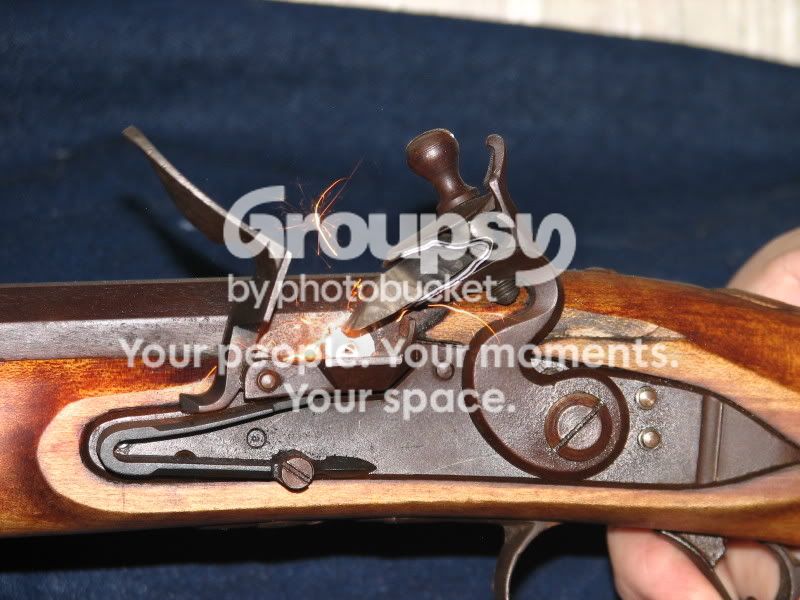
I took some pics one time to see how my Siler sparked.
Did this one first.
Sparks11015.jpg


Then shot a whole bunch like this.
Sparks11013.jpg


Cheers nessy
 
Great knowledge and fantastic pics! The second pic sure shows just how well a flintlock works. Not sure what is more impressive; the photo it's self or the fact that you captured it!
 
Back
Top Bottom