












































How much is too much (metal removal) when deburring flash hole?

blsonne

BANNED
Regular
BANNED
Rating - 100%
9   0   0
Location
Toronto
Hello Allo,

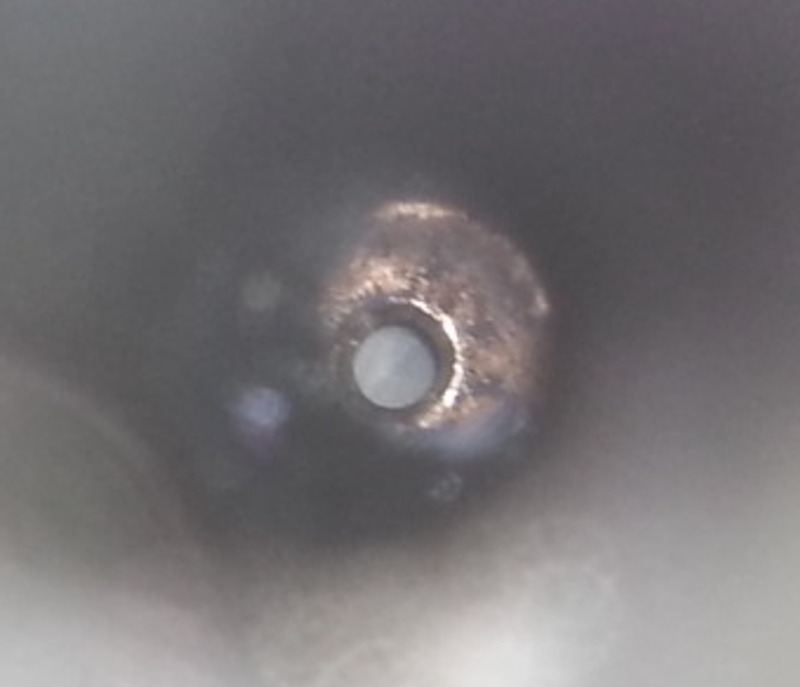
Noob reloader here again. I've been prepping some brass today and it occurs to me that I don't know how much is an appropriate amount of deburring to perform on the flashole. I'm currently sticking an RCBS flash hole deburring tool down the neck of my 308s and twisting it clockwise & counter-clockwise lightly about 10 times. It's leaving a noticeable chamfer.

Does anyone have a picture of what a properly deburred flash hole looks like (especially the extent of the chamfer) perhaps even a before-and-after photo? I'm using an otoscope stuck down the case neck to inspect (it works great) but I can't get a good picture using it to show y'all.


OK, tried using my phone camera and this actually worked better:
FWYAtW3.jpg
 
Last edited:

That's too much in my opinion.
Debut the flash hole after trimming.
This way you can adjust the collet so that it only removes the burr.
Different brands of brass may need a collet adjustment.
 
Huh? Why on earth is a newbie reloader deburring the flash hole? Unless there is some kind of silly new trend in reloading of which I am unaware, I don't see how an operation like this could benefit anybody other than possibly a world-class benchrest shooter.
 
I'm loading 308 for precision and F-T/R with a goal of 1000yd+, and it's what I was taught to do. I certainly wouldn't bother doing this for 5.56 and 9MM.
 
IMO deburing means removing the bur.

Now you are actually making a large chamfer and removing a lot of metal.
That's not "deburring" to me.

I am no expert sorry. But for sure, this is not deburring.
 
I don't know why I didn't think of this before, but there's gotta be a SAAMI spec that describes the diameter of the flash hole and the conical dimensions of the chamfer. Unless it's supposed to be a straight walled hole? I dunno. Well, if I have pooched these shells, at least I've pooched them consistently! :)
 
I am thinking along the same lines as BattleRife. I have been reloading for hunting and target shooting for years and never done anything to a flash hole except clean the tumbling media out of it. But then again I don't consider myself an expert on reloading so maybe I am missing something.
 
I'm loading 308 for precision and F-T/R with a goal of 1000yd+, and it's what I was taught to do. I certainly wouldn't bother doing this for 5.56 and 9MM.

If you're benchrest shooting for 1,000y then screw that brass and buy some Lapua or Norma bras and save yourself the hassles.
All 100 cases within a 1 grain extreme spread. Drilled and not punched centered flash holes. Annealed necks right out of the box.
The cheapest investment in precision you can make.

I have no issue with someone trying to maximize the precision out of his brass but he better have enough of it to segregate into lots great enough to shoot.
 
If you're benchrest shooting for 1,000y then screw that brass and buy some Lapua or Norma bras and save yourself the hassles.
All 100 cases within a 1 grain extreme spread. Drilled and not punched centered flash holes. Annealed necks right out of the box.
The cheapest investment in precision you can make.

I have no issue with someone trying to maximize the precision out of his brass but he better have enough of it to segregate into lots great enough to shoot.

bingo
 
I guess I kinda like the hassle, and maximizing what I already have. I've heard very good things about Lapua and Norma brass... but I gots what I gots. Although the $70-80$ for a 100 box of Lapua brass doesn't sound too bad.
 
Get the deburring tool below it automatically stops at the correct depth then the tool touches the base web area of the case. The rod is drilled out and the cutter is inside the rod, when the mouth of the rod touches the inside of the case the cutter stops. I have the older GEN I without the cutouts along the side and brass can build up inside the drilled out section of the rod. A few taps and the brass cuttings fall out, the new GEN II allows the brass cuttings to fall to the side and not build up.

No adjusting is required and all the flash holes are the same depth of cut.

GEN II UNIVERSAL FLASHHOLE DEBURRING
http://www.sinclairintl.com/reloading-equipment/case-preparation/flash-hole-deburring-tools/gen-ii-universal-flashhole-deburring-tool-prod34127.aspx

Inspect Your Flash Holes on New Brass
http://bulletin.accurateshooter.com/2007/12/inspect-your-flash-holes-on-new-brass/

Flash-Hole First Aid — Removing Flash Hole Obstructions
http://bulletin.accurateshooter.com/2012/12/flash-hole-first-aid-removing-flash-hole-obstructions/


Nosler Custom Brass

Fully prepped, ready to load Case mouths are chamfered and deburred NoslerCustom® Brass is hand-inspected and weight-sorted Flash holes are deburred and checked for proper alignment Quality made, NoslerCustom® Brass is packaged in quantities of 25, 50 and 100 count boxes Each piece of brass is full length sized and trimmed to proper length


The reason this is done is because some flash holes are punched out and some are drilled. A bur inside the flash hole can change the flash pattern of the primer. If your using CCI benchrest primers and have a undersized flash hole and a bur inside your ignition will not be uniform. It would be comparable to having too little or too much powder in the pan of a flintlock.

drilled-flash-holes-vs-punched-flash-hole_zps65a09029.png


If the choke on a shotgun effects the shot pattern, what happens if the flash hole is choked?

FIRE IN THE HOLE!!!!!
5Remington75_zps2b532d7c.jpg


Was that a mouse fart or a wet match???
3CCIBR4_zpsa43a3c3a.jpg


Adding raw linseed oil and Remington 7 1/2 primers to the cattle feed!

cow_zps8715d784.jpg
 
Last edited:

IMO deburing means removing the bur.

Now you are actually making a large chamfer and removing a lot of metal.
That's not "deburring" to me.

I am no expert sorry. But for sure, this is not deburring.

I would have to agree^ I like to think of it as flash hole unifying, take the bur off and in turn making them all the same..... You don't need to take off that much material to make them consistent.
 
IMO that chamfer bit on the heavy side. A very thin chamfer just enough to remove the burr is enough. Not all flash hole deburring tools bottle out, I use a Lyman and you have to set a stop on the rod to control the depth.
 
and IMO, if you shoot 1000 yards and are serious about it, get 100 lapua brass..... and they are already good.
Personally I have never touched a flash hole (and never will).
 
Back
Top Bottom




















