












































How much variance is acceptable, charge weights.

Kelly Timoffee

BANNED
BANNED
BANNED
EE Expired
Rating - 100%
52   0   0
This is about the only variance I can honestly say is part of my reloading equation a see a problem with, unless I am completely oblivious to something else.

Time to get rid of the charge master?

The charge was thrown on the charge master, then checked with the other two.
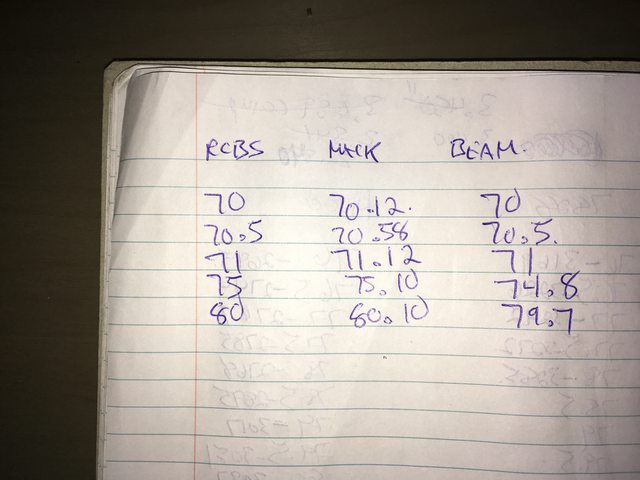


I don't use the Mack or beam for my reloading, just have them in case.
 
Last edited:
Looks to be within the error range. I have the charge master lite. If i am going to be needing perfection i always check on my beam scale. I have found 9/10 times it is within one kernel.


If you use heavy powder like N570. One kernel is pretty much .1gr.
 
take a powder charge and reweigh on each scale 10 times... chart the results.

The scale that gives the SAME output ... not close... the same... use that and rework your loads and see what happens.

Charge weight variations is a killer for consistency... why many LR competition shooters have invested in very expensive milligram scales.

It matters.

Jerry
 
Looks pretty good to me.

If you you want better, set it to throw a little light and manually trickle it up to exactly what you want.

started doing this too, i was throwing with just a Lee thrower, but 2208 is long grain an isnt throwing very great, a few taps sometimes helps but generally i go a little light an trickle up to be exact.

because i felt that could well an truely be not helping with the 303 accuracy, not that i would develop load charges doing so, but any testing after a load settled on would of been not showing exact referencing!

i hear some of the granules crack or get broken inbetween the wheel of the thrower sometimes, so i know its not exact lol.

Good thread though, nice to read some replies here
 
I throw everything on a Chargemaster then reweigh it in an Acculab VIC 123. Then pinch the powder to the desired weight. Acculab scale weighs +/- .02 grains. Target weight is +/-.00 to +.02 grains.
Brass is weight sorted to within .5 grains for .308 and within .3 gr for .223. I use this ammo to shoot targets from 300 to 1000 yards.
 
This is about the only variance I can honestly say is part of my reloading equation a see a problem with, unless I am completely oblivious to something else.

Time to get rid of the charge master?

The charge was thrown on the charge master, then checked with the other two.


I don't use the Mack or beam for my reloading, just have them in case.

I know in several of my better rifles, a good node will have a 1gr window which means if you pick the charge in the middle you have essentially a tolerance of .5gr up or down and still be in the node and same POI. Any means of throwing a charge should easily be able to give much better than that. I have read/heard many competition shooters also say consistent fill/powder volume in the case is more important than exact weights.
 
take a powder charge and reweigh on each scale 10 times... chart the results.

The scale that gives the SAME output ... not close... the same... use that and rework your loads and see what happens.

Charge weight variations is a killer for consistency... why many LR competition shooters have invested in very expensive milligram scales.

It matters.

Jerry

This is the right answer. It doesn't matter much how different units compare. What matters is repeatability, the scale that measures the least variance is the best.
 
Make sure your beam scale is calibrated properly, use check weights on it, do the same with the chargemaster, compare a bunch of loads at different weights like Jerry said, if they match, you are good to go. In looking at what you posted, the Mack scale appears to be whacko. You won`t see any fantastic difference in .1gr shooting 1-300yd targets in most applications, may see a hair at 300, but, will most probably not be able to decipher it anyway.
 
Back
Top Bottom





















