How not to get lost in the bush

My Silva Ranger backs up my newest Sunto. Sunto only because it has a luminous compass rose, which comes in handy for night searches. Still like the Ranger in the daytime,though.

Geologist, how often do you recommend replacements, based on your incident?

It depends on use. The more hard knocks the compass receives, the greater the chance for the needle to de-magnetize and stop working.

A recreational compass used 14 days per year could last a lifetime. A compass that is used for hard field work throughout the year, I'd replace it after 4 years. They're cheap after all.
 
My Sylva Ranger was bought about 1976, it was a requirement for a forestry course I took in college.
It has a bubble in it now, but works fine anyway.
It has been my companion for three weeks of deer and moose hunting, as well as canoe trips, backpacking, scouting, ATV tours, and some other uses, like trying to find corner posts on bush lots, based on bearings.
It's never let me down, and probably won't at this rate.
 
HUNTER.jpg


No compass required and you may even see one of those canteen trucks coming with fresh coffee
 
Probably an iron formation. These are large naturally occuring formations that can extend for many kilometers. They will render your compass useless when you walk over them....

,,,Oh yeah, stay calm. When you first realize that you are turned around you will experience some level of panic. I have felt it and I am very experienced in the bush. If it is safe to do so, sit down, have a smoke or a drink of water and bite to eat. You may be able to figure out which way to go. The sit down will help you to calm down and avoid panicking and doing something stupid.

I'm curious about the iron deposits.

Do you come across them often?

Do you rely on gps when the compass fails?
 
I'm curious about the iron deposits.

Do you come across them often?

Do you rely on gps when the compass fails?

Iron formations generally occur in older Pre-Cambrian greenstone belts eg the Canadian Sheld.

You can also get magnetite deposits in areas where intrusions are in contact with calcareous rocks like limestones and limey shales.

When I was walking the greenstone belts in Ontario and Quebec, there were no GPS's. We cut picket line grids through the bush that were unaffected by magnetic deflections. Sun charts can also be used in areas where magnetic compasses are useless. GPS technology has changed most of this.
 
Beyond using the above tools and strategies to not get turned around it is important to convince yourself that the inevitable (eventually) is not that big of a deal. Worst case you get to spend some quality time with your thoughts best case you end up with extra exercise. Hard to do but avoiding the sick panic feeling and replacing it with 'dam this is a minor bother' is an important way to keep the stupids at bay. Lost is a temporary state of being.
 
With no map - with no compass - with no cell phone etc. -
Watch the sky -
Carry a long stick dragging behind you -
Point it at the objective or you will die -
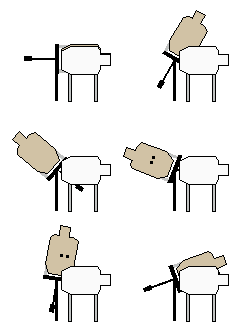
Right handed humans walk in a left circle -
Left handed humans walk in a right circle -

Amazing all the cidiots on nutz -

:ar15:
swingerlh.gif

Is this true?
Good point to remember.
I carry a garmin rino 130, have a spare set of batteries in my pocket and a spare set in my pack, pouch, truck.
Just love this thing.
Gives hunting a whole new meaning.
 
Beyond using the above tools and strategies to not get turned around it is important to convince yourself that the inevitable (eventually) is not that big of a deal. Worst case you get to spend some quality time with your thoughts best case you end up with extra exercise. Hard to do but avoiding the sick panic feeling and replacing it with 'dam this is a minor bother' is an important way to keep the stupids at bay. Lost is a temporary state of being.

David, that is so true. Just get used to the idea, and with that thought, don't wait to make a night camp, until it is so dark that you can't see anything. And, above all else, don't try to travel in the bush after dark.
When they introduced official hunter training in BC, the CORE program, in 1971, they sent out one man to run three day courses, teaching people how to become CORE instructors. This official provincial trainer was an RCAF chief instructor for RCAF survival training. He ran two types, bush survival training, which they did in northern Alberta and arctic survival. The CORE program instructo training covered all aspects of the course, but this fellow, with his vast survival background, spent close to half the course on survival. I was one of half dozen here who took the instructor training course.
Don't panic was high on his list, along with getting a fire going, but the two go hand in hand. He taught, assuming you are alone, to get a fire going and you are now not alone! It is now you and your fire and you now have a purpose, keep your fire going.
It was a great course and it certainly got the hunter training program away to a good start.
 
David, that is so true. Just get used to the idea, and with that thought, don't wait to make a night camp, until it is so dark that you can't see anything. And, above all else, don't try to travel in the bush after dark.
When they introduced official hunter training in BC, the CORE program, in 1971, they sent out one man to run three day courses, teaching people how to become CORE instructors. This official provincial trainer was an RCAF chief instructor for RCAF survival training. He ran two types, bush survival training, which they did in northern Alberta and arctic survival. The CORE program instructo training covered all aspects of the course, but this fellow, with his vast survival background, spent close to half the course on survival. I was one of half dozen here who took the instructor training course.
Don't panic was high on his list, along with getting a fire going, but the two go hand in hand. He taught, assuming you are alone, to get a fire going and you are now not alone! It is now you and your fire and you now have a purpose, keep your fire going.
It was a great course and it certainly got the hunter training program away to a good start.

their RCAF book/field manual "Down but not out" is still IMO one of the best reference guides made.
 
right. thats the one.

do you also recall the smaller red covered RCAF survval manual? It contained most of the same material but was about half the size, probably intended to accompany field kits.

I had a couple I swiped from Anaconda or Noranda, but have since given away one and misplaced the other.
 
As I stated previously, when BC launched the hunter training program in 1971, there was a provincial instructor that went around to the various areas in the province and in a three day course, taught people how to be instructors for the new CORE program.
The fellow teaching us was the chief survival instructor for the RCAF. I forget his name, but he was originally from Quebec and was a veteran pilot.
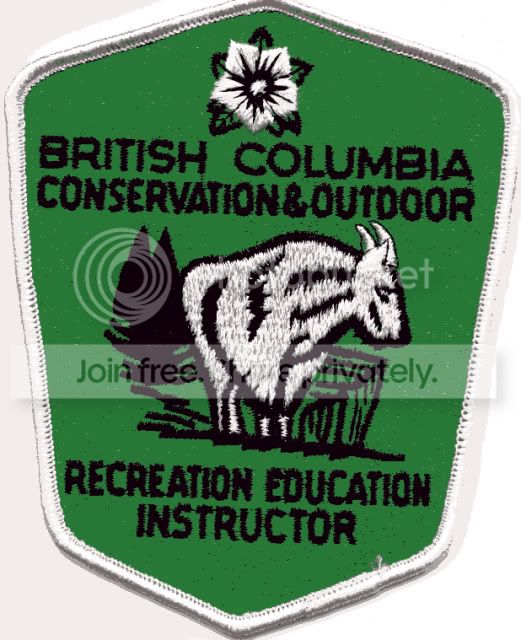
Here is the the jacket patch we were given on completion of the course.
HT.jpg
 
For those that have not taken such a course, and I agree, they are an invaluable aid, there are tricks, and mind games you can play, when alone in the bush, to keep you sane, and most important, calm.
Simply keep your mind busy, don't drift into that mindless 'what am I gona doooo?' thing.
Spending a night unprepared in the bush, isn't a heap of fun, but, it can be a life changing experience. You learn to use your wits, there are no backups, no expert to ask.
Pretend, just like you were a kid, if you like, that you are on a simple camping trip. Keep your brain occupied, and out of that spinning state that accomplishes nothing.
A cool head that has done this before, can organize him/herself. There are things that must be done before dark, that kind of thing.

But for most of us, one, or at the outside two nights is all you can expect to spend, before you are found, that is, if people know you are missing.
Be prepared, be sure that people know where you are going, and when you are expected back. Your life could easily depend on that one item.

If you hunt, or camp, in northern regions, like Ontario north of about the French river, or or north of the Trans Canada corridor along Lake Superior, or similar wild places in other provinces, the chances of a much longer stay in the bush multiply rapidly.

About thirty years back, another camp had a helicopter searching for a guy who spent the night in a parcel of land that isn't ten miles on each side, bound by roads, hydro lines, and a wide logging road.
It's easy to get circling.

And yes, it's true, that people are right, or left legged, in the same manner that they are right, or left handed, and tend to circle one way or the other, even given the flat ground of a desert.

 
Oh yes, the guy who spent the night. (November ) He never stopped walking, even in the dark, he got hot and tired, threw off his coat and hat, propped his rifle against a tree, where he figured he'd find it, and kept walking blindly.
The chopped didn't find him, he blundered out to the hydro line about ten am the following day. About half starved, near frozen, and totally dehydrated, they took him to hospital for a bit, but he survived.
There are a couple of nasty cliff faces in that area of bush, he's a very lucky man.
Another camp found his stuff the second week of hunting, so he even got that back.

A very lucky damned fool.
 
Speaking of lucky fools...

haha.jpg


That's an "as the crow flies" path that some misguided individual took when he happened across our tiny lake. He was moose hunting and staying at a camp on that larger lake. Back when this occurred, there were no roads and no forestry operations. It was just bush and it was a fly-in only trip for us.

After walking around for 6 hours, he reached the opposite side of the lake, saw smoke coming from our cabin, and fired 2 shots. We picked him up with the boat, brought him in, stripped him of his firearm and waited for the googly-eyes to go back to normal. We radioed a plane that came and returned him to his lake/camp.

Had he missed our lake, he would have been done for - nothing north, and nothing for at least 40 miles to the south. He had his rifle and a Chinese Rambo knife with the compass in the pommel.
 
The thing to remember is that you can easily perrish in one night, in freezing weather. One of the worst possible conditions is a late fall, or early winter day, a cold rain in just above freezing temperature, your soaking wet, it gets dark early and you are lost. Then clearing over night with hard frosts by morning.
If you don't get a fire going well before dark and get dried out, you will not be around the next day!
 
I've been lost lots of times....I even wrote an essay on being lost and getting out , while in highschool. In that essay I debunked the current myth(this was over 50 years ago) about moss only growing on the north side of trees( it does, but only in clearings that have lots of sunlight . In heavy timber or shaded areas ( cliffs) or on the south sides of timbered lakes moss will grow on any or all sides.
So I had quite a bit of experience on getting lost although I never had to spend the night in the bush .
I grew up in the heavy bush of NW Ontario and us boys were in the bush a lot, especially during hunting season, but also to pick the various berries(raspberries , pin cherries, choke cherries etc. and of course blue berry picking as they came into season.
We didn't have compasses so we learned to keep an eye on the terrain, the sun and the wind and even a few times the position of the North star .
I have climbed a few tall trees in my time to work out the direction to safety. One trick is to lay your rifle or a stick pointing in the direction you think you should be going .If you work out the correct direction of travel from high up in the tree and look down at your rifle(or marker) you might be surprized to see it pointing in a completely wrong direction .
Like H4831 I have circled back onto my own tracks, but unlike him , I refused to believe the evidence(the vaugely familiar trees etc.) so I wrote my name, drew an arrow in the snow and set off again onto the getting -to -be well beaten path. Sure enough, 45 minutes later, I was back at my signature.
The Silva compass(I had boughten one years ago, as soon as I could afford one) wouldn't read right, even when placed on a log away from my rifle or any metals that might be on my clothing( buttons zippers, change).Musta been a mineral deposit in the rocks....lot of minerals 30 miles South West of Dryden.
The sky was completely overcast with light snow . No wind . Heavy second growth mixed timber(20 or so years after a forest fire)
I got out by lining up 3 trees . When I reached the first tree , I would line up another tree with the remaining two . After an hour or so I came to the bottom of a lake that I recognized and followed close to the shoreline for a couple of miles to our moose camp...just after dark .
 
Last edited:
Years ago, when I was doing mining exploration in the the New Brunswick bush, I had a very interesting experience. We had traversed about 10 miles into a very isolated area, and bad bush to boot. Deerfly was was at max, so my partner and I were fully clothed, hats, etc and lots of Ol' Woodsman (anybody remember that smell?)
We decided to take a break and have a can of pop. As was our custom when the flies were bad, we took off our packs and placed them in a tree above us. I was straining the last of my pop through my teeth (to keep the flies out), when we heard a wild clanging noise coming through the woods. A minute later, we were surprised to see a hiker coming at us, with the largest rigid frame backpack I had ever seen. The clanging was caused by various pots and pans getting caught up in the tight packed spruce bush.
The fellow approached us, wrestling with the spruce branches, obviously in distress. He was wearing shorts and a tee shirt, and the bugs were getting him bad. We lathered him up with Woodsman, and gave him a hat and a pop - he settled down. He explained he was a tourist from the Boston area, and was doing his own version of a wilderness tour. We asked "Why here?" and he explained that he was interested in one of the local rivers (Upsalquitch, Sevogle?...).
As we were doing geochem work, we knew all the rivers around, and my partner gave me the eye. The river he mentioned was a good 15 miles away. We asked some more questions, he got his map out and showed us his traverse route. My partner, normally very stoic and subdued piped up "You're nowhere fuggin' near that place, here's where you are!" A rather terse discussion followed. We pointed out to him that the terrain matched our topo, and not his (he was using a different map.)
We told him that he was best off returning with us - we'd take him back to his wheels. The fact that he had completely gone off his map had us concerned about his ability to navigate in the woods. He declined, and prepared to depart. He took the compass he had hanging around his neck and established his bearing. Immediately, we both noticed the two pound utility pocket knife he also had hanging around his neck!


Needless to say, after a short discussion, he made his way back with us. I have always wondered what would have happened to him if he hadnt stumbled upon us.
 
Last edited:
Back
Top Bottom