How precise are your loads ?

Below is from Accurateshooter.com posted today and Ron AKA being a parrot and just repeating what he has read but has no experience with.

A poster in another thread made a good suggestion, which I have not tried, but will try in your situation. The suggestion was to pop the primer from a fired case (the one that measured 3.135 would be a good one), and then partially reseat the primer again so it is sticking out half way or so. Chamber it, and close the bolt carefully. Now when you extract it take another measurement to see how much of the primer is still sticking out. That is an indication of how far your shoulder on the case may be from the shoulder in the chamber. It is quite possible your brass if just once fired may be still short of full expansion. A more reasonable bumping target would be to get within 0.002" of the shoulder in the chamber. That may mean some or even all of the cases still do not require bumping.


And Ron AKA, well before your posting today he was told in the same posting to remove the primer "before" measuring his fired case length. Meaning the fired primers in the cases he was measuring with his Hornady case gauge were giving him a false readings and the primer method for head clearance was not even needed. (but "YOU" missed that)

Below my photos that are well over 10 years old and posted here many times and what the parrot is repeating. Its not just my postings that are irritating, but the majority of what he is posting all over the net is that he read somewhere else. You have been warned.

IMGP0704-1_zpsu8rohxmz.jpg


IMGP0706-1_zps9jbdmfqj.jpg


IMGP0710-1_zps1wlffukp.jpg
 
Last edited:
IMG_0922_zpsywhcameb.jpg


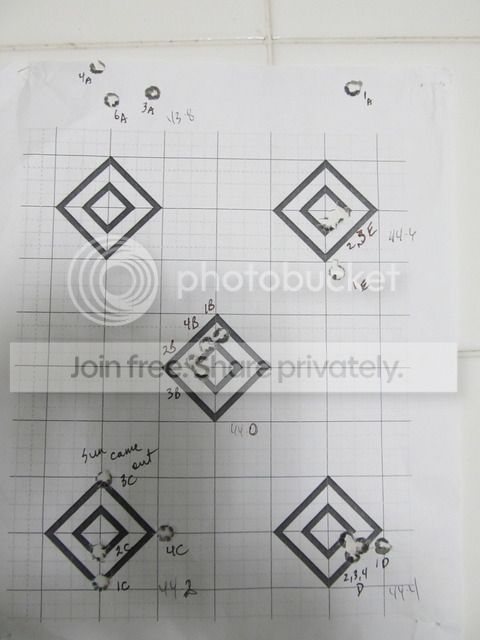
For the OCD reloaders out there, here is the point.

New Krieger put on by Terry at BARC (great job). Same specs as my previous FTR barrels so I had a very good idea of where my node would be. All groups shot at 250yds. Pretty calm to light left to right wind. Started overcast except for the shot marked when the sun came out and I wanted to see how high it would go up.

The number indicates the shot - I plot where each shot lands. The letter is the same load level. A's are starting load into the node and 1 and 2 (higher above 1) were sighters. Shot 5 is higher about 1/2" above the paper 3 to 6 formed the first group.

B shows promise with a bit more vertical then I wanted

C is out of tune... shot 3 was in sunshine and yes, light will change POI vertically - notice that shots 1,2 and 3 are straight up and down. Even if shot 3 was nearer to 2, the shots are landing like on a totem poll. That is not going to work at 1000yds in competition. I am guessing 4 was wind.

D is what all that OCD is about. I suspect shot 1 is due to a bit of wind left over from the gust that pushed 4C off to the right Really doesn't matter.. it will work.

E is coming out of the node. That actually is a very big change in vertical and would be very obvious at extended distances. If I increased to a load "F", the group size would be significantly bigger

I didn't adjust for the winds and just held center and let the groups form.

The grid is smaller then 1"... whatever came off the printer.

The average shooter would have been thrilled with load A... the competition shooter wants load D. The load charges are 0.2gr apart held to the same kernel. All the OCD stuff in ammo prep and rifle set up.

Would the average shooter notice any difference in loads B to E or just call it a wide node? Would they care?

For those that do, with the right set up and good shooting under low wind conditions, charge weight does have a significant affect on load tuning, especially vertical. Until you have a scale that can hold charge mass to the kernel of extruded powder, and have a set up accurate enough to show the results, the average shooter just isn't going to notice these type of results.

YMMV

Jerry
 
Last edited:
My friend would load 50 rounds of 223 using a Lyman 55 powder measure.
Refill the hopper, check the weight, and load another 50.
At the range, he shot a 10 shot group with target sights that measured 1 9/16" at 300 yards off his elbows.
That said, keeping tolerances close helps many if for no other reason than personal confidence.
When developing a load for a guntech built 700 in 260 with 3.5 grains difference in the loads . . . 2" groups at 200 meters.
If searching for a minute of deer, moose, gopher or coyote then 0.1 grain is fine. With 200 rounds under your belt and trying to achieve 0.02 trickling in one grain at a time might be a case of mind over matter! Maybe it is time to find out what one grain of powder weights on my Gem Pro . . .


#1 was the lowest powder charge and the first shot. One the second group it was in the group with the others.
 
Last edited:
Did you chronograph the loads, if yes what were your ES's between your load spreads?
bb

In general, I only use a magnetospeed in testing if I have a new set up and don't know where my min/max velocities are wrt to powder charge for that barel. The testing for this barrel was using known components and set up. I just had to find THE load it liked... I knew where the range would be.

Over the years, I have used chronie's and now magnetospeed. When comparing to paper, I have both loads with single digit es/SD that shot great and poorly so it is far from being a perfect indicator of success.

I know many can't shoot at the range as far as they may compete or play. Here a good chronograph can help sort out the load options but I would reserve judgement until I could shoot as far as needed.

If a shooter chooses to use a chronie to help diagnose a load, use a good one. Magnetospeed, or labradar seem to be the leading edge that most can access/afford. Each has their own quirks and neither is perfect. If the device you use has a mechanical error similar to the numbers you are trying to generate, the output becomes pretty much useless as the error has too much influence on the results

For me, the real strength of a chronie like a labradar is finding bad components. Say you get a low shot out of your group at distances AND that shot shows a low velocity. Or a high shot and a high velocity. That makes sense and would lead me to test the various components I use. You can find some bad primer lots this way... or a bad scale.

But when the bullets are falling into an itty bitty group way out there, if the velocities are varying some, just can't be bothered cause it is obviously not important for that set up and useage.

Velocity tuning is not an absolute... the target is.

YMMV

Jerry
 
Last edited:
Back
Top Bottom