Hunting guide files lawsuit against province over B.C. grizzly hunt ban

what portion of business is the grizzly for guide outfitters? As a dual season hunt (fall/spring) i would presume it be more profitable than deer/moose/elk as you can double dip of sorts in a year?

It saddest the ban came on at a time where I personally saw a steep increase in grizz activity, including bears coming into our cow calls. It seems the new trend is for a grizz to present itself in plain view within 48 hours of boots hitting the ground cow calling, northern BC.

Funny enough, I now pack a 338wm not for hunting moose but more for the bears we can encounter.
 
It's going to cost Fleming and his supporters thousands and thousands of dollars and cost the taxpayers even more in legal fees and I'll bet it gets thrown out of court. Pissing into the wind as far as I can see.

sometimes standing up for what is right and refusing to be indifferent has real world costs.
 
Wildlife First™
FIGHT FOR THE HUNT: Q-and-As

When was the class action filed?
•The class action was filed December 19, 2018.

Who filed the class action?
•Ron Fleming, owner of Love Bros & Lee, a 45-year guide outfitting company outside Smithers, BC, and longtime member of GOABC, initiated the class action proceedings in BC Supreme Court.

Why is this class action happening?
•In 2017, the Government of BC implemented a complete ban on grizzly bear hunting based on emotion instead of science.
•A settlement will bring financial relief to the guide outfitters who have and will continue to see substantial losses to their businesses or livelihoods because of the government’s arbitrary action.
•It is disappointing that small businesses have no choice but to bring a lawsuit against the government.

What is the next step?
•The first big milestone of a class action is to achieve certification. In this step the court decides whether the lawsuit should proceed to a class action. Once certification is successful, notice will be given to potential members of the class.
•We expect to reach this milestone by April 2019.

Who will be included in the class?
•As we understand it at this time, all outfitters who were issued quota in 2017 will automatically be included in the class. Those who do not wish to be part of the class action must opt out and thereafter take no part in the proceeding.

How long does a class action take?
•It can take anywhere from two to three years to complete a class action.

Can Ron sue to re-open the grizzly bear hunt?
•No. Businesses may only sue for damages. This is also why resident hunters do not have a legal option.
•The remedies sought are: damages for negligent misrepresentation; damages for misfeasance in public office; special damages; and, punitive damages.

What was wrong with the government’s action?
•The complete ban on hunting does nothing to address the very real and legitimate threat of habitat loss, which was confirmed in a recent Auditor General’s report.•Grizzly bear hunting in BC has been highly controlled and regulated since 1976. Harvesting less than 2% of the total grizzly population annually helps prevent population swings and maintain a reliable, healthy balance.

What is GOABC’s position?
•GOABC is disappointed that the Government of BC implemented a complete ban on grizzly bear hunting, ignoring the environmental evidence and putting at risk the livelihoods of outfitters.
•GOABC regrets the need for a lawsuit, but supports our members taking an action they feel is necessary to protect their businesses and families from financial hardship.

Is GOABC taking a position on the government’s transition fund offer?
•No. Individual guide outfitters should do whatever they think is appropriate for their circumstances. GOABC will not advise our members on what action they should or should not take. Supporting our members, however, is our mission and, as such, we will keep members informed about options available, including the class action and our work attempting to reach a better deal with the government.

Can an outfitter accept the government’s transition offer and also participate in the class action?
•Those who have decided to accept government’s transition offer by February 1st, 2019 must sign government’s release letter and will therefore no longer be eligible to participate in the class action.

Will the outcome of this class action set Canadian case law?
•Yes, this case is filed with the BC Supreme Court and will set Canadian case law.

What can supporters of grizzly bear hunting do if they want to get involved?
•Hunters and businesses across BC connected to guide outfitting are encouraged to contact their local MLA to voice their concern. •Make a contribution to Ron’s legal defence fund via lovebroslee@bulkley.net or direct deposit to the account #02160-1001718.

​https://huntersforbc.ca/images/Grizzly-Docs/Fight_for_the_Hunt_-_Q_and_As.pdf​​​


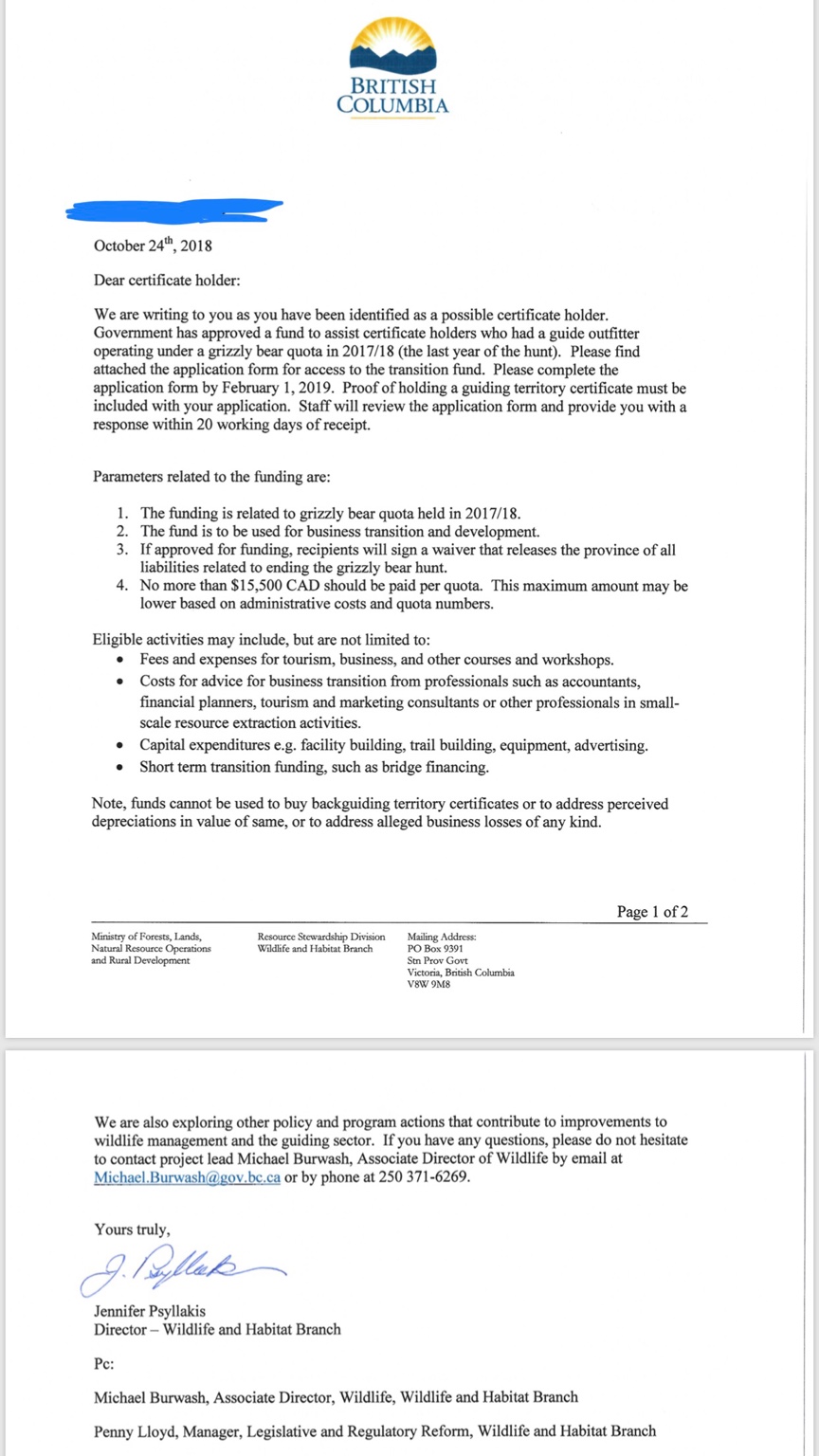
Can anyone enlighten regarding "the government's transition offer" to outfitters effected by the Grizzly Bear hunt closure ??


Wondering...

Nog

 
Got something of an answer... From one directly involved:

fc807926a324c8d71c6b3f9d770272b3.png


So each year we receive a quota letter outlining what our yearly quota is based on our 5 year maximum quota.

So in 2017 I had a quota of 2 grizzly in my northern concession, my southern concession is owned by an American Corporation even though I hold the Guide/Outfitters license so they will fight as a separate entity.

So my compensation offer is based off those 2 bears for just that one season. In essence $15,500 maximum per bear on quota ($31,000 max )

This was the first year (2017) of our new 5 year quotas, so even the guys with the lowest quota in the province of 1 bear in 5 years, would be included because they had 1 bear on quota in 2017. The highest quota I know of was 26 bears in 5 years, so that outfit would have had 5 or 6 bears on quota for the first year (2017)

The class action lawsuit is based on your 5 year quota, so far more accurate as to what each Outfitter will be eligible to receive, if we win that is.

And yes Matt, share away. I don’t believe it was meant to be kept a secret from our end.


Cheers,
Nog

 
what portion of business is the grizzly for guide outfitters? As a dual season hunt (fall/spring) i would presume it be more profitable than deer/moose/elk as you can double dip of sorts in a year?

It saddest the ban came on at a time where I personally saw a steep increase in grizz activity, including bears coming into our cow calls. It seems the new trend is for a grizz to present itself in plain view within 48 hours of boots hitting the ground cow calling, northern BC.

Funny enough, I now pack a 338wm not for hunting moose but more for the bears we can encounter.

I agree.
I am very well oriented regarding hunting opportunity around Kamloops B.C.
Grizzly population is on the rise big time, there is plenty of them here where 5-10 years ago there were almost nil.
To the point that except in the city proximity black bears population is decimated.
Also big numbers of wolfs in big, unheard of numbers in the last 30 years are now decimating deer, moose, cows, coyotes, etc
Lieberals did nothing and NDP also are sitting on their hands doing nothing about trimming populations of those killing machines....
I am afraid that hunting opportunities around Kamloops will diminish considerably in no more than 2-3 years.
 
Last edited:
The closure of the grizzly bear hunt is such a poor decision on so many levels.

On the one hand you have a very well managed quota system designed to balance a long term sustainable cull of a small percentage of bears that it had a negligible effect on long term populations. Few quotas of any species any where are as conservatively applied as that of the grizzly hunt in B.C. where predominantly older ###ually mature, dominant bears or bears past their prime are targeted as trophies and subsequently culled for up to $40,000 per bear.

Not only is the opportunity to hunt such a majestic species lost but the much needed income in this part of the country is also lost. Even if you disagree with outfitters’ ability to profit from the sale of trophy hunts, (and I am fully in support of outfitting within reason), it goes without saying outfitters are an indispensable part of conservation and their knowledge of hunting, contribution to conservation and wildlife population and demographics knowledge is unmatched and cannot be understated. In many cases oufitters are an indispensable tool to wildlife management and conservation as well as a long term, economically sustainable industry centered around renewable resources - hunting and angling.

On the other hand you have a reverse conservation effect, and to make matters worse, now the bears become a liability instead of an asset. Rather than having a high value as a species, these bears will now be seen as a cost. This in itself is worrisome from a conservation perspective. Having an apex predator pay its way into conservation through marketing of trophy hunts is one thing but now a bear has no chance of competing with other species, such as cattle, which may overlap the bears range as grazing increases into areas of B.C. less suitable for such activity. This will inevitably lead to predation of domestic livestock and ranchers will deal with the bears by shooting them at every opportunity.

Thus human caused bear deaths will still occur and now, presumably at a higher rate, and certainly there will be no economic gain in such cases. For each bear killed, $40,000 in potential revenue will be lost for the provincial economy, and this does not include taxidermy fees or other incidental costs that may have been spent by a hunter in pursuit of a grizzly bear in the province. A rancher would need to lose 20 cows at an average price of $2000 to pay for the loss of one bear, all things being equal.

In the end, not only will the hunters and outfitters lose, but ranchers will see increased livestock predation, people who live in remote areas will see increased conflict with bears, especially with young or very old males. The province itself will lose valuable revenue and have to pay increasing damages from human - bear conflicts. But the worst affected will be the bears themselves. As an apex predator, and a species with no economic value, they will be marginalized into oblivion as the world destroys them to make space for everything else or to just get rid of them for “safety” reasons. And this will be another lesson learned in how not to do conservation.

In a couple decades the grizzly bear, a symbol of Canadian wildlife will be reduced to another animal bred in captivity in a zoo. You will read about the grizzly in a book about how it used to be wild once, but now one will have to gaze throug a 500x500 foot enclosure and pay admission to see a grizzly. And it will all be because, ironically grizzly bear hunting was banned.

I can only hope the province is smart enough to re-institute a limited quota based hunt once again before the last few grizzly bears need to be captured from the wild and sent to breeding facilities in order to save the species.
 
Like all resource decisions in 5hit for brains BC it was based on politics and spin not facts.

Like renaming the Central Mid-coast Timber Supply Area to the Great Bear Rainforest in order to destroy the resource industries working in those areas.

And of course with moronic Canadians it worked.

Saving the Great Bear Rainforest with good marketing

Justine Hunter

Sitting in an Italian restaurant in San Francisco in 1997, a gathering of environmental activists wrestled with a marketing challenge. They were mapping out an ambitious plan to prevent logging of old growth forests along the edge of British Columbia’s coastline.

The problem was the name of the region: The Central Mid-coast Timber Supply Area. The intent of the campaign was to persuade consumers in Europe and the United States to stop buying B.C. forest products from the region.

Asking people to protest against logging in a timber supply area was not going to fly.

At the table were veterans of the battle over logging in Clayoquot Sound: Chris Hatch, Karen Mahon, Tzeporah Berman, Valerie Langer and Ian McAllister.

They were searching for something evocative, something that matched the Amazon, the Serengeti, the Grand Canyon, in offering a sense of place.

After a few glasses of wine, the paper tablecloth was covered with potential new names: The Great Salmon Forest, the Spirit Forest. The word “wilderness” was discarded because it implied the absence of human settlements – and First Nations have lived there for thousands of years.

One name stood out by the end of the night: The Great Bear Rainforest.

The Great Bear Rainforest campaign was launched, and both industry and the provincial government were immediately on the defensive, trying to figure out a way to eradicate the phrase. When that did not work, they eventually jumped on the bandwagon and tried to make it a marketing asset for B.C.’s forest products.

http://www.theglobeandmail.com/news...inforest-with-good-marketing/article24954082/
 
Back
Top Bottom